
Lieferung heute & morgen

Qualitätsgarantie

Willkommens-Angebote freischalten: KOSTENLOSE Lieferung | Bis zu 80 % RABATT | Kostenlose 30-Tage-JoyPlus-Testphase
App herunterladen
Wall lights combine room lighting with decorative design. Whether you’re looking for a living room wall light, a bedroom wall light, a hallway wall light or accent lighting for the stairs, the right indoor wall light should do more than look good. It should also suit the size of the room, the existing electrical installation and the kind of light you want.
When shopping, however, there are a few common marketing traps that can lead to the wrong choice:
Colour temperature is measured in kelvin (K):
A warm white wall light with a colour temperature of 3,000 K, such as several Pheashine models, creates a different atmosphere from a light with a colour temperature of 6,500 K. Lumens give you a better idea of actual brightness than watts. Wattage mainly indicates energy consumption or power input.
When choosing an LED wall light, also check the stated lifespan, colour quality and whether the LED module can be replaced. With an E27 wall light, you can change the bulb, giving you the flexibility to adjust the colour temperature and brightness later.
Before ordering, measure the wall space, distance from furniture and position of the electrical connection. A compact black wall light measuring around 10 to 15 cm in diameter is better suited to narrow hallways or small reading areas. Larger models can look more at home on a wide living room wall or beside a bed.
Check the beam direction:
A modern wall light should also sit clear of doors, curtains and walkways. In a bedroom, choose a fitting height that won’t get in your way when you get up or cause glare.
The IP rating indicates protection against solid objects and water. For dry indoor spaces such as living rooms or bedrooms, a light designed for indoor use is often sufficient. In bathrooms or damp areas, you must take the relevant installation zones and the manufacturer’s stated IP rating into account. The absence of an IP rating doesn’t mean a light is safe to install in a bathroom.
Fixed-wiring models should be installed by a suitably qualified person. Before carrying out any electrical work, switch off the circuit at the consumer unit. Depending on the design, models with a cable and switch can be positioned more flexibly, but they need a suitable socket and safe cable routing.
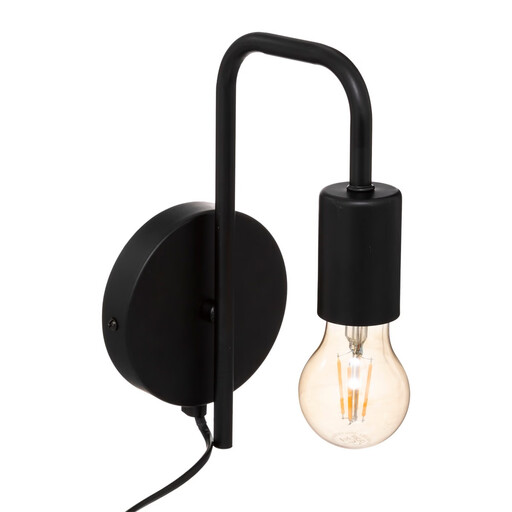
Why this product suits this profile: This compact black wall light has an E27 fitting and can be used in the living room, bedroom, kitchen or dining area with a suitable bulb.
The E27 fitting means the colour temperature and brightness depend on the bulb you choose. According to the product details, dimming isn’t supported.
Black metal, an E27 fitting and a stated maximum power of 40 W; bulb not included.
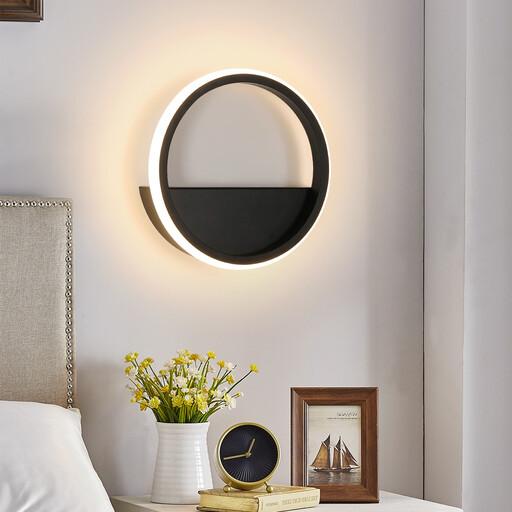
Why this product suits this profile: This round aluminium light, measuring 20 cm in diameter and producing warm white light at 3,000 K, is designed for living rooms, bedrooms, hallways and stairways.
The product details clearly state its power input, colour temperature, shape and diameter. This makes it easier to check that the light will suit your wall space before installation.
Integrated LED technology, 12 W, an aluminium housing and warm white light at 3,000 K; the product details don’t mention dimming.

Why this product suits this profile: These flexible LED strips work well as decorative wall lighting in gaming rooms, TV areas and party spaces, or as indirect background lighting.
It’s clearly intended for smooth, dry surfaces. Mounting it with adhesive tape shouldn’t be confused with a fixed electrical installation.
App, remote control and voice control with Alexa or Google Assistant, plus 16 million RGB colours and more than 40 dynamic scenes, according to the product details.
We’ve put together a complete, regularly updated list of products that meet these strict selection criteria and the safety requirements applicable in the EU.
A warm white wall light with a colour temperature of around 2,700 to 3,300 K and a shielded light source that minimises glare is often a good choice for a bedroom. An adjustable spotlight can work well beside the bed. Also check whether the switch is on the cable, on the light or on the wall.
It depends on power input, how long the light is used and the bulb. An LED light often uses less electricity than an older type of bulb to produce a similar amount of light. For a fair comparison, consider lumens, watts and daily running time. With E27 wall lights, you can replace the bulb later.
No. A dimmable wall light must be explicitly described as dimmable. With E27 models, the bulb and dimmer must also be compatible. For integrated LED wall lights, dimmer compatibility depends on the built-in driver, so check the technical details before you buy.