
Lieferung heute & morgen

Qualitätsgarantie

Willkommens-Angebote freischalten: KOSTENLOSE Lieferung | Bis zu 80 % RABATT | Kostenlose 30-Tage-JoyPlus-Testphase
App herunterladen
The right wall light should illuminate the room effectively, complement your interior and be safe to install. In practice, however, unclear product specifications, unsuitable IP ratings and misjudged brightness are common causes of disappointing purchases. This buying guide explains what to look for when choosing wall lights, LED wall lights and outdoor models.
Power consumption in watts shows how much electrical power a lamp requires. On its own, however, it says little about how bright a light actually is. For comparison, the luminous flux in lumens is the crucial factor.
A wall light with 300 lumens is more suitable for accent or orientation lighting. For a hallway, staircase or entrance area, considerably more lumens may be appropriate depending on the size of the room. With decorative wall lights, you should also check whether the light is emitted directly, indirectly, or upwards and downwards.
An indoor wall light cannot automatically be used outdoors, even in a sheltered location. For patios, gardens, garages or driveways, you must check the IP rating. The first digit describes protection against solid foreign objects, while the second indicates protection against water.
IP44, for example, means protection against solid foreign objects measuring 1 millimetre or more, as well as protection against splashing water. This is suitable for many covered entrance areas, but it does not replace checking the specific installation position. Direct exposure to the elements, standing water or pressure washing may require a different level of protection.
A wall light with a motion sensor or sensor wall light can be practical if it reliably detects movement in the relevant area. However, if the sensor is positioned behind an obstruction, points towards a busy road or is obscured by plants, the automatic switching may not work as intended.
Compatibility is also important with a dimmable wall light. Integrated LED modules require a suitable LED dimmer. Not every light can be dimmed using an existing wall switch.
A warm white wall light of around 2700 to 3000 Kelvin is often used in living spaces. Compared with neutral white light, it generally creates a softer atmosphere and is suitable for living rooms, bedrooms and cosily designed hallways. Neutral white or daylight white light, on the other hand, can be useful for garages, work areas and security lighting.
Also pay attention to the beam angle:
Measure the available wall space before buying. In narrow hallways or next to doors, slim indoor wall lights with minimal wall clearance are a sensible choice. A light with a projecting shade could become an obstruction in these locations.
You should also check:
For permanently wired 220–240-volt lights, the electrical connection should be carried out by a suitably qualified person. Before working on the electrical installation, disconnect the power supply at the fuse box.
Many modern wall lights feature an integrated LED module. This saves you from buying a separate bulb, but a fault may require the entire light to be replaced. Models with an E27 fitting offer greater flexibility, as you can replace the bulb and choose the light colour yourself.
Approximate electricity costs can be calculated as follows:
Watts ÷ 1000 × operating hours × electricity price per kilowatt-hour
A 10-watt light operating for three hours a day uses 0.03 kilowatt-hours per day in theory. For a realistic estimate, use the actual operating time and your current electricity tariff.
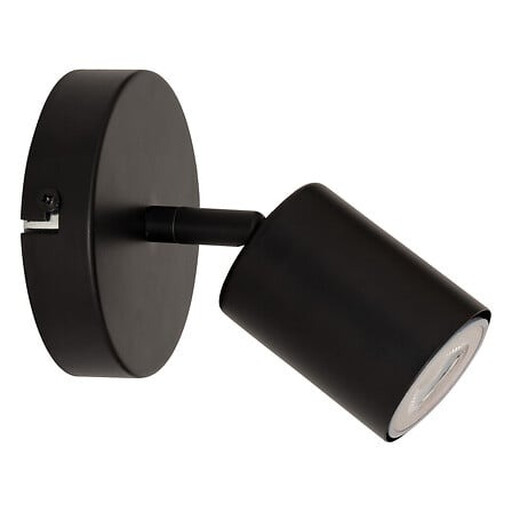
Why this product suits this profile: This compact steel wall light takes up very little space and features an adjustable spotlight. It is suitable for living rooms, bedrooms or hallways when you need targeted illumination.
The dimensions of 10.5 cm in diameter and 15 cm in height are clearly specified. The adjustable spotlight reduces the risk of an unsuitable, fixed light distribution.
Compact design; adjustable beam; black steel housing.
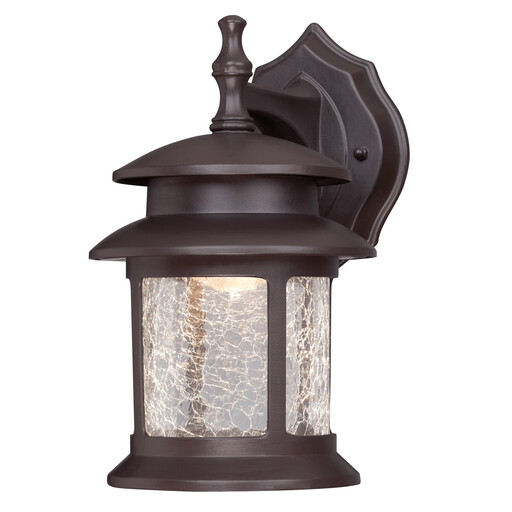
Why this product suits this profile: This garden wall light combines 3000 Kelvin, 1000 lumens of luminous flux and dimmable LED lighting with an aluminium housing and IP44 rating.
The IP rating, voltage, power consumption, colour temperature and luminous flux are all specified. A compatible LED dimmer must be used for dimming.
9 watts LED; 3000 Kelvin; 1000 lumens; IP44; dimmable with a suitable dimmer.
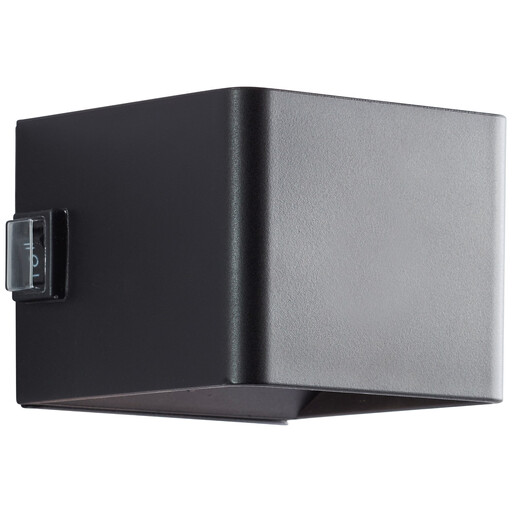
Why this product suits this profile: This battery-powered light with 300 lumens, 3000 Kelvin, a USB charging cable, magnet and motion sensor is designed for locations without a permanent power connection.
Power is supplied by an integrated rechargeable battery rather than non-existent wall wiring. The IP44 rating and installation guidance help define the intended area of use.
Battery-powered; motion sensor; magnetic mounting; 4 watts; IP44.
We have put together a complete, regularly updated list of products that fully meet these strict selection criteria and the safety regulations applicable in the EU.
Decorative wall lights, indirect models or dimmable wall lights are all suitable options for the living room. Warm white light of around 2700 to 3000 Kelvin is often chosen for living spaces. Check whether the light is bright enough to serve as the main lighting or whether it is intended only as supplementary lighting.
The lifespan depends on factors including operating time, heat dissipation, the quality of the LED module and the ambient temperature. With integrated LEDs, it is important to check whether the manufacturer states a specific lifespan and whether the module can be replaced. Good ventilation must not be obstructed by covers or unsuitable installation.
The cost depends on the wattage, daily usage and electricity tariff. For a rough calculation, divide the wattage by 1000, then multiply the result by the operating hours and the price per kilowatt-hour. Sensor lights can reduce running time by activating only when movement is detected.