
Lieferung heute & morgen

Qualitätsgarantie

Willkommens-Angebote freischalten: KOSTENLOSE Lieferung | Bis zu 80 % RABATT | Kostenlose 30-Tage-JoyPlus-Testphase
App herunterladen
A wall light can illuminate a room precisely, take up very little floor space and complement a wide range of interior styles. However, product images and brief marketing claims do not always lead to the right choice. The key factors are the technical specifications, installation method and intended location.
Decorative wall lighting can look appealing while providing too little light for a hallway, staircase or workspace. Specifications such as watts primarily describe energy consumption. For actual brightness, the luminous flux in lumens is more meaningful. With integrated LED lights, you should also check whether a specific lumen value is provided.
Not every wall light includes a light source. With an E27 wall light or E14 light, the suitable bulb must be purchased separately. This offers flexibility, but it also creates additional costs and requires you to check the socket, maximum wattage and bulb shape. Integrated LEDs eliminate the need to replace a bulb; however, if the LED fails, the entire light may need to be replaced, depending on its construction.
A light with a cable and mains plug is installed differently from a hardwired wall light. A fixed connection may require installation by a qualified electrician. The wall material also matters: plasterboard, concrete and masonry require different types of fixings.
For bathrooms, outdoor areas and damp basements, the IP rating is important. A light without a stated IP classification should not be installed where it could be exposed to splashing water. The CE mark is a mandatory conformity marking, but it is not an independent seal of quality.
A LED wall light is generally energy-efficient and does not require a replaceable bulb when the LED is permanently integrated. Warm white light around 3000 Kelvin is often well suited to living rooms, bedrooms and hallways because it creates a welcoming atmosphere. Neutral white light may be more suitable for functional areas such as home offices or kitchens.
If you want to adjust brightness for different situations, look specifically for a dimmable wall light. A light is not automatically dimmable simply because it can accommodate a dimmable bulb. The socket, bulb and dimmer must be technically compatible.
Before buying, compare the light’s height, width and projection from the wall with the available space. Compact models are often more practical in narrow hallways or beside a bed. A slim light saves space, while a generously proportioned shade becomes a more prominent interior feature.
For use as a wall-mounted reading lamp, an adjustable lamp head or directional light output is helpful. For an even ambient effect, choose a light with a diffusing cover or illumination directed both upwards and downwards.
Metal, steel, aluminium, glass and acrylic differ in weight, finish and maintenance requirements. A black wall light often complements minimalist or industrial interiors. A gold wall light or copper finish creates a distinctive accent. With exposed sockets, a decorative filament bulb can also play a major role in the overall look.
You should also check whether the light is intended for operation via a wall switch, a cable with plug or a fixed electrical connection. Details such as “for indoor use” or “not dimmable” should be considered when making your purchase.
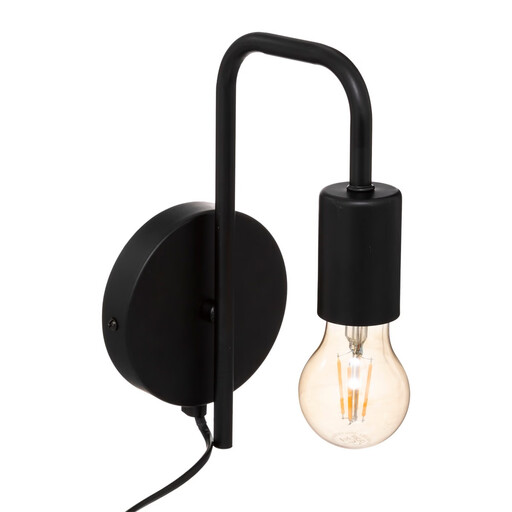
Why this light is a good fit: Measuring 12 cm in width and featuring an E27 socket, this compact wall light is suitable for bedrooms, kitchens or living rooms where a replaceable bulb is preferred.
The product specifications state that it has an E27 socket, a maximum power rating of 40 watts and a 1.80 m supply cable. The bulb is not included.
Replaceable light source, screw mounting and downward-directed light output according to the product description.
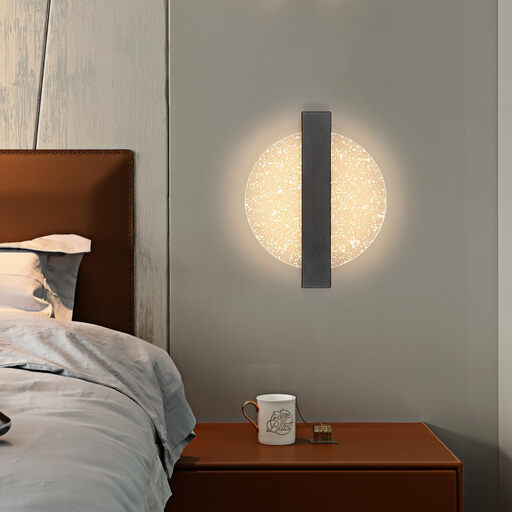
Why this light is a good fit: Its round shape and black finish complement modern, pared-back interiors. The 3000-Kelvin warm white light is designed for bedrooms, living rooms and hallways.
The integrated LED technology eliminates the need to purchase a separate bulb. Even so, check before buying that the permanently installed light source meets your intended service life.
12 W LED, stated luminous flux of 1,500 lumens and versatile use as accent, hallway or staircase lighting.
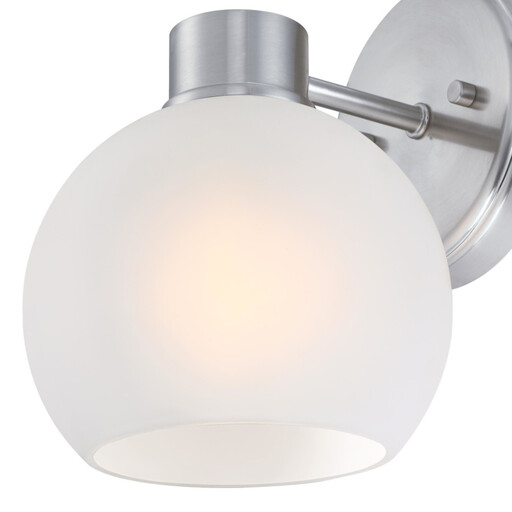
Why this light is a good fit: The brushed nickel housing and hand-blown opal glass shade appeal to buyers who value refined material combinations and a clearly defined form.
The light uses a clearly specified E27 light source rated up to 60 W; the bulb is not included. This leaves the choice of light colour entirely up to the buyer.
220–240 V, 50 Hz, dimensions of approximately 23 × 17 cm and installation with light directed upwards or downwards.
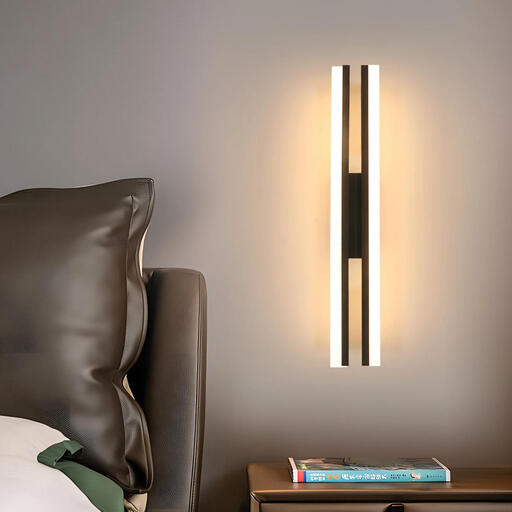
Why this light is a good fit: According to the product description, this rectangular model with a black finish can be installed vertically or horizontally, making it suitable for living rooms, bedrooms and stairwells.
The orientation can be adapted to the wall surface. Before ordering, check the power outlet, mounting position and required connection type.
16 W, warm white light at 3000 Kelvin and an acrylic cover according to the product specifications.
We have curated an up-to-date selection of products that meet these criteria and the applicable EU requirements for indoor lights.
A wall light with warm white illumination around 3000 Kelvin, an adjustable reading lamp or a light with a diffusing cover can all be suitable for a bedroom. With an E27 wall light, the bulb can be selected separately based on brightness and light colour. Ease of operation from the bed and sufficient clearance from the wall or headboard are also important.
Consumption depends on the wattage and daily operating time. A 12 W light running for five hours a day uses approximately 0.06 kWh per day. To calculate annual costs, multiply this consumption by actual usage and your individual electricity tariff. Wattage alone does not provide a direct comparison of brightness; the lumen value should also be considered.
With replaceable bulbs, service life depends primarily on the bulb used. For integrated LEDs, check the service life stated by the manufacturer. Heat generation, switching cycles and operating time also affect longevity. Statutory warranty rights remain unaffected by such manufacturer specifications.