
Lieferung heute & morgen

Qualitätsgarantie

Willkommens-Angebote freischalten: KOSTENLOSE Lieferung | Bis zu 80 % RABATT | Kostenlose 30-Tage-JoyPlus-Testphase
App herunterladen
A wall-mounted clothes rail can create storage space in a hallway, bedroom or dressing area without blocking the floor with an additional wardrobe. A wall-mounted clothes rail can also be used in many ways in the kitchen, bathroom, living room or on a sheltered balcony. However, to ensure it performs well in everyday use, buyers should look beyond colour and design.
A stated maximum load does not automatically apply to every installation situation. The wall material, wall plugs, screws and correct installation are all crucial. A wall-mounted clothes rail may support a different load on a solid concrete or brick wall than on a lightweight partition or plasterboard wall.
An especially slim construction saves space, but coats and jackets may end up resting against the wall. This can make the rail less practical to use and dirty the wall. As well as checking the width, you should therefore also check the projection or depth of the wall-mounted clothes rail.
A long clothes rail provides more hanging space, but requires a sufficiently strong section of wall. For a narrow hallway or alcove, a 64 cm clothes rail may be more suitable than a 100 or 114 cm model. Before buying, you should also check that doors, windows and light switches remain accessible.
A metal clothes rail or an Industrial Style clothes rail is suitable for open clothes storage when the construction is robust. A smooth, scratch-resistant surface makes cleaning easier and reduces visible signs of use. With a white clothes rail, you should also look for an even coating and clean it properly without using abrasive cleaning products.
Measure the available wall space before ordering. As a guide:
The actual number of garments it can hold depends on their width and weight. Winter coats need considerably more space than lightweight blouses or T-shirts.
Pay attention to the load limit stated by the supplier and distinguish between the maximum product load and the load-bearing capacity of your wall. For the eSituro models listed here, different values are stated depending on the version and wall type. The supplied installation components and illustrated instructions make installation easier, but they do not replace checking whether the wall plugs and screws are suitable for the substrate.
Before hanging heavy clothing, make sure all fixing points are secure. A suitable reinforcement or an approved fixing system may be required for a lightweight partition wall. The load should be distributed evenly along the rail.
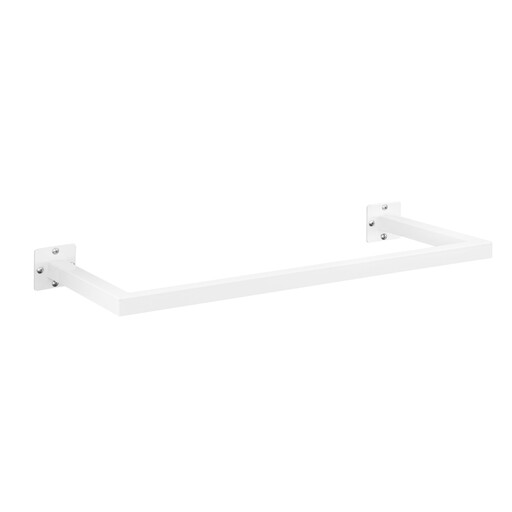
Why this product suits this profile: The compact 64 cm width is ideal for small hallways, alcoves or individual clothing areas. The white metal complements light, minimalist interiors.
The dimensions are clearly specified as 64 cm wide and 30 cm deep. This makes it easier to check in advance whether there is sufficient wall and movement space.
Metal construction, open storage, installation kit and illustrated instructions; stated load capacity of up to 50 kg on a cement wall or 75–100 kg on a wooden board wall.
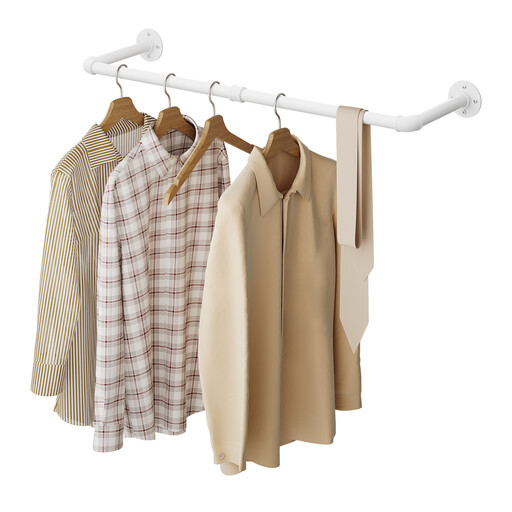
Why this product suits this profile: The 100 cm length offers a practical balance between wall space and hanging capacity. The simple white design works well in bedrooms, hallways or kitchens.
The stated maximum load of 50 kg and robust metal construction provide clear guidance rather than a purely promotional claim about stability. The condition of the wall remains crucial, however.
100 cm width, 26 cm depth, smooth scratch-resistant surface, plus an installation kit and illustrated instructions.
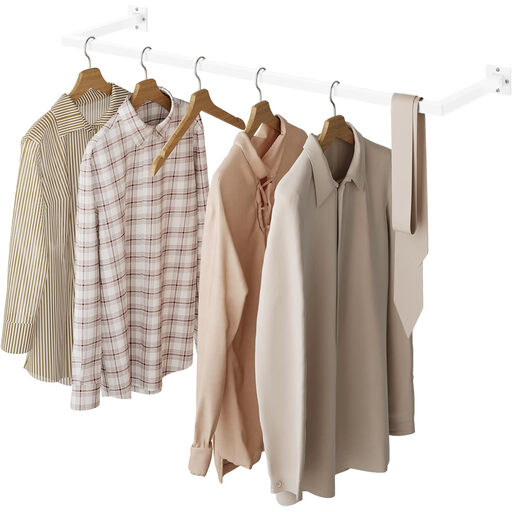
Why this product suits this profile: The 114 cm version is suitable for larger wardrobes, coats, trousers or versatile use with accessories and kitchen utensils.
The product specifications distinguish the load capacity according to wall type: up to 50 kg on a cement wall and 75–100 kg on a wooden board wall. Before use, check that the installation is suitable for the specific substrate.
114 cm width, 30 cm depth, Industrial Style metal pipe and clear visibility of the items being stored.
We have put together a complete, regularly updated list of products that fully meet these strict selection criteria and the safety regulations applicable in the EU.
Open clothes storage makes items easy to see. However, it only looks tidy when garments are grouped by type, colour or frequency of use. Additional hooks or shelves may be needed for shoes, bags or plants, provided they are suitable for the construction.
This depends on how it will be used and the height of the room. For shirts and jackets, leave enough room underneath for easy movement. If you are hanging long coats, you will need more clearance from the floor. In a hallway, the rail must also not obstruct doors, mirrors or walkways.
Solid concrete, brick or load-bearing wooden walls generally provide a suitable base, provided the correct fixings are used. Plasterboard and other lightweight partition walls require special wall plugs or an existing supporting framework. The permitted load always depends on the complete installation system, not just the metal pipe.
There is no one-size-fits-all answer. Lightweight garments need less space than winter jackets or coats. A 64 cm-wide rail naturally holds less than a 100 or 114 cm model. Leave a little space between the hangers so that clothes remain easy to access and the load is distributed evenly along the rail.