
Lieferung heute & morgen

Qualitätsgarantie

Willkommens-Angebote freischalten: KOSTENLOSE Lieferung | Bis zu 80 % RABATT | Kostenlose 30-Tage-JoyPlus-Testphase
App herunterladen
A wall-mounted clothes rail makes use of free wall space instead of taking up valuable floor space. This is particularly practical in small flats, narrow hallways, bedrooms, bathrooms or covered balconies. However, not every wall-mounted clothes rail is suitable for every wall or purpose.
Before buying, you should therefore focus less on attractive product images and more on load capacity, wall type, dimensions and mounting accessories. This will help you avoid common poor purchases, such as a clothes rail that is too short, unstable hooks or a wall-mounted clothes rail whose stated load capacity only applies under certain conditions.
A specification such as ‘up to 50 kg’ does not automatically describe the load capacity of every mounted clothes rail. The following factors are crucial:
An industrial clothes rail made from metal may be sturdy, but with unsuitable fixings, the wall remains the critical point. The manufacturer’s specification should therefore always be read together with the installation instructions.
A wall-mounted coat rack with a small width will fit into many alcoves. However, the structure also needs depth for clothes hangers, coats or towels. With a wall-mounted clothes rail approximately 26 to 30 cm deep, you should take doors, walkways and adjacent furniture into account.
Before buying, measure:
A coat rack with hooks is practical for coats, bags and keys. A wall-mounted coat rack with a shelf provides additional space for hats, small baskets or decorations. Both can improve organisation, but they also increase the number of components and the demands placed on the fixings.
So check whether you actually need a continuous clothes rail, individual hooks or a combination of a rail and shelf.
The stated maximum load is a technical guideline and should not be used continuously at its limit. Heavy winter coats create a greater load at individual points than lightweight shirts. In addition, hanging up and taking down items creates extra pulling force.
For everyday use, we recommend:
In rented properties or with plasterboard walls, it is sensible to check the wall construction before drilling. Suitable drill bits and wall plugs must be used for bathroom tiles.
Metal is easy to care for when used in a wall-mounted clothes rail and is often suitable for industrial or minimalist interiors. A painted or coated finish can make cleaning easier and protect the metal from everyday marks caused by use.
Wood with a protective lacquer creates a more homely look. In the bathroom or kitchen, make sure the surface has been treated appropriately. Rounded edges on hooks are useful because they make it less likely for textiles to snag.
A width of 100 cm is suitable for a manageable selection of clothing. At 114 cm, there is slightly more space, but you will also need more unobstructed wall space. Hooks are useful for accessories, bags and towels. A shelf increases storage space, but if overloaded, it can place greater strain on the wall fixings.
For small hallways, a slim wall-mounted coat rack is often sufficient. If you want to store lots of clothes openly, however, look for a longer rail or a two-piece set.
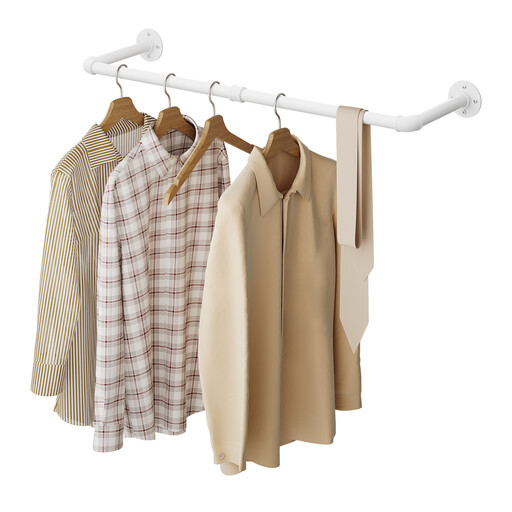
Why this product suits this profile: The 100 cm-wide metal rail is designed for hallways, bedrooms, kitchens or bathrooms and uses the wall to provide additional storage space. A mounting kit and illustrated instructions are included.
The maximum load of 50 kg is expressly linked to secure wall mounting. This makes it clear that it is not just the metal rail that matters, but also the fixings.
Metal construction, scratch-resistant finish, 100 cm width and wall-mounted design for space-saving storage.
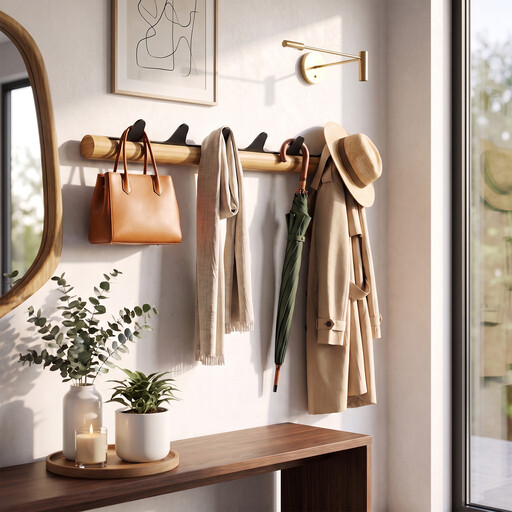
Why this product suits this profile: FSC-certified rubberwood with a lacquered finish is combined with six aluminium hooks. The wall-mounted coat rack is suitable for jackets, towels, hats, rucksacks and kitchen utensils.
The load capacity is specified as 30 kg and must not be exceeded. Rounded hook edges and guidance on suitable wall anchors make the product’s usage limits clear.
Six separate hooks, lacquered rubberwood and aluminium hooks with rounded edges for a range of storage needs.
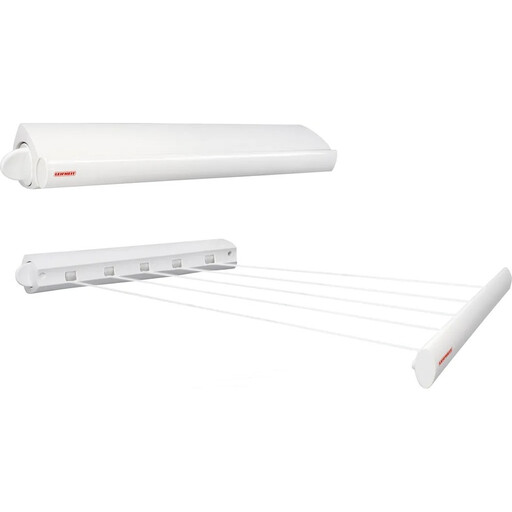
Why this product suits this profile: The extendable clothes dryer is designed for balconies or bathrooms and provides five lines with a total drying length of 21 m. It is an alternative to a wall-mounted clothes rail when laundry rather than clothing needs to be hung up.
The lines retract automatically when not in use. The product warnings also point out the need for secure wall mounting and advise against hanging heavy or sharp-edged items.
Up to 4.20 m of extendable line per line, a total drying length of 21 m and a retensioning system.
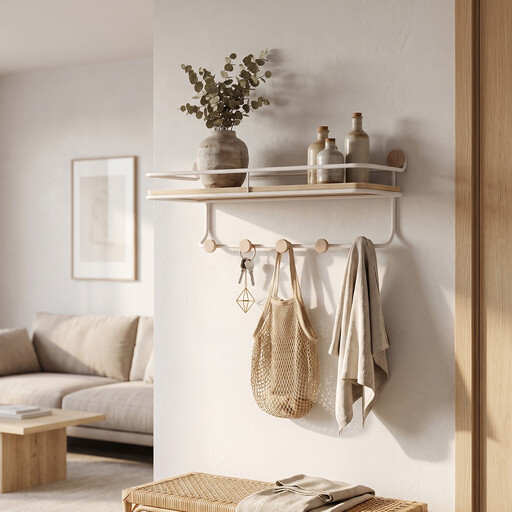
Why this product suits this profile: The combination of a shelf, retaining rail and five hooks is suitable for entrance areas, bedrooms, bathrooms or offices where small items and jackets need to be organised together.
The maximum load is specified as 20 kg. The retaining rail helps prevent small items from falling, but it is not a substitute for suitable wall anchors.
Five hooks, a shelf with retaining rail and a combination of rubberwood and powder-coated steel.
We have put together a complete, regularly updated list of products that fully meet these strict selection criteria and the safety regulations applicable in the EU.
Before installation, check the wall for cables, suitable fixing points and its substrate. With plasterboard, tiles or cavity walls, do not automatically use the wall plugs supplied. Instead, check whether they are suitable for the specific substrate.
After installation, we recommend:
A wall-mounted towel holder can be installed in a similar way in the bathroom, but should only be used for the purpose intended by the manufacturer. A clothes rail is not a grab rail and must not be used as a support.
For clothes on hangers, choose a height that allows the longest garments to hang freely while making it easy to clean the floor underneath. In a hallway, you should also check that jackets are easy to reach and that doors can be opened without obstruction.
Concrete, brick and sturdy wooden substrates generally provide suitable fixing options. With plasterboard or other panel walls, special cavity wall plugs or load-bearing profiles are required. The permissible load may differ significantly from the product specification depending on the wall and fixings.
This depends on the model, the fixings and the wall type. Lightweight coat racks with hooks are designed for jackets, bags or towels; according to the manufacturer’s specification, metal rails may, for example, support up to 50 kg. This specification only applies when the product is installed correctly and must not be exceeded.