
Lieferung heute & morgen

Qualitätsgarantie

Willkommens-Angebote freischalten: KOSTENLOSE Lieferung | Bis zu 80 % RABATT | Kostenlose 30-Tage-JoyPlus-Testphase
App herunterladen
A cluttered entryway can tarnish the first impression of a home. A wall-mounted coat rack with a shelf promises a simple solution for neatly storing jackets, keys, and accessories. However, not every model delivers on its promise. Many buyers only discover after installation that their new piece of furniture has flaws that weren't apparent beforehand. This guide highlights the most common pitfalls and explains which criteria truly matter when making your selection.
The three most common problems during selection are:
A well-thought-out decision prevents such disappointments and ensures that your new wall-mounted hallway rack is both functional and durable.
To find a suitable and long-lasting solution, three core aspects should be examined. These will help you objectively evaluate a product's quality.
The combination of wood and metal is popular in modern coat racks. Here, the details are crucial.
The specified maximum load capacity is a critical value. It should be realistic for your usage—several heavy winter coats can quickly weigh over 10 kg. However, what's crucial is not just the stability of the rack itself, but also how it is fastened to the wall.
A good hook rail with a shelf is more than just a board with hooks.
Based on the criteria mentioned, we have identified a few models that are suitable for different user profiles and living situations.
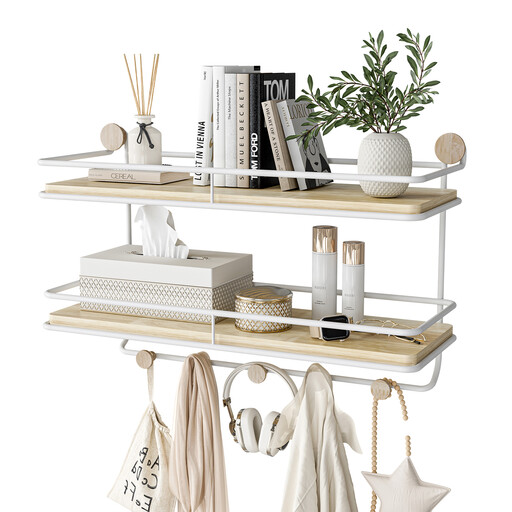
Why This Fits Their Persona: Ideal for users seeking an aesthetically pleasing yet highly functional solution. The combination of two shelf levels and hooks offers ample storage space, while the award-winning design (per the manufacturer: New York Design Award 2023) adds a modern accent.
The integrated guardrails on both shelves prevent items from falling off—a direct remedy for the impractical design of flat shelves.
Dual shelf space for maximum organization. Materials like FSC-certified rubberwood and powder-coated steel stand for durability.
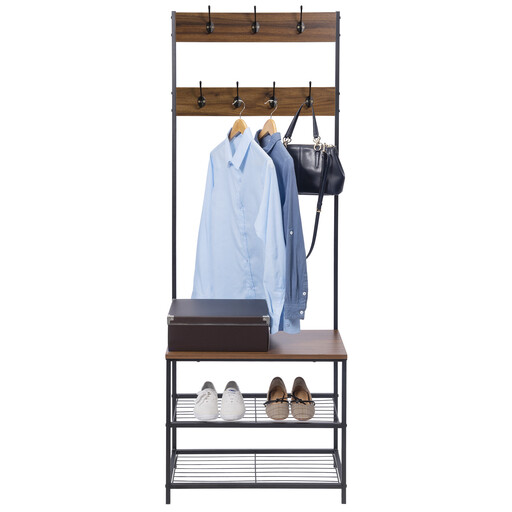
Why This Fits Their Persona: An excellent alternative for anyone who doesn't want to or can't drill into walls. This freestanding model combines hooks, a shoe rack, and a practical bench—ideal for rental apartments or for users who like to rearrange their decor.
It completely bypasses the problem of unstable wall mounting. As a freestanding unit, its stability depends solely on correct assembly and a level surface.
No wall mounting required. Multifunctional with a seat, hooks, and shoe rack. The load capacity per hook (5 kg) and for the shelf (20 kg) is clearly specified.
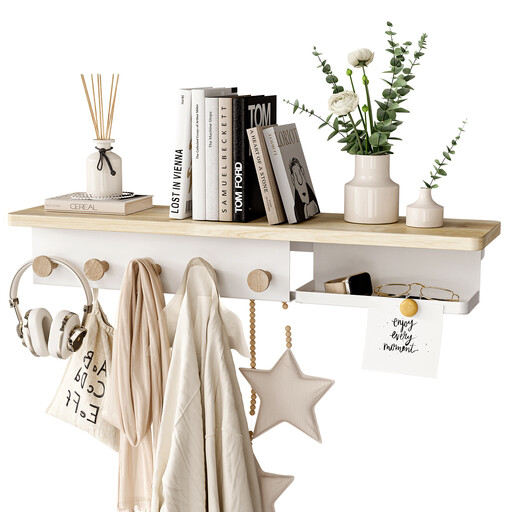
Why This Fits Their Persona: Perfect for users with limited space, such as in a narrow hallway. The design with hooks on both the front and back doubles the hanging capacity in a minimal footprint. Small compartments provide additional storage for accessories.
This model solves the problem of hooks being too close together through an innovative layout. It maximizes functionality instead of just relying on a simple hook rail.
Space-saving design with front and back hooks. The maximum load capacity of 20 kg (44 lb) is solid for a compact coat rack.
We've compiled a complete, up-to-date list of products that fully meet these strict selection criteria and safety standards.
Safety depends on correct installation. Always use a spirit level to align the drill holes perfectly. The choice of wall anchors is crucial: for solid walls like concrete or solid brick, expansion anchors are suitable. For hollow walls (e.g., drywall), special hollow-wall anchors made of metal or plastic are mandatory to distribute the load safely. Always follow the manufacturer's installation instructions.
For the frame and hooks, powder-coated steel is a great choice as it is robust and rust-resistant. For the shelf, solid wood offers the highest quality and durability. A more budget-friendly yet durable alternative is high-quality MDF boards (Class E1) with a scratch-resistant and moisture-repellent melamine or PVC coating.
The maximum load capacity varies greatly depending on the model and construction and is specified by the manufacturer. Compact models often support between 10 and 15 kg, while more robust constructions can hold 20 kg or more. It is important to note that this capacity can only be achieved with proper installation on a suitable wall. The load-bearing capacity of the wall itself is often the limiting factor.