
Lieferung heute & morgen

Qualitätsgarantie

Willkommens-Angebote freischalten: KOSTENLOSE Lieferung | Bis zu 80 % RABATT | Kostenlose 30-Tage-JoyPlus-Testphase
App herunterladen
An overflowing desk and stacks of documents taking up valuable space—a common problem in offices and home offices. A wall-mounted document holder promises a simple solution: it creates order, utilises vertical space, and keeps important documents within reach. However, not every model lives up to its promise. Many buyers invest in products that quickly prove to be impractical or unstable.
Before you make a decision, it's important to know the typical pitfalls that often only become apparent after the purchase:
To avoid a bad purchase, you should focus on three objective criteria that determine the durability and functionality of your wall organiser.
The choice of material is crucial for load capacity and lifespan. A metal wall organiser is generally the most robust choice. Pay attention to the following specifications:
The functionality of a wall-mounted letter tray lives or dies by its dimensions. Check these two aspects before buying:
Secure wall-mounting for a magazine rack is essential. A good product is distinguished by a well-designed mounting system.
Based on these objective criteria, we have identified several models that are suitable for different users and use cases.
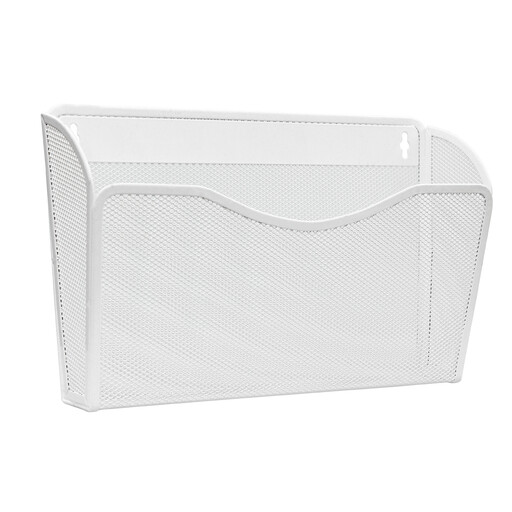
Why This Fits Their Persona: Ideal for users seeking a sleek solution for a specific task, like sorting incoming mail in the hallway or keeping the current project file next to their desk. The landscape format allows for quick access.
The powder-coated metal construction prevents bending. The landscape format is specifically designed for A4 documents, preventing papers from getting jammed.
Very space-efficient and focused on a single function. The mesh design has a light, modern look. Mounting hardware is included.
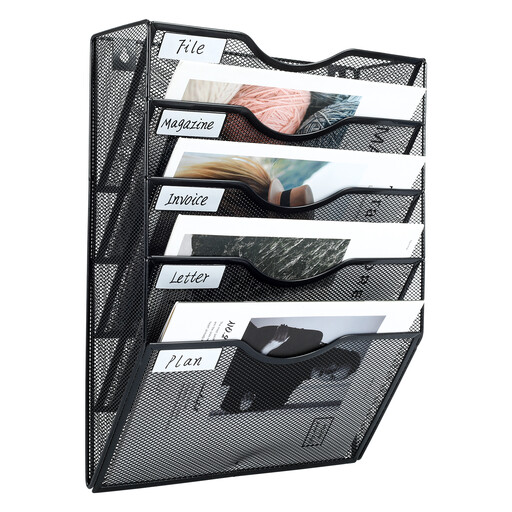
Why This Fits Their Persona: Perfect for professionals working from home or small business owners who need to manage multiple projects, invoices, or client files simultaneously. The five pockets allow for clear thematic separation.
The sturdy metal construction can support several full folders. The pockets are designed for A4 formats, and the included label plates solve the problem of disorganised filing.
Enables systematic organisation with 5 separate pockets. The option to add labels provides a clear overview and saves time when searching for documents.
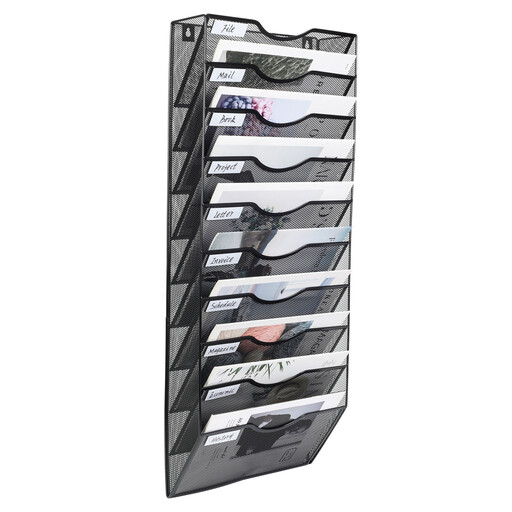
Why This Fits Their Persona: Designed for users with a very high demand for filing capacity, such as in shared offices, archives, or for managing extensive records. It replaces a small shelf while only using wall space.
The stable metal construction is designed for heavy loads. The design with 10 pockets and label plates offers a solution for maximum organisation and prevents the chaos of large paper stacks.
Maximum storage capacity on minimal wall space. The arched design of the pockets makes it easy to access contents even when fully loaded.
We've compiled a full list of products that meet these strict selection criteria.
Safety depends on correct installation. First, identify your wall type (e.g., drywall, brick, concrete). For drywall, use special hollow-wall anchors. For brick or concrete walls, the included anchors are often sufficient. Be sure not to exceed the manufacturer's specified maximum load capacity and check that the screws are tight before loading the holder.
Powder-coated metal (steel or aluminium) offers an excellent combination of stability and durability. The powder coating provides effective protection against rust and wear. Compared to untreated metal or plastic, it is significantly more dimensionally stable and resistant to daily use.
This depends on the internal depth and width of the pockets. Most of the models presented here are designed for standard A4 documents and also have room for papers in plastic sleeves or thin file folders. For very thick binders or ring binders, you should check the exact internal dimensions of the product. Models with a pocket depth of over 9 cm are generally better suited for this.