
Lieferung heute & morgen

Qualitätsgarantie

Willkommens-Angebote freischalten: KOSTENLOSE Lieferung | Bis zu 80 % RABATT | Kostenlose 30-Tage-JoyPlus-Testphase
App herunterladen
A garden hose can quickly get in the way, become tangled or end up lying on damp ground after you’ve finished gardening. A suitable wall-mounted garden hose holder provides a place to store it and helps keep it neatly arranged. However, wall-mounted holders vary considerably in their materials, fixings and load capacity.
If you focus only on a low price or an attractive black finish, you could overlook important details. The points below will help homeowners, garden owners and keen gardeners choose a suitable wall-mounted garden hose holder.
A holder may be made from sturdy metal and still be unsafe if it isn’t mounted securely. The key is whether the supplied screws and wall plugs are suitable for the surface. Concrete, solid brick, wood and external wall insulation systems all require different fixings.
A hose holder with screws and expansion plugs is a practical choice when the fixings are suitable for your masonry. If your wall is made from a different material, choose suitable wall plugs separately. The holder must sit firmly against the wall at every fixing point.
A wet garden hose is considerably heavier than an empty one. Pulling the hose away from the holder can also put it under strain. If there’s no information about hose length, weight or maximum load, it can be difficult to judge whether a holder is suitable.
For a wall-mounted garden hose holder for hoses up to 38 m, check that this capacity is explicitly stated in the product description and that your hose will fit. The maximum length won’t necessarily be suitable for every hose thickness or type.
A black garden hose holder isn’t automatically suitable for permanent outdoor use. With coated steel, it’s important to check whether the surface has been treated to protect against oxidation and rust. Scratches or water left standing on the surface can compromise that protection.
Even a rust-resistant hose holder needs care. Remove any dirt, wipe the surface down occasionally and check the holder for damage.
Coated steel, iron and stainless steel are among the options for outdoor installation. When choosing a metal hose holder, look for the following details:
A coating provides protection, but it can’t guarantee resistance to every kind of weather. If the surface is damaged, moisture can reach the metal. Avoid putting unnecessary strain on the holder with tools or hard objects.
Before buying, check the length and outside diameter of your hose. A holder that projects 29 cm from the wall may suit many standard hoses, but it won’t necessarily have enough room for very stiff or thick models.
You’ll also need to consider the available wall space. Position your wall-mounted hose holder so you can put the hose on and take it off without bending it sharply. Make sure the water connection isn’t under strain.
Useful features include pre-drilled fixing holes, screws and wall plugs supplied with the holder, and a design that doesn’t require any additional assembly. Even so, take care when mounting it on the wall:
A holder with protective strips can reduce contact between the metal and the hose. This is particularly useful if you’ll be putting the hose on and taking it off frequently.
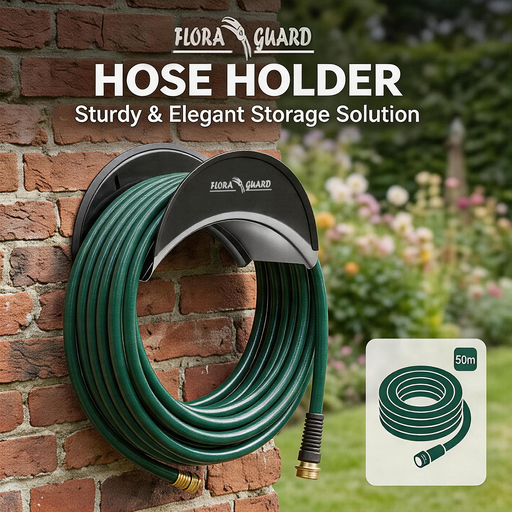
Why this product suits this type of user: This single wall-mounted holder is a compact option for anyone with a standard garden hose who only needs one place to store it.
The product description specifies a coated iron construction, protective strips to help prevent scratches, and wall mounting with suitable fixings.
Projects 29 cm from the wall, with a black surface coating and integrated protective strips, according to the product details.
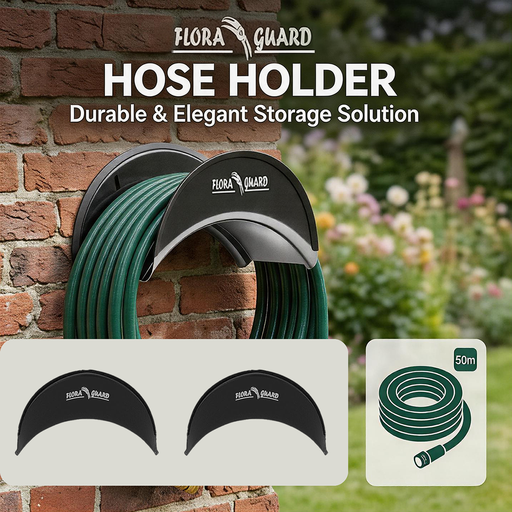
Why this product suits this type of user: The two-pack is a practical choice if you need two storage points or want to route the hose to different areas of your garden.
The pack includes two holders, fixing screws and wall plugs. Protective strips reduce direct contact between the hose and metal.
Coated iron, corrosion protection and two mounting units that project 29 cm from the wall, according to the product description.
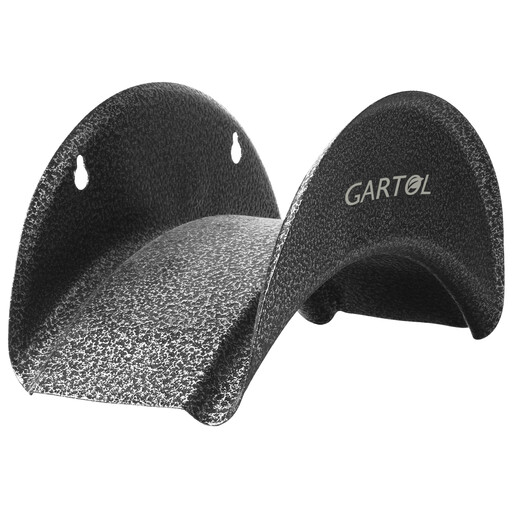
Why this product suits this type of user: This holder is designed for people with longer standard hoses. According to the product details, it is suitable for garden hoses up to 38 m long.
The description specifies a coated high-carbon steel construction, two pre-drilled fixing holes, screws and expansion plugs.
Suitable for standard garden hoses up to 38 m, requires no additional assembly and comes with fixings, according to the product details.
We’ve put together a complete, regularly updated list of products that meet these strict selection criteria and fully comply with the safety regulations in force in the EU.
Mount the holder as close to the water supply as possible, without sharply bending the hose when you hang it up. A sheltered spot can reduce direct exposure to rain and UV rays. After use, let any remaining water drain out, then loosely place the hose on the holder.
Avoid pulling the hose under tension over a sharp edge. Check the screws, wall plugs and coating regularly. If you notice cracks, a loose fit or heavy rust, don’t put any more strain on the holder.
First, check that the wall and fixings are compatible. Mark the drill holes, insert suitable wall plugs and secure the holder with screws. A solid wall is particularly important for heavy or long hoses.
As well as the length of the hose, consider its outside diameter, stiffness and weight. Treat the “up to 38 m” claim as a guide for standard garden hoses only. Before you buy, compare the product dimensions and manufacturer’s details with your own hose.
Keep the holder clean and dry, don’t overload it and check it regularly for damage. Placing the hose on the holder without sharply bending it, and avoiding scratches to the coating, can help reduce the wear and tear of everyday use.