
Lieferung heute & morgen

Qualitätsgarantie

Willkommens-Angebote freischalten: KOSTENLOSE Lieferung | Bis zu 80 % RABATT | Kostenlose 30-Tage-JoyPlus-Testphase
App herunterladen
A wall shelf is more than just a storage surface. It's a smart solution for transforming unused wall space into valuable storage or a stylish display stage. However, the market is flooded with products whose quality only becomes apparent after purchase—and often after a tedious installation process. Before you reach for the drill, you should be aware of the common pitfalls that can quickly turn a supposed bargain into a disappointment.
This guide will help you identify the crucial features to find a durable and functional hanging shelf that perfectly suits your needs.
Many buyers focus solely on design or price, but the most costly problems lie in the details. Pay special attention to these three points:
To avoid a bad purchase, focus on three verifiable criteria. These determine the stability, durability, and functionality of your new shelf.
The material is the foundation of quality. Look for precise specifications:
The maximum load capacity is not an absolute number. It is always the result of the shelf itself, the mounting hardware, and the wall.
The installation method determines both the look and the stability.
Instead of making a blanket recommendation, we have identified products that address specific living situations and needs.
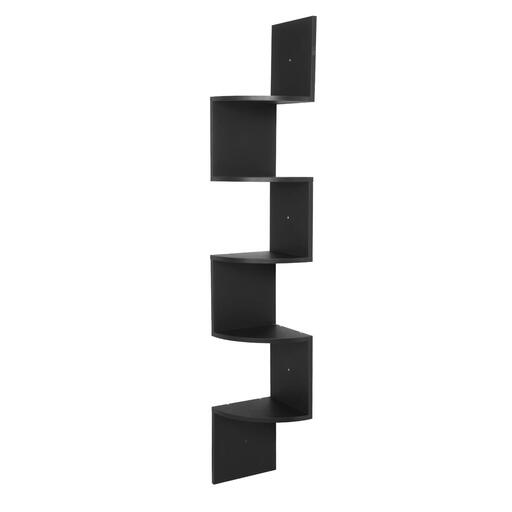
Why this model is a great fit: Ideal for small apartments or hallways, as it transforms unused corners into vertical storage. The five tiers offer ample space for books, plants, or decor without taking up valuable floor space.
The zigzag construction, where the shelves support each other, provides high inherent stability and prevents sagging. The product description explicitly states that it is not suitable for plasterboard walls, thus preventing installation errors.
Maximum space utilisation with a minimal footprint. Installation is done via an integrated, invisible hanging system.
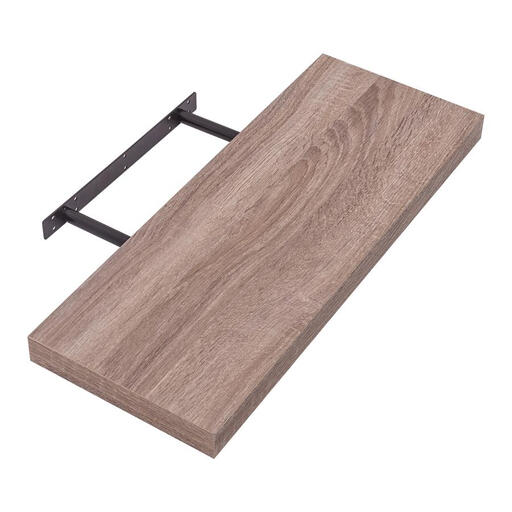
Why this model is a great fit: This classic floating shelf with a concealed bracket creates a clean, uncluttered aesthetic. Perfect as a living room shelf or for the office, it allows you to display books or selected decorative objects as if they are floating.
With a material thickness of 3.8 cm and construction from E1-class MDF board, it is significantly more resistant to bending than thinner models. The robust T-shaped metal bracket ensures a stable connection to the wall and prevents the typical "forward tilt."
A true floating effect thanks to completely concealed mounting. The moisture- and scratch-resistant surface also makes it versatile.
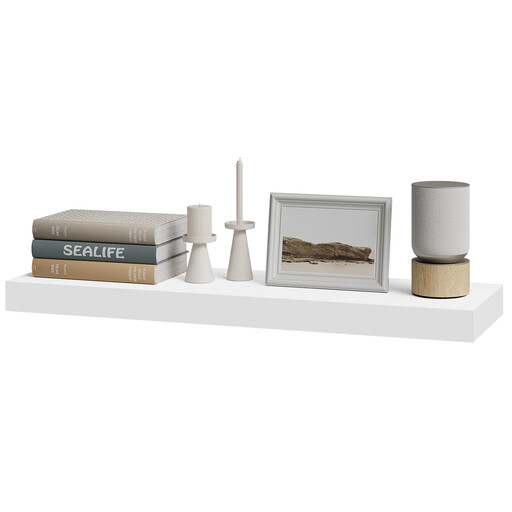
Why this model is a great fit: This shelf combines a display surface with an integrated, handleless drawer. It is the ideal solution for an entryway to discreetly store keys and mail, while leaving space above for decor.
The drawer features a stop mechanism that prevents it from falling out when opened—an important quality feature. The material is an E1-class MDF board with a moisture-resistant PVC veneer, making it robust and easy to clean.
Combines an open display area with concealed storage in a single minimalist design.
We have compiled a complete, up-to-date list of products that fully meet these strict selection criteria and UK safety regulations.
The actual load capacity depends on three factors: the shelf's construction, the quality of the bracket, and, most importantly, the condition of your wall. A solid concrete wall can support significantly more weight than a plasterboard wall. As a rule of thumb, reduce the manufacturer's stated capacity by at least 50% for a plasterboard wall and always use special hollow-wall anchors. Distribute the weight evenly and place heavy items as close to the wall as possible.
No. High humidity can cause untreated wood or low-quality particleboard to swell. For the bathroom, you should only choose shelves whose surfaces are explicitly marked as moisture-resistant. This includes models with a continuous plastic coating (e.g., PVC), powder-coated metal, or shelves made from appropriately treated solid wood like bamboo or teak.
MDF (Medium-Density Fibreboard) is made from very fine wood fibres pressed under high pressure, making it denser, more uniform, and more resistant to bending than particleboard, which is made from coarser wood chips. The E1 classification is a European standard that ensures the board emits only very low levels of formaldehyde. Therefore, a shelf made from E1 MDF is not only more stable but also a better choice for a healthy indoor environment.