
Lieferung heute & morgen

Qualitätsgarantie

Willkommens-Angebote freischalten: KOSTENLOSE Lieferung | Bis zu 80 % RABATT | Kostenlose 30-Tage-JoyPlus-Testphase
App herunterladen
A wall shelf creates storage space without taking up floor space. In the living room, it can hold books and photo frames; in the kitchen, it can serve as a spice rack; and in your home office, it can provide extra space for documents. To make sure it remains a worthwhile purchase over time, however, you should look beyond colour and shape.
Three common buying pitfalls come up time and again:
For a living room wall shelf, longer models or multi-piece sets are a good choice if you want to display books, vases and pictures together. In a bedroom wall shelf, compact shelves are often enough for small plants, alarm clocks or personal belongings.
A kitchen wall shelf should be deep enough for spice jars and kitchen accessories. Slim models are a good option for hallways, bathrooms or small work areas. Before buying, measure the width of the wall, the available height and the distance from doors, windows and plug sockets.
A corner wall shelf makes use of out-of-the-way spaces. Check that the corner is actually a right angle and that both adjoining walls are suitable for installation.
A wooden wall shelf creates a warm feel and works well with rustic, Scandinavian or minimalist interiors. Coated MDF boards are often easy to care for and have a consistent finish. For products made from E1 MDF, the label indicates a defined formaldehyde emission class. However, it does not replace checking the other product information.
A metal wall shelf or metal frame can work well in industrial-style interiors. Clean black powder-coated surfaces with a soft cloth; abrasive cleaning products can damage the coating.
For damp rooms, bear in mind that a water-repellent surface is not necessarily waterproof. MDF should not be exposed to standing water or high humidity for prolonged periods. Take particular care when assessing areas of the bathroom that may be exposed to splashes.
The maximum load must be suitable for how you plan to use the shelf. A floating wall shelf with concealed brackets can create a discreet look, but it must be installed correctly. The stated load capacity generally applies only when the wall is suitable, the correct fixings are used and the weight is distributed evenly.
Practical checklist:
A wall shelf with a shallow depth is better suited to lightweight decorations. For books, supplies or kitchen utensils, it’s especially important to check the load capacity, number of shelves and depth.
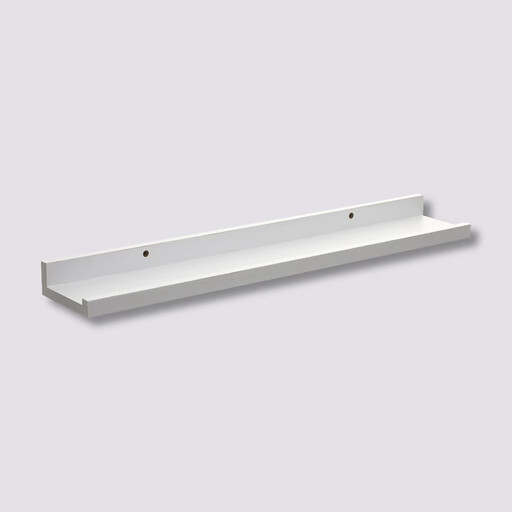
Why this product suits your needs: This slim wall shelf takes up very little space and is suitable for lightweight decorations, herbs or small kitchen utensils. Its white wood effect makes it easy to incorporate into modern interiors.
The product details give the exact dimensions of 58 x 10 x 4 cm and a maximum load of 3 kg. This makes it easier to judge whether it’s suitable for your intended use.
Compact dimensions, FSC information and a stated load limit of 3 kg.
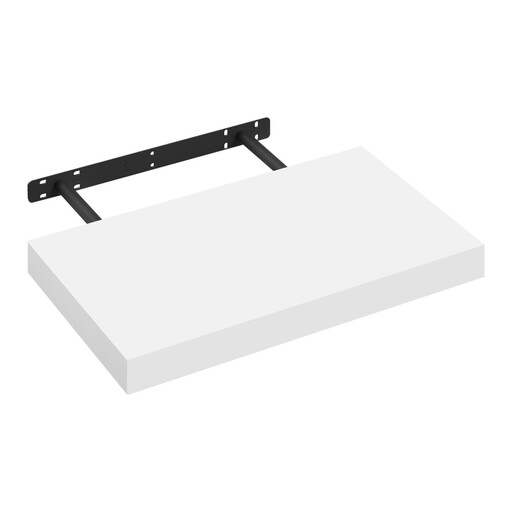
Why this product suits your needs: This model combines a matt, water-repellent surface with a metal bracket, making it suitable for use in the living room, bedroom, kitchen, bathroom or office.
The installation instructions specify suitable wall plugs for different wall types. The maximum load is also stated as 10 kg, provided the weight is distributed evenly.
E1 MDF, a metal bracket, installation accessories and a stated maximum load of 10 kg.
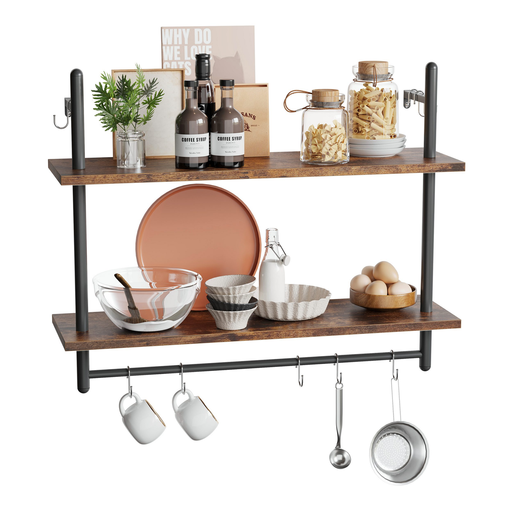
Why this product suits your needs: Two shelves and eight S-hooks provide space for mugs, towels, kitchen accessories or decorations. The industrial design works well in the kitchen, bathroom, living room, garage or utility room.
The product details distinguish between the load per shelf and the wall fixing: each shelf is specified to hold 9 kg. The fixings must be suitable for the wall.
80 cm wide, two tiers, eight S-hooks and a stated load capacity of 9 kg per shelf.
We’ve put together a complete, regularly updated list of products that meet these strict selection criteria and fully comply with the safety regulations in force in the EU.
It depends on the product, the bracket and the wall. Figures such as 3 kg, 9 kg or 10 kg refer to the individual manufacturers’ specifications and should not be applied universally. Plasterboard requires suitable cavity wall plugs, while solid walls may need different types of plug. The weight should be distributed evenly.
Around 10 to 15 cm is often enough for paperbacks or decorations. Larger books, folders or storage containers need more depth. Measure your largest items before buying. You should also leave enough clear space in front of the shelf, particularly in hallways and small rooms.
There’s no set lifespan that applies to every shelf. It depends on the material, load, humidity and installation. Regularly checking the screws, distributing weight evenly and cleaning the shelf according to the manufacturer’s instructions can help you use it safely. A shelf should never be used as a climbing aid.