
Lieferung heute & morgen

Qualitätsgarantie

Willkommens-Angebote freischalten: KOSTENLOSE Lieferung | Bis zu 80 % RABATT | Kostenlose 30-Tage-JoyPlus-Testphase
App herunterladen
A wall shelf might seem like a simple purchase. But the selection is vast, and not every shelf that looks good is also practical or durable. Choosing the wrong material or an unstable design can lead to the new piece of furniture causing more frustration than joy. This guide will help you avoid common buying pitfalls and find a wall shelf that perfectly suits your needs.
Many buyers focus solely on aesthetics, overlooking crucial technical details. This often leads to three common problems:
To make an informed decision, you should check three essential aspects. These determine the durability, safety, and functionality of your new wall shelf.
The material is crucial for the shelf's stability and where it can be used.
kitchen wall shelf.wooden wall shelf made of solid material is robust and durable, but also more maintenance-intensive and higher-priced.industrial wall shelf style, are very stable, easy to care for, and resistant to moisture.The mounting method affects both the look and the stability.
floating shelf (also called a wall board) is attached to the wall with an invisible system. This creates a minimalist, floating appearance.Before buying, be sure to check the condition of your wall. For a solid wall made of concrete or brick, most included anchors will suffice. For a drywall (plasterboard), you will need special hollow-wall anchors to ensure a secure installation. The maximum load capacity always depends on the combination of the shelf, the mounting hardware, and the wall.
The depth of the shelf is just as important as its width. A wall bookshelf needs a shelf depth of at least 20–25 cm to support standard books. For a purely decorative wall shelf that will only hold picture frames or small plants, a shallower depth is often sufficient. Measure the available space accurately and consider what you want to place on the shelf.
Here are some recommendations tailored to different needs and living situations.
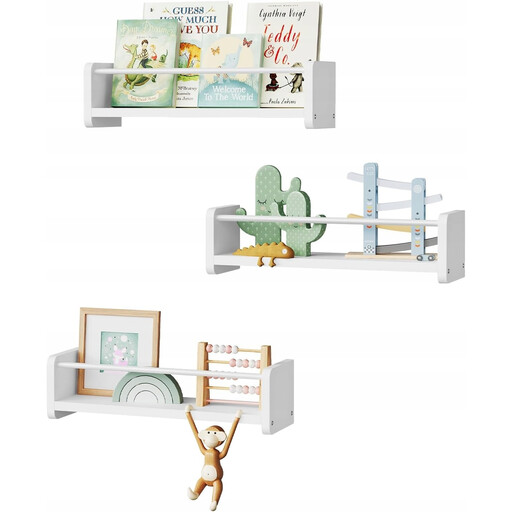
Why it's a good fit: Ideal for anyone looking to create flexible storage space on a limited budget. The set of three shelves can be arranged individually and fits into living rooms, kitchens, or children's rooms thanks to its simple design.
The product description points to a metal reinforcement that benefits stability. The material is clearly declared as MDF board, so there are no false expectations of solid wood.
As a set of 3, it offers excellent value for money and flexible mounting options (e.g., with the rod facing up or down).
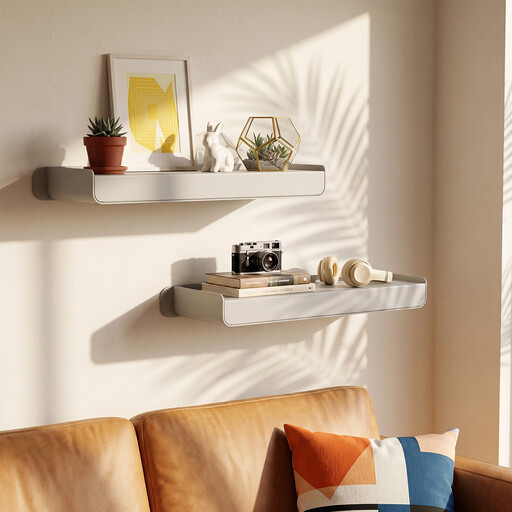
Why it's a good fit: For users who value durability, high load capacity, and a minimalist design. This shelf is an investment in quality and is also suitable for demanding environments like the bathroom.
The material is aluminium—it's waterproof and rust-resistant, thus avoiding the risk of swelling common with wood-based materials. The specified load capacity of up to 20 kg is high for a shelf of this type and indicates a robust construction.
Extremely durable and low-maintenance material. According to the manufacturer, the design was honoured with the German Design Award 2022.
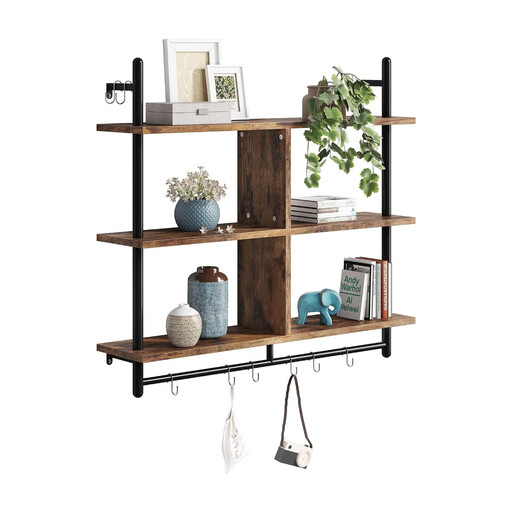
Why it's a good fit: Perfect for the kitchen or balcony where not only shelf space but also hanging options are needed. This `industrial wall shelf` offers plenty of storage in a small footprint with its three tiers and hooks.
The construction, featuring a sturdy metal pipe frame, directly addresses the problem of instability. It is designed for practical use, not just decoration, which is reflected in its robust build.
The combination of three shelves and additional hooks offers high functionality, ideal for organising kitchen utensils, mugs, or herbs.
Kitchens, in particular, have special requirements for material and function. We have compiled a selection of products that meet these criteria.
The load capacity varies greatly and depends on three factors: the shelf's construction, the mounting hardware used, and, most importantly, the type of your wall. Always check the manufacturer's specified maximum load capacity and ensure you use the correct anchors for your wall type. When in doubt, it's safer to load the shelf a little less.
Yes, it's possible, but it requires special care. You must use special hollow-wall anchors (also called drywall anchors) that expand behind the board. However, the load capacity on a drywall is significantly lower than on a solid wall. Some manufacturers explicitly advise against mounting heavy shelves on plasterboard walls.
A floating shelf is characterized by a concealed bracket that disappears into the shelf board. This creates the impression that the shelf is "floating" on the wall. A hanging shelf, on the other hand, has visible supports, brackets, or is suspended by ropes. The choice is primarily a matter of aesthetics, although visible supports often allow for greater stability.