
Lieferung heute & morgen

Qualitätsgarantie

Willkommens-Angebote freischalten: KOSTENLOSE Lieferung | Bis zu 80 % RABATT | Kostenlose 30-Tage-JoyPlus-Testphase
App herunterladen
Investing in a home EV charging station is a crucial step for any electric vehicle owner. An 11kW wallbox with an app promises convenient, fast, and smart charging. However, the market is saturated with options whose technical details and marketing promises often create more confusion than clarity. Making the wrong choice can lead not only to frustration but also to unexpected costs or a charging solution that fails to meet your needs.
This guide highlights the most common pitfalls when buying a smart wallbox and explains which technical parameters truly matter to make a future-proof and efficient choice.
Before you make a decision, you should be aware of the common issues that can arise when selecting a charging station.
To avoid the problems mentioned above, you should carefully examine three core technical aspects. These are key in determining the efficiency, safety, and convenience of your charging solution.
Charging power is the decisive factor for charging speed. While 22 kW wallboxes promise faster charging, their installation in Germany requires a permit and is often associated with significant hurdles and costs. An 11kW charging station represents the ideal compromise:
A crucial feature of a truly smart wallbox is dynamic load management (DLM). This function is essential to prevent an overload of your home's main electrical connection.
A well-designed app transforms a simple charging station into an intelligent energy management tool. Look for the following features:
Not every wallbox is right for every user. Here are three recommendations tailored to specific needs.
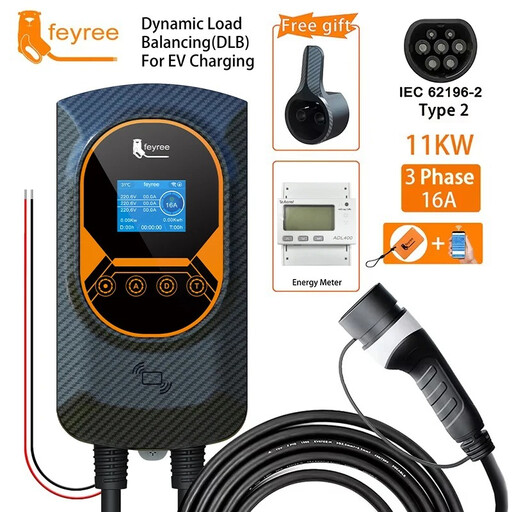
Why This Fits Their Persona: Ideal for homeowners seeking a fully automated and safe charging solution. The dynamic load management ensures that charging the car never pushes the household grid to its limits, thereby optimising energy costs and grid safety.
The integrated dynamic load balancing (DLB) actively prevents overloading the home's main connection—a common and costly pitfall. Furthermore, control via the Tuya app offers extensive, subscription-free features.
Complete charging intelligence through DLB and app control. IP66 protection rating for safe outdoor operation.
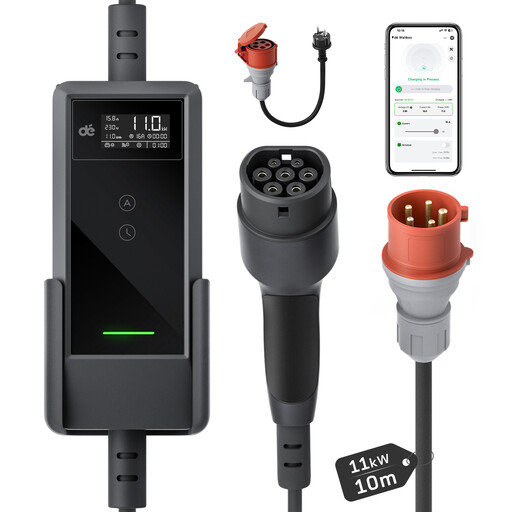
Why This Fits Their Persona: Perfect for renters, holiday home owners, or anyone who doesn't want a permanent installation. This mobile wallbox offers full 11 kW power and app control but can be easily taken with you and operated from any CEE-16A socket.
It bypasses the need for a complex and permanent installation. The charging power, adjustable from 6A to 16A via the app, allows for manual adaptation to the respective power supply, thus preventing overload.
Maximum flexibility thanks to its portable design. The 10-metre cable provides excellent reach and convenience.
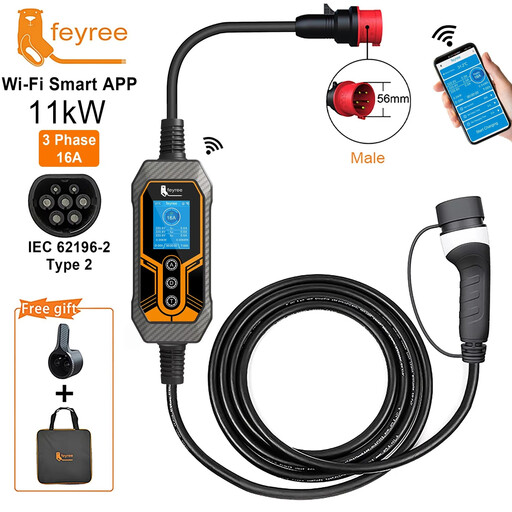
Why This Fits Their Persona: An excellent choice for anyone looking for a reliable and smart 11 kW charging solution without paying for premium features like DLM that they may not need. It offers the core functions of a smart wallbox in a portable package.
The app enables scheduled charging to avoid peak electricity rates. Connectivity via Wi-Fi and Bluetooth ensures that app control works reliably and is not dependent on poor Wi-Fi coverage in the garage.
Excellent value for money. Offers full 11 kW charging power and smart app control with charge scheduling.
We have compiled a complete, up-to-date list of products that fully meet these strict selection criteria and safety regulations.
No, in Germany, a wallbox with a charging capacity of up to 11 kW does not require a permit. However, it is subject to a reporting obligation. This means the installation must be registered with your local grid operator before commissioning. This task is usually handled by the certified electrician performing the installation. In contrast, wallboxes with more than 11 kW of power require formal approval from the grid operator before installation.
The difference lies in the number of phases of the electrical grid used and the resulting charging power. A 1-phase wallbox at 16 amps achieves a maximum charging power of about 3.7 kW (1 phase × 16 A × 230 V). To achieve the full 11 kW, a 16A 3-phase wallbox is required. It uses all three phases of the high-voltage connection, enabling a charge that is roughly three times faster (3 phases × 16 A × 230 V ≈ 11 kW).
Yes, the Type 2 wallbox plug (also known as a Mennekes plug) is the European standard for AC (alternating current) charging. Almost all electric cars and plug-in hybrids sold in Europe are equipped with a Type 2 charging socket. Therefore, a wallbox with a Type 2 connector is compatible with the vast majority of vehicles. However, the actual charging speed achieved depends not only on the wallbox but also on the vehicle's on-board charger.