
Lieferung heute & morgen

Qualitätsgarantie

Willkommens-Angebote freischalten: KOSTENLOSE Lieferung | Bis zu 80 % RABATT | Kostenlose 30-Tage-JoyPlus-Testphase
App herunterladen
You've decided on an electric car, but now you face the next crucial question: How do you charge it efficiently and safely at home or on the go? The market for wallboxes and portable chargers is vast and confusing. Many products advertise high charging speeds and smart features, but not every solution is right for every need. Incorrect assumptions can quickly lead to unnecessary expenses or daily frustration in your garage.
As your Joybuy Product Recommendation Officer, I'll help you understand the key criteria and avoid common purchasing pitfalls. This guide focuses on the technical facts that truly matter for making an informed decision.
Before we dive into the technical details, let's look at the three most common and costly mistakes buyers make:
To avoid these pitfalls, focus on three crucial technical features. These determine the safety, compatibility, and efficiency of your future home charging station.
Charging power, measured in kilowatts (kW), determines how quickly your vehicle's battery charges. The key factor here is not just the wallbox's output, but also the maximum charging capacity of the on-board charger (OBC) in your EV.
Always check your vehicle's maximum AC charging power in the manual before buying. A Type 2 11kW charging cable is perfectly sufficient for a car with an 11 kW OBC.
In Europe, the Type 2 connector has become the standard for AC charging. Nearly all public charging stations and private wallboxes use this connector.
Safety is non-negotiable when dealing with high currents. A high-quality wallbox should have the following protection mechanisms:
Based on these criteria, we have identified a few products that represent a suitable solution for specific user groups.
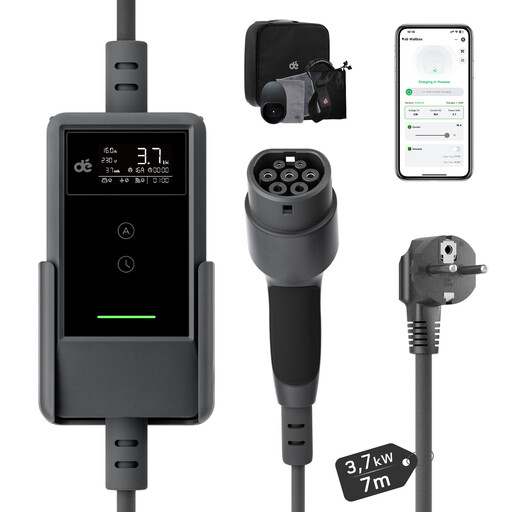
Why it's a good fit: Ideal for users who don't want to or can't install a fixed wallbox. Perfect for PHEV drivers or BEV owners who charge their vehicle overnight. Simply plug it into an existing Schuko socket and start charging.
This EV charger completely bypasses the installation cost trap. It's a plug-and-play solution that requires no expensive electrician work. The charging power is designed for safe use with a standard household socket.
Features app control for charge scheduling and current adjustment (6-16A). The 7-metre-long cable offers good flexibility for parking.
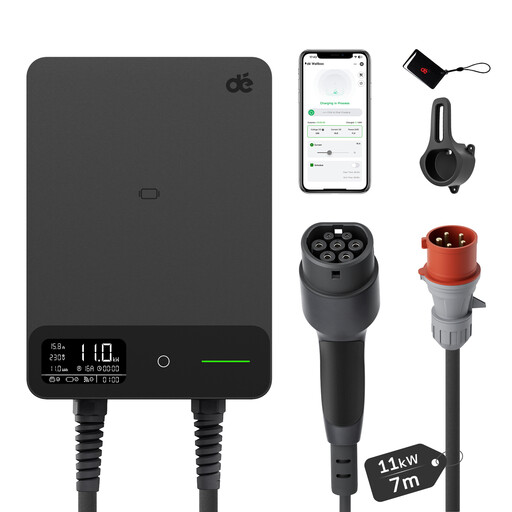
Why it's a good fit: The ideal solution for BEV owners looking for a permanent, fast, and secure charging station for their home garage. The 11 kW power is optimal for daily charging, and the RFID function prevents unauthorised use.
This wallbox bypasses the power and cost traps. It offers the right power for most EVs at 11 kW without requiring approval. The integrated Type B RCD (AC 30mA + DC 6mA) saves the cost of an expensive external RCD.
Comprehensive connectivity via the Tuya Smart App for charge scheduling and monitoring. Includes RFID cards for access control and a 7.5-metre-long cable.
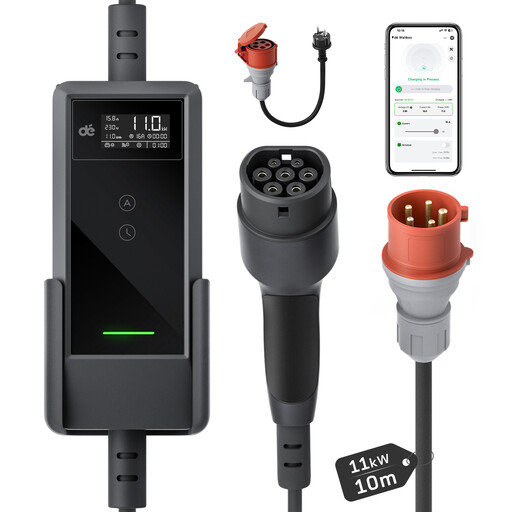
Why it's a good fit: For users who want to combine the power of a fixed wallbox with the portability of a mobile charger. Ideal for travel, a second home, or when a permanent installation isn't possible. Charges at up to 11 kW from a CEE 16A socket.
This device solves the compatibility trap with its mobility and CEE connector, which enables fast charging in many locations. The extra-long 10-metre cable provides a solution for almost any conceivable parking scenario, making extension cords unnecessary.
Combines 11 kW charging power with portability. The current is adjustable via the app, allowing it to adapt to different power grids. The 10-metre-long cable is a unique feature in this class.
We have compiled a complete, up-to-date list of products that fully meet these strict selection criteria and German safety regulations.
1. Does an 11 kW wallbox need to be approved by the grid operator? No, in Germany, a wallbox with a charging capacity of up to 11 kW does not require approval. However, it must be registered with the responsible grid operator before it is commissioned. This is usually handled by the certified electrician performing the installation. Only charging stations with more than 11 kW (e.g., a 22 kW wallbox) require prior approval.
2. What is the difference between a Type A and a Type B RCD? An RCD (Residual Current Device) protects against life-threatening electric shocks. A Type A device only detects AC fault currents. However, when charging electric cars, smooth DC fault currents can also occur. Only a Type B device (all-current sensitive) can also detect these, thus providing the comprehensive protection recommended for EV charging stations. A wallbox with an integrated Type B RCD is therefore a safer and often more cost-effective choice.
3. Can I use a portable wallbox with a standard socket? Yes, many portable chargers, often called "trickle chargers" or "granny chargers," come with an adapter for a standard household socket (Schuko). The charging power is then limited to a maximum of 3.7 kW. It is advisable to have an electrician check the socket and your home's wiring for suitability for continuous load to prevent overheating and fire hazards. For higher charging speeds of up to 11 kW, portable wallboxes require a red CEE 16A three-phase socket.