
Lieferung heute & morgen

Qualitätsgarantie

Willkommens-Angebote freischalten: KOSTENLOSE Lieferung | Bis zu 80 % RABATT | Kostenlose 30-Tage-JoyPlus-Testphase
App herunterladen
As an electric car owner, you face the decision of how to charge your vehicle at home most efficiently and safely. The range of charging stations is vast, from permanently installed units to flexible mobile solutions. The technical differences, especially in charging power and feature sets, can make the choice challenging.
This guide, written by the Joybuy Product Recommendation Officer, is intended to provide you with objective guidance. We will explain the key criteria for selecting a wallbox and present a selection of different models to help make your decision easier.
Three central aspects determine which charging solution is right for your needs: charging power, form factor, and feature set.
The charging power, measured in kilowatts (kW), indicates how quickly your vehicle's battery can be charged.
The choice between a permanently installed and a mobile charging station depends on your usage patterns.
Modern charging stations offer useful additional functions that make the charging process more convenient and cost-effective.
Here you will find a selection of chargers that cover different requirements—from flexible mobile solutions to powerful, permanently installed stations.

What makes it stand out: This mobile charger combines a solid charging power of up to 11 kW with the benefits of smart control. It connects via a CEE plug and, thanks to its integrated Wi-Fi functionality, allows full control through an app. Users can adjust the charging current, schedule charging times, and monitor the status in real-time.
Advantages:
Who is it for? EV drivers looking for a powerful and flexible charging solution that can be used both at home and on the road with industrial sockets (CEE 16A) and who value smart features.
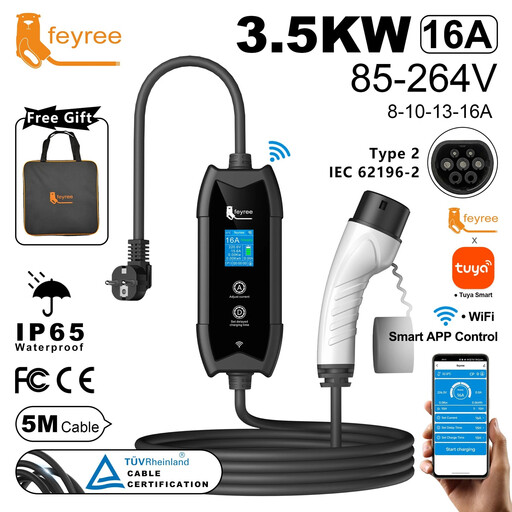
What makes it stand out: This very lightweight and compact charger is designed for connection to a standard household socket and delivers a charging power of up to 3.5 kW. Despite its simple handling, it offers smart features via an app, such as adjusting the charging current (8A-16A) and scheduling charge and delay times.
Advantages:
Who is it for? Owners of plug-in hybrids or EV drivers who primarily charge overnight and need a straightforward, portable solution for use with standard household outlets.
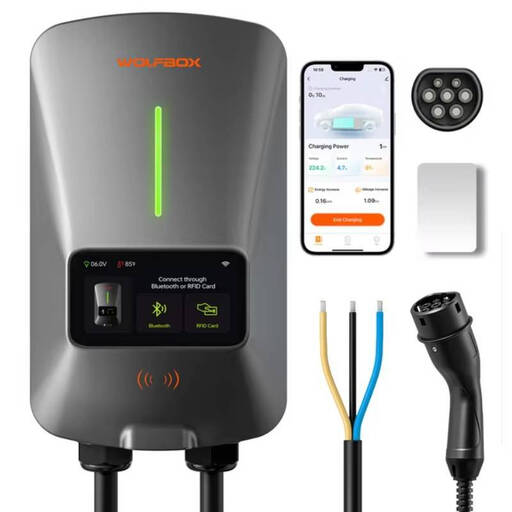
What makes it stand out: The WOLFBOX AC07 is a wallbox for permanent installation with a charging power of 7 kW (single-phase, 32A). It offers flexible control options via a mobile app as well as access control using RFID cards. The integrated LCD display provides all important charging data at a glance.
Advantages:
Who is it for? Homeowners or small businesses looking for a reliable, permanently installed EV charging station for home with secure access control and smart monitoring features.
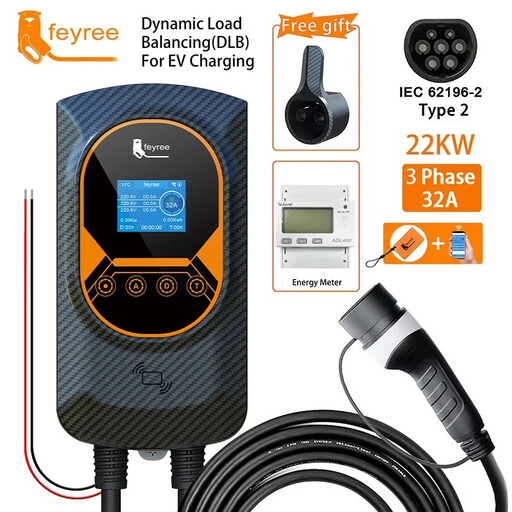
What makes it stand out: This powerful 22 kW wallbox is equipped with a Dynamic Load Balancing (DLB) feature. It intelligently balances the power consumption between the charging vehicle and other household appliances to prevent an overload of the electrical system. It is conveniently controlled via an app.
Advantages:
Who is it for? Homeowners with a powerful electrical connection and a 22 kW-capable vehicle who need a future-proof charging station with load management for intelligent integration into their home's electrical system.
If this selection doesn't include the right model for your specific needs, you can find a wider range of products in our main category. There you can compare various chargers, cables, and other accessories.
Discover our entire range of Electric Vehicle Charger Accessories.
No, in Germany, a wallbox with up to 11 kW of charging power does not require a permit. However, it must be registered with the local grid operator before use. Charging stations with more than 11 kW (e.g., a 22 kW wallbox) require prior approval from the grid operator.
A simple Type 2 charging cable connects the car to a public charging station or a wallbox. A mobile wallbox, on the other hand, is a complete charging device. It contains the control and safety electronics in a control box and connects directly to a CEE or household socket to charge the vehicle.
For safety and warranty reasons, the installation of a permanently installed wallbox must be carried out by a certified electrician. They will check the home's electrical connection, install the necessary circuit breakers, and ensure that all standards are met. Mobile chargers that connect to an existing and correctly fused socket do not require such installation.