
Lieferung heute & morgen

Qualitätsgarantie

Willkommens-Angebote freischalten: KOSTENLOSE Lieferung | Bis zu 80 % RABATT | Kostenlose 30-Tage-JoyPlus-Testphase
App herunterladen
By: Joybuy Product Recommendation Officer
A wall hook set can provide space-saving storage for coats, bags, towels and accessories. However, not every set automatically delivers a tidy, long-lasting solution. Installation, materials, load capacity and the intended location all matter. If you choose based solely on colour or the lowest possible price, you may overlook important details.
A load rating does not always apply to the complete set. It may refer to one individual hook, a particular type of wall or professional installation. With a double hook, you should also check whether the rating applies to the entire hook or to each hanging point.
For heavy winter coats, rucksacks or several bags, do not simply consider the number of hooks. Check the specific manufacturer’s information and choose suitable wall plugs for the surface you have.
Wall hooks without drilling are practical for rented homes and smooth surfaces. However, self-adhesive hooks require a clean, dry and sound surface. Textured plaster, wallpaper, flaking paint, brickwork or damp surfaces can affect adhesion.
Extra care is also needed in the bathroom: self-adhesive hooks are not automatically suitable for prolonged moisture or direct contact with water. Read the care and installation instructions for the specific product before buying.
Decorative wall hooks need to do more than look good. Hook arms that are too short, sharp edges or missing retaining grooves can cause clothing and towels to fall off or become damaged. With a wall-mounted coat rack, the distance between the individual hanging points is also important, so that thick coats do not overlap.
Wood, MDF, aluminium, stainless steel and iron are all suitable options for hallways, bedrooms and kitchens. Sturdy metal hooks can withstand regular use, but in the bathroom they should have a suitable surface treatment. Aluminium, for example, may be described in product specifications as water-resistant and rust-resistant. Stainless steel is often suitable for damp areas, provided that the adhesive connection is also designed for this use.
Wood and MDF give a hook rail a homely appearance. However, MDF products should be protected from direct water and high humidity. For a towel hook in an area exposed to splashes, the material and installation details are therefore more important than the colour alone.
For permanently screwed-in wall-mounted coat hooks, screws and wall anchors are usually included. Even so, the load capacity depends on the wall material. With plasterboard, cavities or porous walls, you will need suitable wall plugs. For heavy coats, it is advisable to secure the hooks in suitable load-bearing areas.
Adhesive models should only be attached to the smooth surfaces expressly specified. You may need to wait before placing any weight on them. For example, the JORDAN&JUDY model recommends avoiding heavy loads on the hooks for 24 hours after installation.
A wall hook set with eight double hooks provides plenty of individual hanging points, but requires sufficient wall space. A compact rotating solution may be suitable for a small entrance area. A hook rail for the hallway, on the other hand, distributes the hanging points along a fixed length.
Measure the available width before buying and check that doors, drawers and walkways remain unobstructed. For coats and towels, rounded edges and a sufficiently long hook arm are practical considerations. For keys, lightweight scarves or kitchen utensils, a smaller version is often enough.
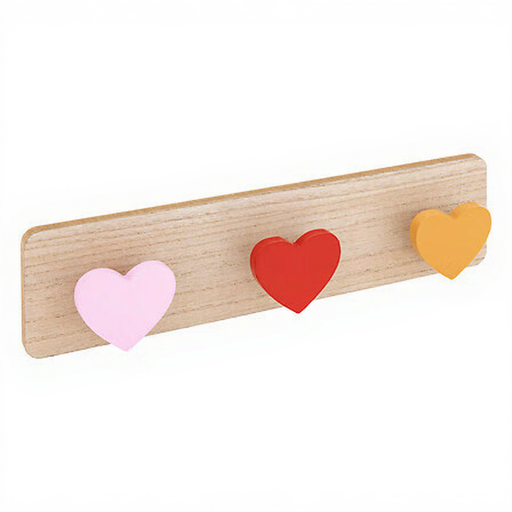
Why this product suits this profile: This set of three E1 MDF hooks is designed for lightweight everyday items such as keys, scarves and hats in the hallway or bedroom.
The description specifies that it is intended for lightweight items and warns that it should be protected from water and high humidity.
Three coloured hooks; stated dimensions of 9.5 × 4.5 × 36 cm per element.
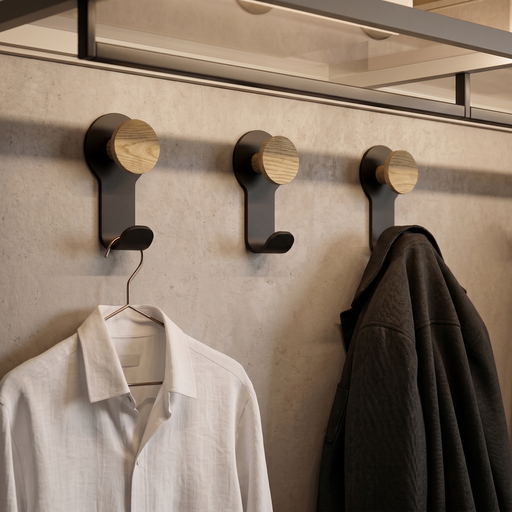
Why this product suits this profile: The combination of FSC-certified wood and coated metal brings together decorative styling and multiple hanging points for the hallway, bedroom or bathroom.
The product information mentions rounded edges, a rubber buffer on the back and installation with screws and wall anchors.
Set of eight double hooks; according to the product information, supports up to 11 lb per hook.
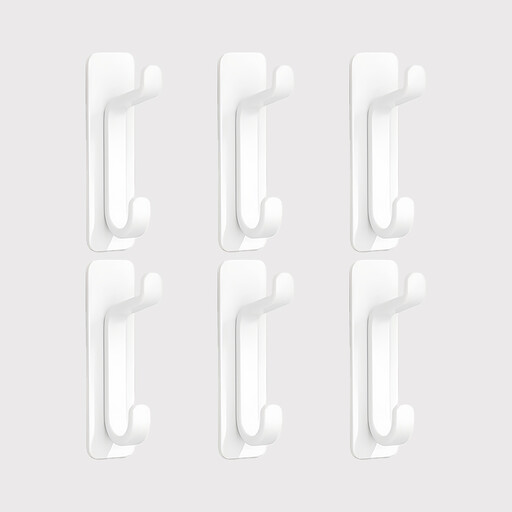
Why this product suits this profile: For tenants or flexible storage solutions on doors, in the kitchen, bathroom or hallway, this set allows no-drill installation on suitable smooth surfaces.
The product information rules out fragile or unsuitable surfaces and recommends installing the hooks on a dry, clean surface, followed by an initial waiting period.
Six stainless steel hooks with adhesive backing; designed for wall and door mounting.

Why this product suits this profile: The three independently rotating hooks are ideal for a small entrance area where different items of clothing and bags need to remain accessible.
The rotating hanging points avoid a fixed arrangement and make access easier when wall space is limited.
Black iron construction; compact dimensions of 14.5 × 9.5 × 7 cm.
For a permanent wall-mounted coat rack in a family home, a screwed-in hook rail is usually the more predictable option. Individual decorative wall hooks, on the other hand, can be arranged more flexibly. In the bathroom, you should also leave sufficient distance from direct water and follow the care instructions.
We have put together a complete, regularly updated list of products that fully meet these strict selection criteria and the safety regulations applicable in the EU.
For one person, three to six hanging points are often enough in the hallway. Families need more space depending on the number of coats, bags and rucksacks. A set with double hooks makes efficient use of the wall space, while a hook rail sets the spacing in advance.
That depends on the product, the surface and the adhesive system. Self-adhesive hooks are not automatically suitable for heavy loads. Check the stated load capacity, install them only on suitable smooth surfaces and avoid overloading them.
Aluminium or stainless steel hooks may be designed for use in damp rooms. With wood and MDF models, direct contact with water should be avoided. The specific material, installation and care information for the product in question is what matters.