
Lieferung heute & morgen

Qualitätsgarantie

Willkommens-Angebote freischalten: KOSTENLOSE Lieferung | Bis zu 80 % RABATT | Kostenlose 30-Tage-JoyPlus-Testphase
App herunterladen
Reverberation in large rooms, distracting background noise in the home office, and a muddled soundscape in your home cinema are common acoustic challenges in modern living and working environments. Acoustic panels offer a functional solution to improve room acoustics. Models with a walnut finish, in particular, combine this function with an appealing aesthetic.
This article serves as your guide. We'll explain which features to look for when making your selection and present a curated list of walnut acoustic panels to help you make an informed decision.
Selecting the right panels depends on several factors. The following three criteria are particularly important for making a well-informed choice.
The effectiveness of an acoustic panel is largely determined by its construction. A combination of two main components is standard:
The primary goal of acoustic panels is to improve room acoustics by reducing reverberation and echoes. They are not primarily designed for soundproofing—that is, blocking noise from adjacent rooms. Their strength lies in absorbing sound waves within a single space. Look for the sound absorption class, if provided by the manufacturer. For most applications, such as living rooms, offices, or studios, good absorption in the mid and high-frequency ranges (speech, music) is crucial.
Beyond function, aesthetics play a vital role. 3D wood wall panels use their slatted structure to create visual depth and a modern, natural atmosphere. The warm, dark grain of walnut wall panelling blends harmoniously with many interior design styles.
Before purchasing, check the recommended installation methods. Many panels can either be glued directly to the wall or screwed onto a subframe of battens. A screwed installation with an air gap behind the panel can further enhance its sound-absorbing effect, especially at low frequencies.
Based on the criteria above, we have compiled a selection of products that stand out for their material properties and design.
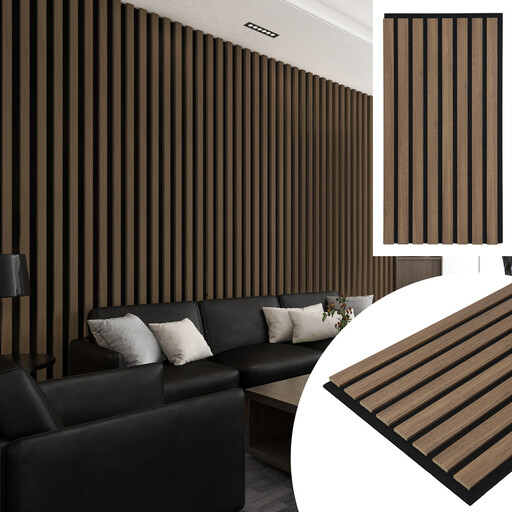
Why It Stands Out This set from Art3d is designed for covering larger areas. With 20 panels that together cover an area of 3.6 m?, it is ideal for creating a full accent wall in a living room, home cinema, or conference room. The construction of MDF slats with a real wood veneer on a dense felt backing is engineered to effectively dampen sound waves.
Advantages
Who It's For For homeowners and business owners looking for a large-scale, acoustically effective, and visually appealing wall covering for spaces like offices, studios, or large living areas.
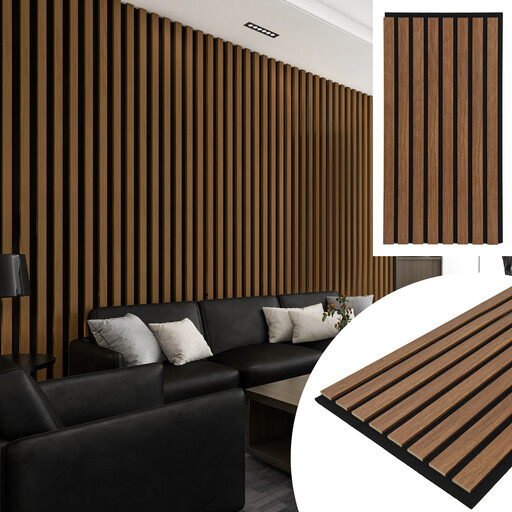
Why It Stands Out The set of 4 from LONGKING is a practical option for smaller applications or for targeted placement on sound-reflective surfaces. The panels combine a deep, linear slatted wood wall look with a high-density felt backing to reduce echo and reverberation. The smaller set allows you to test the effect and appearance of the panels in a limited area first.
Advantages
Who It's For For users who need an acoustic solution for a specific area, such as a workstation, a recording nook, or a small room. Also suitable for those who want to test the product before making a larger investment.

Why It Stands Out This large-format set from LONGKING also places a special emphasis on design. The description highlights a geometric 3D pattern that creates a striking play of shadows, turning the wall into a decorative feature. Functionally, it relies on the proven combination of fibreboard with walnut veneer and a dense felt backing for sound absorption.
Advantages
Who It's For For design-conscious users who are looking for a solution that is not only functional but also aesthetically outstanding, to showcase a wall as a central design element.
A walnut finish is just one of many ways to combine functionality and design. If you are considering other wood types or surface textures, you can find a wider selection of panelling solutions in our category.
? Discover more Shiplap Wood Panels on Joybuy.de
1. How many acoustic panels do I need for a room? The required quantity depends on the room size, its furnishings, and the desired effect. A general recommendation is to start by covering about 25–30% of the wall surface on one or two opposing walls. Begin with the surfaces that directly reflect sound, such as the wall opposite your speakers or the wall behind your workspace.
2. Do acoustic panels improve soundproofing from neighbours? Acoustic panels are primarily designed for sound absorption within a room to reduce reverberation and echoes (improving room acoustics). They offer only a very limited soundproofing effect against noise from outside or adjacent rooms (sound transmission). Effective soundproofing requires structural measures, such as a decoupled wall assembly or other specialised construction methods.
3. Can wood acoustic panels be easily installed yourself? Yes, installation is generally manageable for DIY enthusiasts without special expertise. Depending on the model and wall condition, the panels can be attached with construction adhesive, double-sided tape, or screws. For a precise result, basic tools like a spirit level, a tape measure, and possibly a saw for cutting the panels are helpful. Always follow the manufacturer's installation instructions.