
Lieferung heute & morgen

Qualitätsgarantie

Willkommens-Angebote freischalten: KOSTENLOSE Lieferung | Bis zu 80 % RABATT | Kostenlose 30-Tage-JoyPlus-Testphase
App herunterladen
A walnut wood cutting board with handle combines a natural surface with a practical way to carry and serve food. However, for home cooks and kitchen enthusiasts, choosing the right board is not simply a matter of appearance. Its dimensions, handle design, material thickness and care requirements all determine whether it is genuinely suitable for everyday use.
A narrow board with a long handle can be ideal for bread, cheese or small preparation tasks, but offers less space for chopping vegetables. A large cutting board, on the other hand, is more practical for extensive preparation, but requires more room in the kitchen and cupboard.
Before buying, you should therefore be clear about whether the board will mainly be used as a kitchen cutting board, as a serving board or for both purposes.
The handle needs to suit how you intend to use the board. A long handle makes it easier to carry the board across the table, but increases its overall length and can be awkward on small worktops. A side or short handle takes up less space, but provides less distance between your hand and the food when serving.
Also check whether the product description states that the board should be carried with one or both hands. Safe handling is particularly important with longer models.
Natural wood is not suitable for the dishwasher or prolonged soaking. Water can penetrate the wood and encourage warping, cracks or material damage. Strong heat, naked flames and direct, prolonged exposure to sunlight should also be avoided.
A durable cutting board therefore depends on more than just the type of wood. What matters is whether the care instructions can realistically be followed in everyday use.
With a walnut wood cutting board, the material and workmanship should be clearly described. Walnut wood is recognisable by its brown colouring and visible grain. The natural surface can vary from one product to another; slight differences in colour and grain are normal with wood.
For kitchen use, a sufficiently smooth, splinter-free surface is important. If there are pronounced cracks, warping or chips, the board should no longer be used.
A material thickness of 20 mm is specified for the models presented here. This provides a solid base for everyday cutting tasks without necessarily making the board particularly heavy. Weight affects stability and portability.
For example, the model measuring 250 × 360 × 20 mm weighs 1.3 kg. A round board with a diameter of 310 mm and a thickness of 20 mm is listed as weighing 1.18 kg. Values like these are useful for comparison, but do not replace checking your available worktop space and your own carrying preferences.
The shape should suit your workflow:
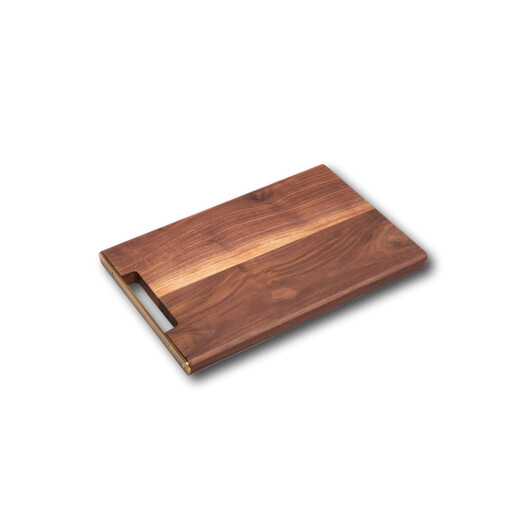
Why this product suits this profile: Measuring 25 × 36 cm, this rectangular model provides a manageable surface for everyday cutting tasks. The I-shaped copper handle makes it easier to lift and carry.
The dimensions and weight of 1.3 kg are clearly stated. This lets you check before buying whether you have enough worktop and storage space.
Walnut wood, 20 mm material thickness and a rectangular format with handle.
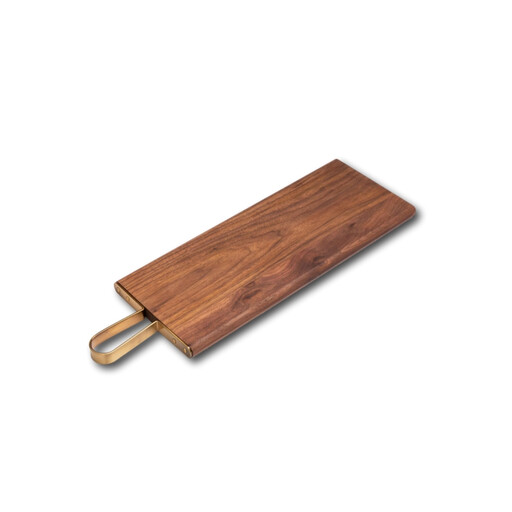
Why this product suits this profile: Measuring 45 cm in length, this format combines a narrow work surface with an extended handle, making it suitable for anyone looking to combine cutting and serving.
The product details explicitly state that the extended handle is designed to be used with both hands. This makes it easier to assess how practical it will be before buying.
45 × 18 × 2 cm, walnut wood and a double extended handle.
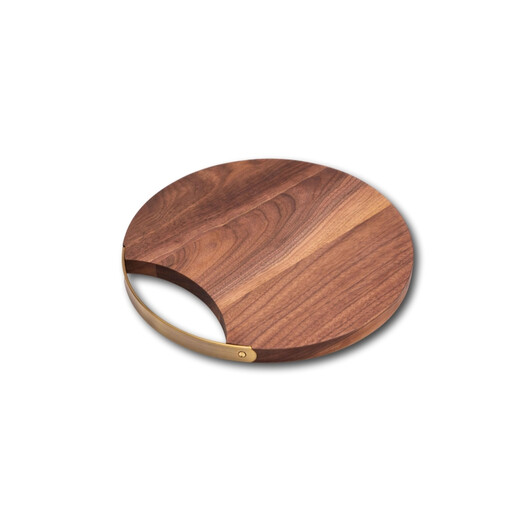
Why this product suits this profile: With its round format and 31 cm diameter, this board is suitable for anyone looking for a compact, circular cutting and serving board.
The round shape is not presented as offering an especially large cutting surface. Its diameter is specified, so you can compare it with the space available in your kitchen.
Round walnut wood format, 31 cm diameter, 20 mm thickness and handle.
We have put together a complete, regularly updated list of products that fully meet these strict selection criteria and the safety regulations applicable in the EU.
To help the walnut wood cutting board with handle retain its shape and surface for as long as possible, we recommend the following routine:
If the board develops deep cracks, significant warping, mould or splinters, it should no longer be used for food for safety reasons. The specific care and warning instructions for the product in question take precedence.
According to the product descriptions, the models listed are intended for general cutting and preparation tasks. A stable work surface, a secure grip and proper care are important. For particularly large quantities of ingredients, compare the available cutting surface with the product dimensions beforehand.
Wipe the board with warm water and mild washing-up liquid, or clean it briefly. It should then be rinsed, dried and left upright to air-dry completely. Soaking and cleaning in the dishwasher should be avoided, as these can damage the wood.
It is not possible to give a standard service life. This depends, among other things, on how frequently the board is used, moisture, heat, knife use and care. Drying it regularly and avoiding the dishwasher and soaking can help preserve the board's useful life.