
Lieferung heute & morgen

Qualitätsgarantie

Willkommens-Angebote freischalten: KOSTENLOSE Lieferung | Bis zu 80 % RABATT | Kostenlose 30-Tage-JoyPlus-Testphase
App herunterladen
A bathroom wall shelf gives you extra storage without taking up valuable floor space. However, not every shelf is suitable for every wall, damp room or household. Tenants in particular often look for a no-drill shower shelf, while homeowners may prefer a permanent, sturdy option such as a recessed shower shelf.
Before you buy, watch out for these three common pitfalls:
For rented homes, self-adhesive shower shelves or models with suction cups are suitable, provided the surface is smooth and sturdy. Before fitting, remove soap residue, limescale and grease, then make sure the surface is completely dry. Once fitted, wait for the manufacturer’s stated curing time before placing bottles on the shelf.
For uneven walls, screw fixing is generally more predictable. This also applies to heavy bathroom wall shelves or a shelf with a towel rail. Choose wall plugs that are suitable for the wall type, such as tiles, concrete, masonry or plasterboard.
A recessed model offers a flush finish, but requires a suitable wall construction. The niche shelf described here requires a wall thickness of more than 10 cm. Make sure any pipes and waterproofing are properly taken into account during installation.
Open shelves with drainage are practical in wet areas. A perforated base stops water from pooling on the shelf. Even with a rust-resistant shower shelf, you should check what it’s made from and whether its surface treatment is suitable for the surroundings.
Before ordering, measure the available wall width, shelf depth and clearance around doors or shower enclosures. The internal height is also important for shampoo and shower gel bottles. A slim shelf saves space, but may not provide enough room for larger bottles.
Check the load capacity in the product specifications, not just in the product image. A model with a maximum load of 6 kg is suitable for lightweight toiletries, while a sturdy bathroom shelf for towels or supplies has different requirements. Never exceed the maximum load. With adhesive fittings, the fixing itself may also be the limiting factor.
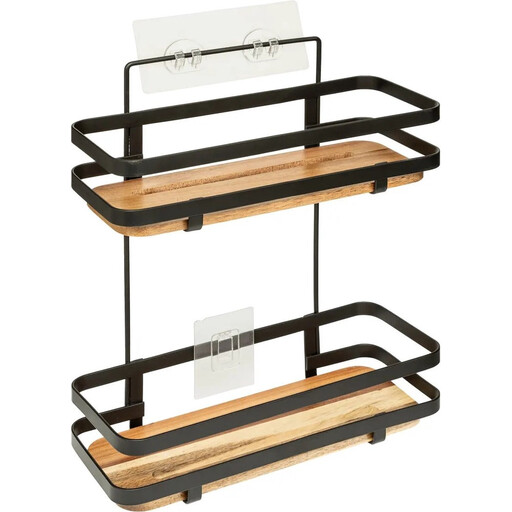
Why this product suits this profile: This two-tier shelf is designed for shampoo, soap and sponges. According to the product description, it can be fitted using adhesive strips or suction cups. Measuring 25 × 15 × 30 cm, it’s a good fit for smaller bathrooms.
Be sure to check the fitting method and note that no maximum load is specified. This helps you avoid putting heavy supplies on the shelf.
Two shelf tiers, compact dimensions and a no-drill fitting option. The maximum load isn’t specified.
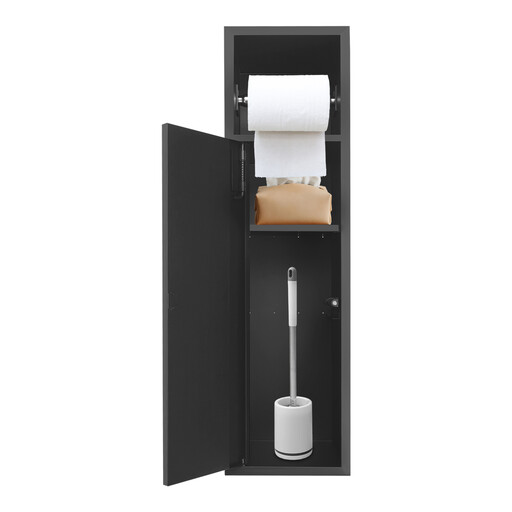
Why this product suits this profile: According to the product details, this recessed bathroom shelf is made from 304 stainless steel. It combines two shelf tiers with a door and a toilet roll holder. It’s suited to homeowners looking for a flush-fitting wall solution that’s planned as a permanent fixture.
The required wall thickness of more than 10 cm and the recommendation for professional installation make the building requirements clear. The edges are designed to be sealed.
The product description states that it has a fully welded construction and a total load capacity of 20 kg. Installation is more involved than with adhesive shelves.
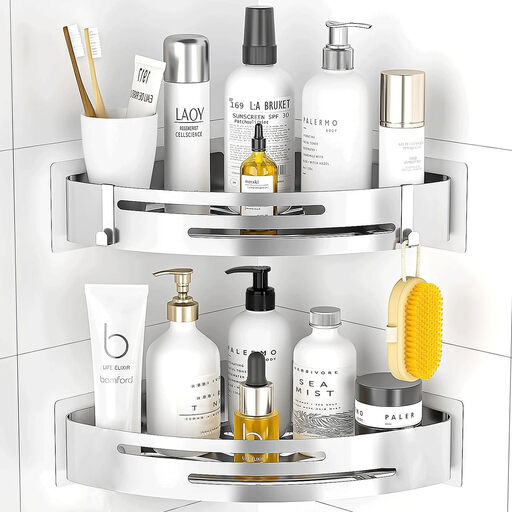
Why this product suits this profile: According to the product details, the two triangular baskets are made from 304 stainless steel and make use of the shower corner. Measuring 21.3 × 21.3 × 5 cm and 20.7 × 20.7 × 4.2 cm, they provide separate storage for several toiletries.
The open bases help water drain away, while the two different sizes make it harder to overload either shelf. The adhesive should only be applied to suitable smooth surfaces.
Two baskets, four hooks and no-drill fitting, according to the product description. Designed for corner installation in the shower.
We’ve put together a complete, regularly updated list of products that meet these strict selection criteria and the safety regulations in force in the EU.
Depending on the model, a no-drill shelf is fitted with an adhesive pad, suction cups or a self-adhesive bracket. The surface must be smooth, clean, dry and sturdy. Adhesion is often limited on grout lines, rough plaster or damp surfaces. Don’t add heavy items until the adhesive has fully cured.
There’s no single answer, as it depends on the surface, humidity, cleaning, installation and load. Checking the adhesive regularly and keeping the load well below the stated maximum can reduce the risk of it coming loose. If you notice cracks, movement or weakening adhesion, remove the weight from the shelf and refit it.
A wall shelf doesn’t normally use energy, so it has no ongoing energy costs. You only need to allow for cleaning and the occasional replacement adhesive pad or fitting. Wooden and MDF models may also need gentle care and a dry location to help keep the surface in good condition over time.