
Lieferung heute & morgen

Qualitätsgarantie

Willkommens-Angebote freischalten: KOSTENLOSE Lieferung | Bis zu 80 % RABATT | Kostenlose 30-Tage-JoyPlus-Testphase
App herunterladen
A wardrobe needs to do more than simply hold clothes. It should suit the size of the room, your everyday habits and your existing furnishings. Poor purchases are often caused not by the price, but by unsuitable dimensions, hard-to-reach compartments or a door design that takes up too much space in daily use.
A large wardrobe may look spacious in photos, but broad central panels, low compartments or an impractical layout can reduce the usable storage inside. So check more than just the width and height:
Hinged doors need sufficient space in front of the wardrobe. In small bedrooms or narrow hallways, a wardrobe with sliding doors or a sliding-door wardrobe may be more practical. However, the runners must be fitted correctly and kept free from obstructions.
A wardrobe with a mirror can also replace a separate full-length mirror. The mirror makes the room look larger, but it is still a delicate glass surface. Make sure the wardrobe is securely fixed to the wall and avoid hard impacts against the door.
A folding wardrobe, fabric wardrobe or portable wardrobe is flexible and usually quick to assemble. It is suitable for rented homes, guest rooms, seasonal clothing or temporary storage solutions, for example. However, its load limits are considerably lower than those of large rigid wardrobes. Heavy winter coats should only be hung if the stated load capacity of the clothes rail is sufficient.
Measure the available wall width, room height and depth. Also take skirting boards, radiators, doors and sockets into account. With a wardrobe featuring sliding doors, you generally do not need to leave additional opening space in front of the furniture. Nevertheless, the doors and runners need sufficient clearance to move freely.
For small rooms, a space-saving wardrobe with sliding doors may be a sensible choice. A large wardrobe approximately 200 cm wide, on the other hand, needs a stable, sufficiently wide area and should not be placed directly against a problematic wall.
A clothes rail is designed for shirts, jackets and dresses, while shelves hold folded textiles. The stated maximum static load capacity is important. This figure generally applies to an evenly distributed load, not to individual heavy items placed in one spot.
Look for adjustable shelves if household members own clothes of different lengths. A combination of a wardrobe with a clothes rail and a wardrobe with shelves usually allows more flexible organisation than a single continuous clothes rail.
For rigid wardrobes, material thickness, edge sealing and the door mechanism are important points of comparison. The models listed, for example, use 16 mm laminated chipboard with ABS or PVC edges. These details describe the construction, but are not in themselves a blanket judgement of quality.
Heavy wardrobes must be secured to the wall in accordance with the assembly instructions. This reduces the risk of tipping. Assembly and transport generally require two people for larger models. With mirrored and sliding doors, you should also watch out for trapping points and prevent children from climbing on the doors or shelves.
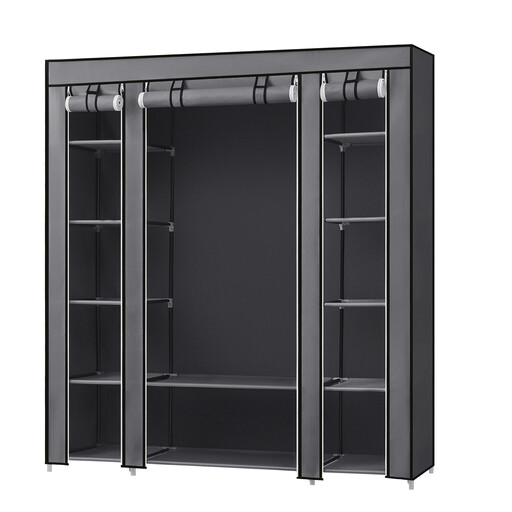
Why this product suits the profile: This portable fabric wardrobe is suitable for rented homes, guest rooms and anyone who wants to create extra storage without a heavy rigid wardrobe. It measures 45 × 150 × 175 cm and weighs 5,3 kg.
The stated load limits make the possible uses clear: up to 5 kg per shelf and 15 kg for the clothes rail. The twelve compartments make it easier to separate clothing and accessories.
16 mm-diameter metal tubes, twelve storage compartments and a non-woven cover to protect against dust. Assembly is carried out according to the instructions.
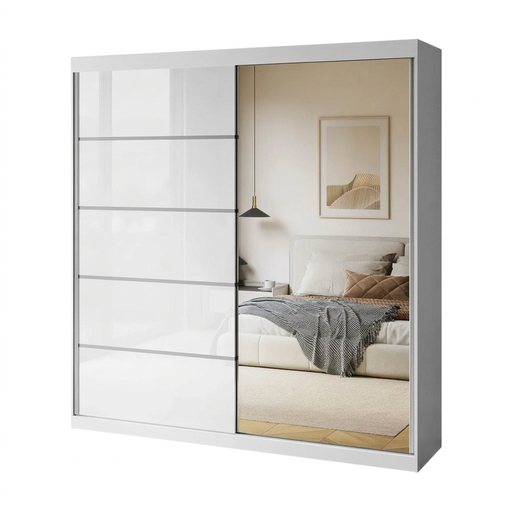
Why this product suits the profile: Measuring 200 × 215 × 58 cm, this model has two sliding doors, one mirrored door, nine shelves and a clothes rail. It is aimed at households with extensive organisational needs and enough space for a wide piece of furniture.
The sliding doors do not need a swing area. The interior layout is specified clearly, with nine shelves and one clothes rail, rather than being described only with a general capacity claim.
16 mm laminated chipboard, ABS edges, aluminium runners and a large mirror. The wardrobe is delivered flat-packed for self-assembly.
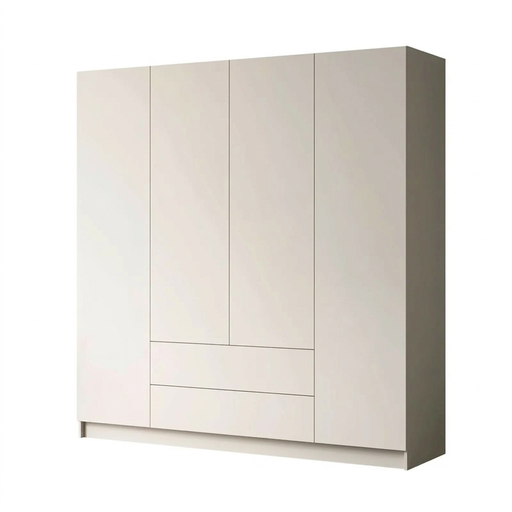
Why this product suits the profile: Families and frequent users get twelve shelves, a clothes rail and two drawers in a 200 × 210 × 57 cm wardrobe. Four doors provide access to several separate sections.
The product details list the complete interior configuration, avoiding vague capacity claims. The push-to-open doors and drawers should be adjusted correctly during assembly.
Twelve shelves, two drawers with ball-bearing runners, a clothes rail and 16 mm laminated chipboard with ABS edges. Wall anchoring is provided for.
We have put together a complete, regularly updated list of products that fully meet these strict selection criteria and the safety regulations applicable in the EU.
For large wardrobes, plan the assembly with at least two people. Read the instructions in full before connecting any components, and secure the wardrobe to the wall if this is specified. Fabric wardrobes should be completely emptied before being moved.
A soft, slightly damp cloth is usually sufficient for laminated surfaces. Abrasive cleaners and solvents can damage the décor, edges or high-gloss surfaces. Clean mirrors with a suitable glass cleaner and a soft cloth. Keep the runners free from dust and foreign objects so that the doors can move smoothly.
For hanging clothes, an external depth of around 55 to 60 cm is often practical, as clothes hangers need sufficient room. With a narrower model, check the internal dimensions and the position of the clothes rail particularly carefully.
Place the wardrobe on a level surface and follow the assembly instructions. Large pieces of furniture should be secured to the wall using the supplied anti-tip fitting. Allow for two people when assembling and transporting heavy rigid wardrobes.
Its service life depends on the material, assembly, load and care. Evenly distributed loads, correctly adjusted doors and a dry environment reduce mechanical strain. With fabric wardrobes, do not exceed the stated load capacities for the shelves and clothes rail.