
Lieferung heute & morgen

Qualitätsgarantie

Willkommens-Angebote freischalten: KOSTENLOSE Lieferung | Bis zu 80 % RABATT | Kostenlose 30-Tage-JoyPlus-Testphase
App herunterladen
A new wardrobe should keep clothes neatly organised, make sensible use of the available space and suit your household’s everyday needs. However, there are clear differences between a large wardrobe, a sliding-door wardrobe with a mirror and a portable model when it comes to dimensions, load capacity, assembly and protection from dust.
Three common purchasing misconceptions particularly often lead to the wrong decision:
Don’t just measure the alcove width; check the room height and depth too. A model with a depth of 58 cm provides space for clothes hangers, but in a small bedroom it may restrict the passageway. A space-saving wardrobe with sliding doors needs less room in front of the doors than a hinged-door wardrobe.
A sliding-door wardrobe with a mirror can also incorporate a mirrored surface. This may save space otherwise needed for a separate full-length mirror and can make a room appear brighter. However, the mirror is a glass surface, so impacts should be avoided during transport, assembly and everyday use.
Before buying, check the following:
A wardrobe with a clothes rail is suitable for shirts, jackets, dresses and coats. Shelves are useful for folded textiles, bags or boxes. With a wardrobe featuring 9 or 12 compartments, the number alone should not be considered in isolation. What matters is how the compartments are arranged and the maximum static load specified for each shelf.
For the fabric models presented here, the stated capacities are up to 5 kg per shelf and 15 kg for the clothes rail. These figures refer to static loads. Heavy items such as books or full storage boxes should only be stored where the construction is designed to support them.
A carcass made from 16 mm laminated chipboard with ABS edges should be assessed differently from a metal tube frame with a non-woven fabric cover. A solid carcass solution is more suitable for a long-term furnishing arrangement. A fabric wardrobe, on the other hand, can be practical when moving house, in a guest room or in rented accommodation.
You should also look for:
For tall or lightweight wardrobes, wall anchoring is particularly important. Children should not climb on doors, shelves or clothes rails. This also applies to a portable wardrobe: it should be completely emptied before being moved.
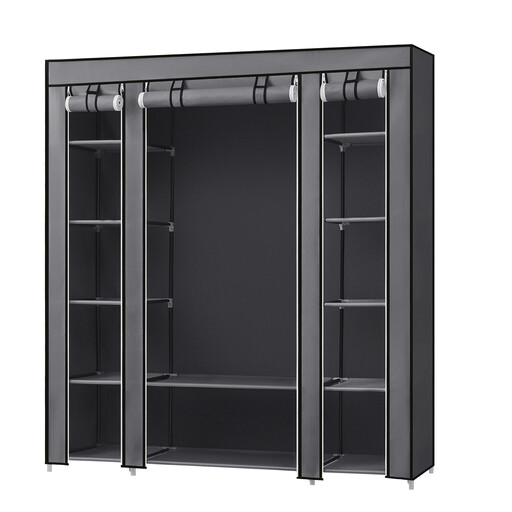
Why this product suits the profile: The grey fabric wardrobe measures 150 × 45 × 175 cm and offers 12 compartments plus a clothes rail. Its low weight of 5.3 kg may make it suitable for rented accommodation, guest rooms or temporary storage needs.
The stated shelf and rail capacities of 5 and 15 kg respectively make it easier to plan how the wardrobe will be used than a simple advertising claim about capacity. The non-woven fabric cover reduces the amount of dust entering directly.
12 compartments, 16 mm-diameter metal tubes and assembly with numbered parts.
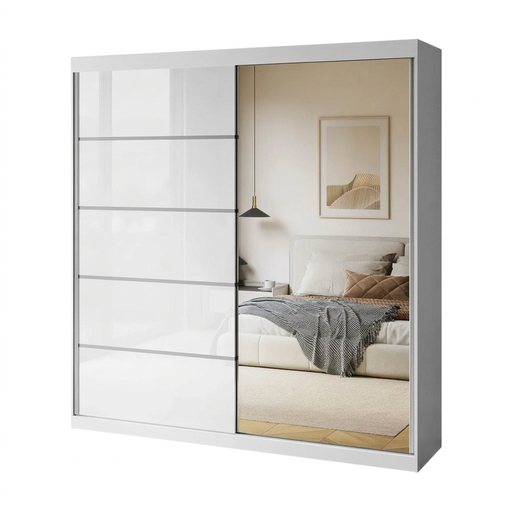
Why this product suits the profile: The combination of a width of 200 cm, a height of 215 cm, a glossy white finish, two sliding doors and a mirror is aimed at households needing long-term storage space.
The interior layout is specified clearly, with 9 shelves and a clothes rail. The Servoll aluminium running system and 16 mm chipboard with ABS edges provide clear, verifiable technical details.
Sliding doors require little space in front; one door features a full-length mirror. The wardrobe is delivered for self-assembly.
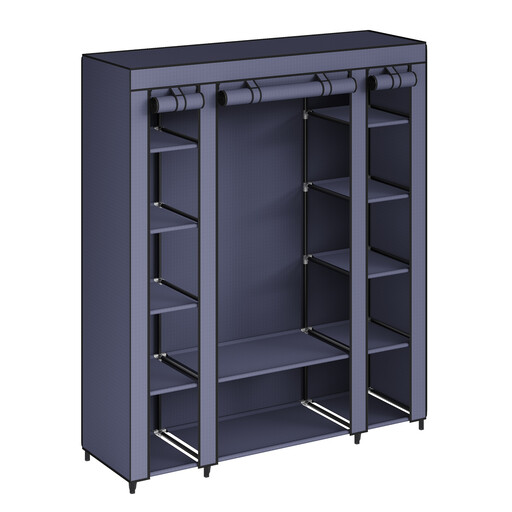
Why this product suits the profile: The dark blue portable wardrobe measuring 150 × 45 × 175 cm offers 12 shelf compartments, a movable clothes rail and a roll-up fabric cover. It is suitable for changing layouts in the bedroom, dressing room or guest room.
The product details specify a load capacity of 5 kg per shelf and 15 kg for the rail. They also advise securing the wardrobe to the wall, emptying it before moving and protecting it from direct sunlight.
Tool-free assembly, a closable fabric cover and a movable clothes rail for flexible use.
We have put together a complete, regularly updated list of products that fully meet these strict selection criteria and the safety regulations applicable in the EU.
With hinged doors, you need to allow for the door swing in front of the wardrobe. Sliding doors need less clearance, but they require a clear, level running track. There should also be sufficient access for assembly and cleaning. For a 200 cm wardrobe, check the wall width, including the gaps at either side.
Its service life depends on the material, load, assembly and care. A solid carcass made from laminated chipboard is intended for long-term use, while a fabric wardrobe is often chosen for flexible or temporary use. Overloaded shelves, forcing the doors open and failing to secure the wardrobe to the wall can put strain on the construction.
A wardrobe does not incur ongoing electricity costs during normal use. Costs may arise from assembly, additional storage boxes or replacement parts. For models with a mirror, you should also use suitable glass and surface cleaners and avoid abrasive products.