
Lieferung heute & morgen

Qualitätsgarantie

Willkommens-Angebote freischalten: KOSTENLOSE Lieferung | Bis zu 80 % RABATT | Kostenlose 30-Tage-JoyPlus-Testphase
App herunterladen
A wardrobe for clothes storage should keep your clothing neatly organised, make the best use of the available space, and remain easily accessible in daily life. In bedrooms, dressing rooms and hallways, however, costly mistakes are often made because product images don't show important details such as internal layout, wall clearances or assembly requirements.
Three typical pitfalls occur particularly often:
Don't just measure the available wall space – also consider the movement area in front of the furniture. A large wardrobe with a width of 200 cm additionally needs enough room for assembly and for accessing doors or drawers.
The depth affects whether coat hangers can hang straight. Models with an external depth of around 57 to 58 cm offer a compact solution, but the back panel, door system and internal construction can reduce the actually usable space. So check the internal dimensions if you need to store heavy jackets, long coats or bulky clothing.
A sliding door wardrobe requires less floor space in front of the furniture than a hinged door wardrobe. The sliding doors run on tracks, making them particularly suitable for smaller bedrooms. Things to consider include a level floor surface, freely accessible running tracks, and a possible pinch gap between the doors.
A hinged door wardrobe, on the other hand, gives you direct access to individual sections. However, the door panels need to be able to open forwards. With four doors or additional drawers, the space required in front of the wardrobe is correspondingly greater.
A wardrobe with a mirror can simplify daily use and visually reflect the room. However, the mirror is sensitive to impact. In households with children, doors should not be used as climbing surfaces.
Pay attention to the combination of shelves, hanging rail and drawers. A wardrobe with shelves and a hanging rail is suitable for mixed storage of folded textiles and hanging clothes. Lots of narrow compartments aren't automatically practical if wide jumpers or storage boxes won't fit in them.
For furniture panels, details such as 16 mm laminated chipboard and ABS edge banding are objective indicators of construction quality. They don't replace a full inspection of the workmanship, but they do provide a reliable guide. A metal hanging rail should be chosen to match the intended load and the width of the compartment. For light displays, a space-saving garment rack can also be useful.
The following selection categorises different solutions according to space requirements, features and intended use. The details refer to the respective product data.
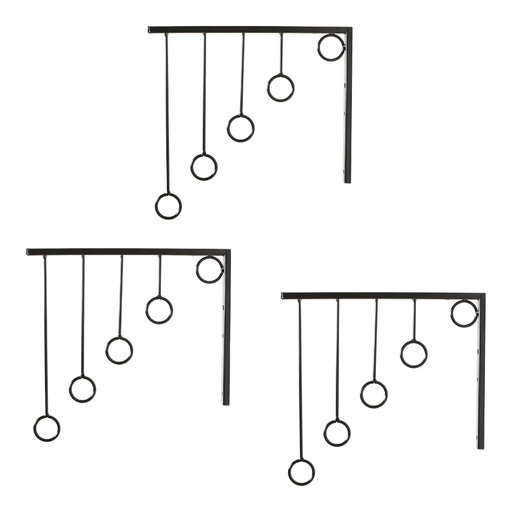
Why this product suits the profile: The three wall-mounted garment racks require no floor space and are ideal for hallways, bedrooms, walk-in wardrobes or a small clothes display.
The vertical arrangement with five descending rings per holder makes clothing items visible. This means you're not being sold on a large wardrobe width when in reality only limited floor space is available.
Set of three holders, each 27.9 cm high, 29.2 cm wide and 2 cm deep; black metal construction. Mounting materials are not included.
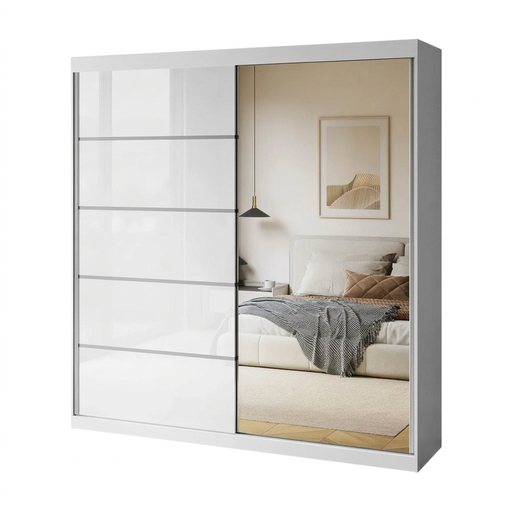
Why this product suits the profile: This model combines a defined internal layout with a sliding door system and a mirrored door. It suits bedrooms where plenty of storage is needed but opening space is limited.
The product data lists both the external dimensions and the nine shelves plus a hanging rail. This makes it easier to plan the storage space than with a purely external view.
Dimensions 215 × 200 × 58 cm, 16 mm laminated chipboard with ABS edges and aluminium running tracks. Assembly is self-assembly; wall anchoring is mandatory.
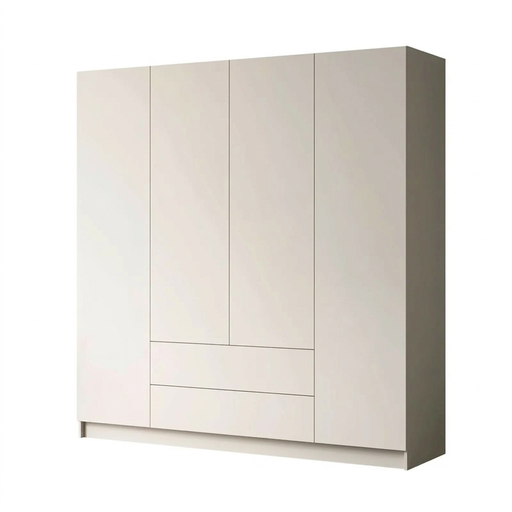
Why this product suits the profile: Four doors, twelve shelves, one hanging rail and two drawers offer organisation distributed across different types of clothing for couples or families.
The layout isn't limited to just a single hanging rail. Compartments and drawers allow separate areas for folded clothes, accessories and hanging textiles.
Dimensions 210 × 200 × 57 cm, cashmere colour tone, push-to-open mechanism and two mirrored doors. The drawers have ball-bearing runners; self-assembly and wall anchoring are required.
We've put together a complete, regularly updated list of products that fully meet these strict selection criteria and the safety regulations in force in the EU.
For tall and wide wardrobes, wall anchoring is a key safety consideration. Fixings must be suitable for your particular wall type, such as concrete, brick or plasterboard. Check for pipes and cables before drilling, and only use appropriate wall plugs and screws. Heavy furniture should always be moved and assembled by two people.
Other practical points:
For a modern white wardrobe, high-gloss finishes are an option, while a wardrobe in cashmere has a more understated look in neutral interiors. What matters isn't just the colour name, but whether the surface, dimensions and internal layout suit your needs.
In front of a hinged door wardrobe, the opening area should be kept completely clear. You also need room to move when getting dressed and for opening drawers. With a sliding door wardrobe, there's no door swing area to worry about, but the running tracks still need to be accessible.
The service life depends on factors including materials, load, assembly and care. Evenly distributing weight across shelves and the hanging rail, a correctly levelled floor surface, and the required wall fixing can all support safe use. A general lifespan cannot be given without specific load and usage data.
For frequently worn jackets, shirts or accessories, a wall-mounted garment rack can be a space-saving addition. However, it doesn't replace a closed wardrobe if you need to protect clothes from dust or store large amounts of folded items. In small boutiques, the visible display can, on the other hand, be deliberately useful.