
Lieferung heute & morgen

Qualitätsgarantie

Willkommens-Angebote freischalten: KOSTENLOSE Lieferung | Bis zu 80 % RABATT | Kostenlose 30-Tage-JoyPlus-Testphase
App herunterladen
An overfilled wardrobe, loose accessories and a lack of space under the bed are common problems in many homes. A wardrobe organiser can help you store clothes, shoes and laundry more neatly. However, not every solution suits every room or purpose. The key factors are dimensions, load capacity, material and how you plan to use it.
Product images often make the storage space look generous. In practice, however, an organiser may be too deep for your wardrobe or too tall for an alcove. Before buying, measure the width, depth and height of the space available. If you’re choosing a portable fabric wardrobe, remember to allow space in front of it so you can open the doors or zips.
A general load capacity tells you little if clothes are spread across several levels. Heavy jumpers, jeans or shoes need sturdier compartments than T-shirts. Check the maximum static load per shelf and look for a separate figure for the clothes rail. Overloading can warp shelves and affect the stability of lightweight designs.
Foldable storage boxes and fabric compartments save space when they’re not in use. But if you’ll be accessing them regularly, sturdy bases, easy-to-reach handles and strong seams matter. A box without a rigid shape can warp if it’s overloaded. For underwear or socks, smaller organisers with compartments are usually more practical than one large, open space.
First, work out how much storage space you have:
A multi-tier wardrobe organiser can help you arrange clothes vertically. Make sure it isn’t so wide that it blocks the existing wardrobe door or drawer.
Non-woven polypropylene or polyester fabrics are lightweight and often foldable. Keep them dry and clean them according to the manufacturer’s instructions. Many fabric boxes can only be wiped with a damp cloth and should then be left to dry completely.
For compartments you use often, look for reinforced edges, sturdy shelves and durable zips. Breathable mesh materials may be suitable for delicate clothing. A laundry and underwear organiser with compartments makes sorting easier, but it doesn’t replace proper fabric care.
Compare the stated capacities for individual compartments and clothes rails. For example, the JOYFURNOS model measuring 45 x 150 x 175 cm is rated for up to 5 kg per shelf and 15 kg on the clothes rail. These are the manufacturer’s static load ratings and should not be exceeded.
For a tall, freestanding fabric wardrobe, the base area matters. The SONGMICS model is supplied with a tip-over restraint for securing it in place. In homes with children, or on uneven floors, a tall organiser shouldn’t be used without suitable fixings. Remove the clothes before moving it.
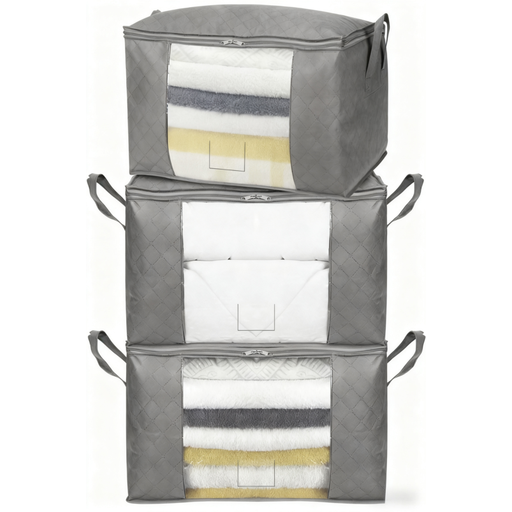
Why it suits this need: This set of three is ideal for seasonal clothes, accessories or light luggage, and takes up very little space when not in use.
The product details specify a foldable design, zips and a load limit of 5 pounds per bag. This makes it easier to distribute the weight.
Three bags with clear windows and carry handles; foldable design for wardrobes, shelves or travel.
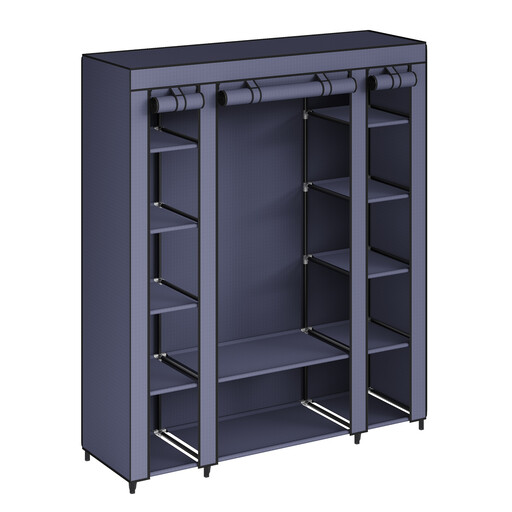
Why it suits this need: This portable fabric wardrobe has 12 shelves, an adjustable clothes rail and a zipped cover.
Its dimensions of 150 x 45 x 175 cm, along with specific load ratings for the shelves and rail, make it easier to plan your space and distribute the weight.
16 mm diameter metal tubes, 12 shelf compartments, a removable or roll-up cover, and stated tip-over protection.
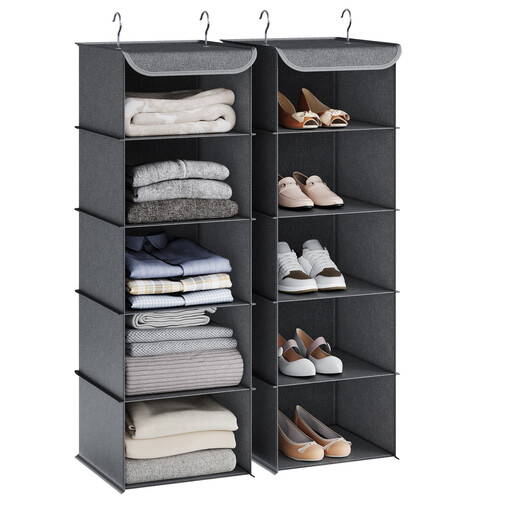
Why it suits this need: These two vertical hanging clothes organisers make use of the space on your clothes rail and are suitable for jumpers, jeans, bags or laundry.
The product details specify a load limit of 2 kg per compartment and 10 kg per organiser. This clear guidance helps you avoid putting heavy items in the wrong place.
Two metal hooks, bamboo inserts and a foldable design; dimensions per organiser: 30 x 30 x 90 cm.
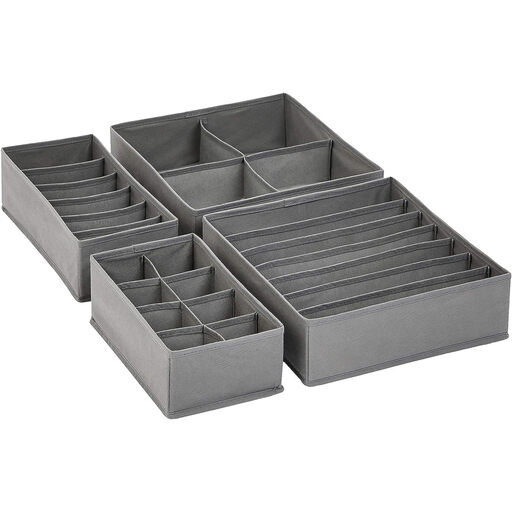
Why it suits this need: Four compact mesh organisers help you organise drawers, wardrobe shelves or luggage for socks, underwear, scarves and ties.
The separate compartments keep small items apart so they don’t get mixed together in a large drawer. That means less time spent rearranging everything.
Mesh material for visibility, a set of four and compact dimensions of around 11 x 30 x 11 cm per unit.
A single drawer organiser won’t solve every storage problem. Depending on your household, you may want to combine several types:
It depends on the available interior space and how many clothes you have. Start by sorting items into categories: hanging clothes, folded textiles, underwear, accessories and seasonal items. Measure the compartments, then choose modules that fit rather than combining several containers of different sizes without a plan.
Its lifespan depends on the material, load, moisture and how often you use it. Don’t overload fabric boxes; store them somewhere dry and clean them according to the manufacturer’s instructions. With a portable fabric wardrobe, distributing the weight evenly helps it keep its shape. Sharp objects can damage non-woven fabric and zips.
Only if you stay within the stated load limit. Foldable designs are often practical for light laundry, T-shirts and accessories. Heavy shoes, books or lots of jeans should only be stored in compartments specifically designed for them. Always check the load capacity per compartment, not just the product’s overall size.