
Lieferung heute & morgen

Qualitätsgarantie

Willkommens-Angebote freischalten: KOSTENLOSE Lieferung | Bis zu 80 % RABATT | Kostenlose 30-Tage-JoyPlus-Testphase
App herunterladen
A wardrobe with plenty of storage should accommodate clothes, shoes and accessories in an organised way without making the room feel unnecessarily cramped. That means colour and appearance are not the only factors to consider. The key considerations are the internal layout, floor space, door system and maximum load.
Many disappointing purchases result from three common marketing traps:
Measure the available wall width, room height and passage width. A 200 cm wardrobe needs not only a 2-metre-wide wall, but also sufficient space for delivery, assembly and wall fixing. A depth of around 57 to 59 cm is provided for clothes hangers in many classic wardrobes. Also check whether skirting boards or radiators increase the distance from the wall.
For smaller bedrooms, a wardrobe with sliding doors can be a practical choice because the doors do not project into the room. With a model featuring hinged doors, you need to allow for the opening area in front of the wardrobe.
Pay attention to the balance between shelves and hanging rails. A hanging rail accommodates shirts, jackets and dresses, while shelves are suitable for T-shirts, jumpers or bed linen. Adjustable shelves make it easier to adapt the storage space to different garments.
A wardrobe with a mirror can provide an additional mirrored surface in the bedroom or hallway. However, the mirror does not replace storage space and should be cleaned carefully with a soft cloth. In households with young children, safety clearances and secure wall fixing are also important.
Laminated chipboard with sealed edges is common in many bedroom furniture pieces. What matters is that the edges are neatly finished and that the construction is suitable for the intended contents. With fabric drawers, you should follow the manufacturer’s stated load capacity. One example from the selection allows a static load of 3 kg per drawer and 50 kg on the top surface.
Large furniture must be secured to the wall to prevent tipping, in accordance with the assembly instructions. As a rule, two people are needed to assemble and transport a large wardrobe. Before buying, check whether the wall is suitable for the supplied anti-tip fitting.
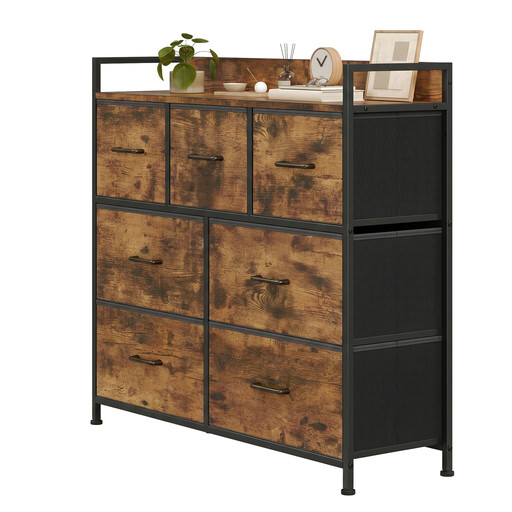
Why this product suits the profile: Measuring 98 × 28.5 × 85 cm, this fabric drawer unit has a relatively shallow depth, making it suitable as an addition to a wardrobe or for smaller rooms. It offers seven drawers for clothes, accessories and laundry.
The drawers are clearly separated and the permitted load of 3 kg per drawer is specified. Heavy items should not be stored in them.
Seven fabric drawers, adjustable feet and a supplied anti-tip kit; the top surface supports a static load of up to 50 kg.
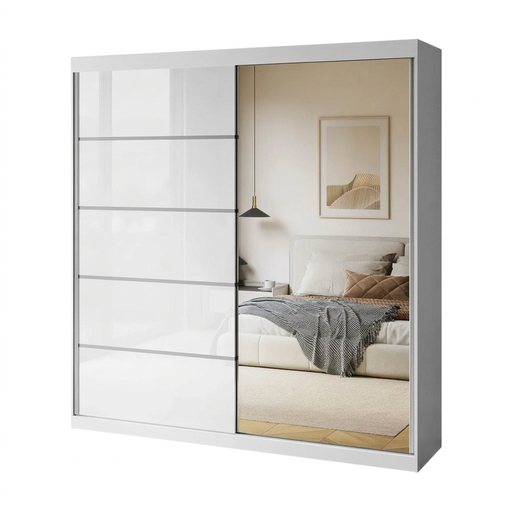
Why this product suits the profile: Measuring 200 cm wide and 215 cm high, this wardrobe is designed for couples or families who need extensive clothes storage. Nine shelves, a hanging rail and a mirrored door organise the interior.
The interior configuration is clearly specified rather than relying solely on a general size description. The sliding-door mechanism saves the swing area in front of the wardrobe.
200 cm width, nine shelves, a hanging rail and a mirrored door; ABS edges and aluminium running rails are specified.
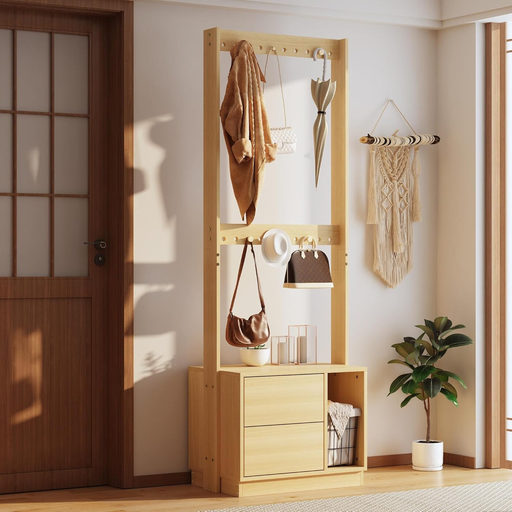
Why this product suits the profile: Measuring 60 × 40 × 175 cm, this open clothes rail fits in hallways, bedrooms or dressing areas. A hook rail, two hanging compartments and two drawers make frequently worn clothes quick to access.
The open design makes it clear how much can actually be hung up. This avoids expecting a compact piece of furniture to replace the storage capacity of a large wardrobe.
Compact footprint, metal frame, two drawers and a hook rail; the stated maximum load is 5 kg.
We have put together a complete, regularly updated list of products that fully meet these strict selection criteria and the safety regulations applicable in the EU.
For clothes hangers positioned at right angles to the back panel, an external depth of around 57 to 60 cm is generally suitable. The usable internal depth is slightly less because of the back panel and doors. Therefore, measure the actual internal dimensions and take skirting boards and the distance from the wall into account.
Sliding doors do not require additional swing space, so they can be practical when floor space is limited. Hinged doors, on the other hand, often provide more complete access to the relevant compartment. The right choice therefore depends on the room depth, accessibility and how you intend to use the wardrobe.
For the large models mentioned, an assembly time of around two to three hours with two people is stated. The actual time required depends on the room, tools, number of components and experience. The anti-tip fitting should be installed after assembly; it is an important part of using the wardrobe safely.