
Lieferung heute & morgen

Qualitätsgarantie

Willkommens-Angebote freischalten: KOSTENLOSE Lieferung | Bis zu 80 % RABATT | Kostenlose 30-Tage-JoyPlus-Testphase
App herunterladen
By Joybuy Product Recommendation Officer, July 22, 2026
A lack of clothes storage is a common problem, especially in rental apartments, dorms, or for those who move frequently. A bulky wardrobe is often impractical, difficult to transport, and may not fit into your next space. Flexible wardrobe systems offer a practical alternative.
This guide introduces various types of wardrobe solutions and explains their specific features. Our goal is to provide an objective basis for your purchasing decision, helping you find the perfect solution for your needs and space.
Before you decide on a model, several objective criteria should be considered. These will help you find a solution that is both functional and durable.
The stability of a wardrobe system depends directly on its materials. Systems made of metal tubes, such as steel, generally offer a higher load capacity than plastic ones. Pay attention to the tube diameter—thicker tubes (e.g., 16 mm) are often more robust. For a fabric wardrobe, the quality of the non-woven fabric, indicated in grams per square meter (g/m?), is an indicator of its tear resistance. A value of 120 g/m? is considered durable. Always check the manufacturer's specified maximum static load capacity for clothes rails and shelves.
Different systems are advantageous depending on your living situation.
Measure your available space carefully before making a decision. Compare the product dimensions (length x width x height) with your room. Consider what type of storage you need. An open wardrobe or a clothes rack offers quick access, while a closed fabric wardrobe protects clothes from dust. Systems with a combination of a clothes rail and multiple shelves allow for organized storage of both hanging and folded clothes.
Here is a selection of different wardrobe systems, each suited for various applications due to their specific features.
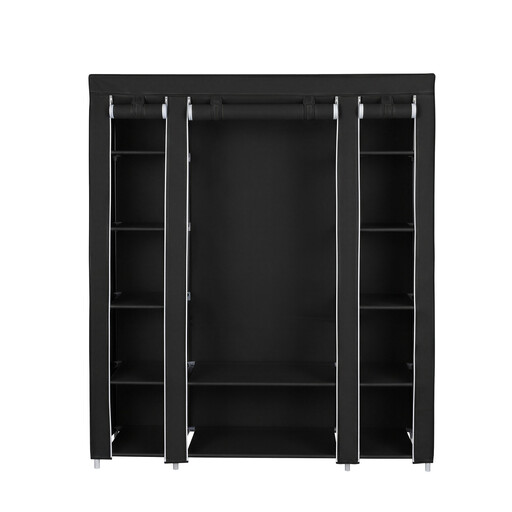
Why it stands out: This model combines the function of a wardrobe with the flexibility of a lightweight, interlocking system. With a width of 150 cm, it offers plenty of space and fully protects clothes from dust with a zippered cover.
Advantages:
Who is it for? For those looking for a complete but temporary wardrobe solution. Ideal for a first apartment, a dorm room, or for seasonal storage of clothes in the basement or attic.
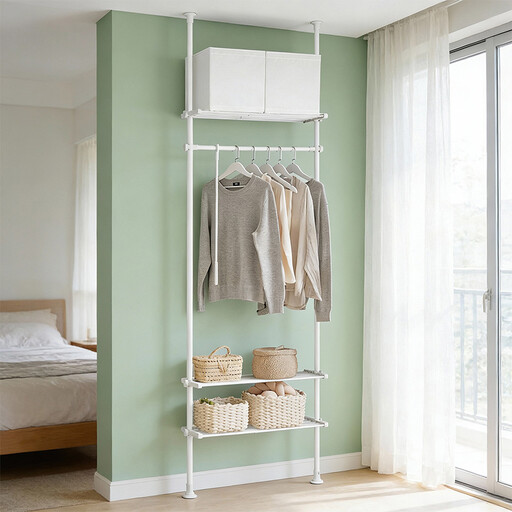
Why it stands out: This drill-free wardrobe system makes optimal use of vertical space by being tension-mounted between the floor and ceiling. Its high adjustability in height and width makes it a solution for awkward spaces like niches or rooms with sloped ceilings.
Advantages:
Who is it for? For renters who need a stable and adaptable storage solution without damaging walls or ceilings. Especially practical for utilizing unused corners or narrow wall sections.

Why it stands out: This garment rack on wheels stands out for its high mobility and simple functionality. As an open wardrobe, it offers quick access to clothes and can be moved effortlessly thanks to its casters.
Advantages:
Who is it for? For those who need a flexible addition to their existing wardrobe, frequently change their decor, or are looking for a temporary solution for a guest room. It is also very practical as a rolling wardrobe in a hallway or dressing area.
The products featured cover a wide range of needs. However, if you are looking for a more specialized solution, such as one for keeping trousers wrinkle-free and neatly organized, other systems might be more suitable.
? Discover our selection of freestanding trouser racks here.
1. How much weight can a garment rack hold? The load capacity varies greatly depending on the model and material. Simple models often support around 15 kg, while more robust steel constructions, like the 5five garment rack, can be rated for up to 30 kg. It is important to check the manufacturer's specifications for maximum static load capacity to avoid overloading.
2. How do I assemble a drill-free wardrobe system? A telescopic wardrobe system is tension-mounted. The vertical poles are adjustable in length and are wedged firmly between the floor and ceiling. Rubberized end caps on the poles protect surfaces and ensure a secure hold without the need for screws or drilling.
3. What is the advantage of a fabric wardrobe over an open clothes rack? The main advantage of a fabric wardrobe is the protection it offers your clothes. The fabric cover keeps out dust, dirt, and light exposure, which is particularly beneficial for long-term storage of seasonal or rarely worn items. An open clothes rack, on the other hand, offers quicker access and better air circulation.