
Lieferung heute & morgen

Qualitätsgarantie

Willkommens-Angebote freischalten: KOSTENLOSE Lieferung | Bis zu 80 % RABATT | Kostenlose 30-Tage-JoyPlus-Testphase
App herunterladen
An overfilled wardrobe, shoes scattered around the entrance and accessories stored in different boxes: especially in smaller homes, choosing the right storage solution determines whether rooms stay tidy in the long term. However, colour and appearance are not the only things to consider when buying. Many products look spacious at first glance, but important limitations only become apparent during assembly or everyday use.
1. Confusing external dimensions with usable storage space.
A wardrobe may be wide and tall, while thick side panels, poorly positioned shelves or a low hanging rail leave little room for clothing inside. As well as checking the width, height and depth, look at the number of shelves, drawers and hanging rails.
2. Treating mirrors and shoe storage as purely decorative.
A large wardrobe with a mirror or a shoe cabinet with a mirror can combine several useful functions. What matters is whether the mirror is easy to access, whether the doors open wide enough and whether the shoe compartments fit your shoe size. With pull-out shoe compartments, the stated capacity often depends on the particular shoe model.
3. Underestimating assembly and safety requirements.
Large wardrobes are often delivered flat-packed and need to be assembled at home. Tall furniture should be secured to the wall to prevent it from tipping over. Also check the package weight, how many people are needed for assembly and whether multiple packages could arrive on different days.
Measure the entire footprint, taking skirting boards, radiators, doors and potential walkways into account. A 200 cm wardrobe needs more than 200 cm of wall width: you also need enough space to open the doors. With hinged doors, the area in front of the wardrobe should remain clear.
For small bedrooms, narrow or tall furniture can be a practical choice. A narrow tall cabinet makes use of the room’s height without taking up much floor space. In hallways, check the depth particularly carefully to ensure that doors and passageways are not blocked.
The internal layout needs to suit what you plan to store:
With organisers, check the maximum total load and the load capacity of each compartment. An organiser with bamboo inserts and metal hooks may retain its shape better than a simple fabric model, but it cannot replace a load-bearing wardrobe structure.
Laminated chipboard with ABS edging is widely used for wardrobe furniture. Sealed edges reduce exposed cut surfaces and make cleaning easier. Correct positioning on a level surface, properly adjusted doors and secure wall mounting in accordance with the assembly instructions remain essential.
Push-to-open doors do away with visible handles. This can give the front a cleaner appearance, but it also means that doors and drawers open when pressed. With mirrors, clean carefully using a soft cloth and a suitable glass cleaner. Keep sharp objects away from the mirrored surface.
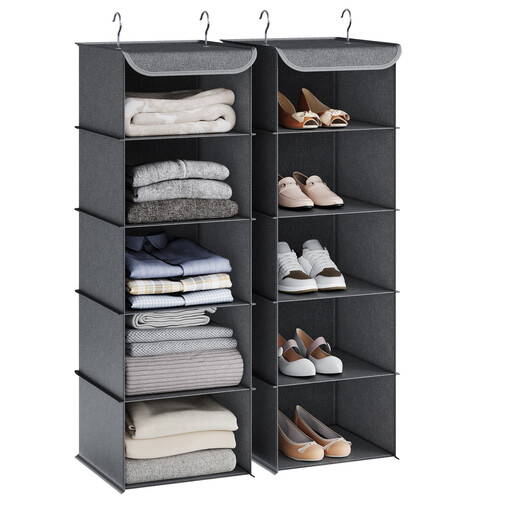
Why this product suits this profile: This two-piece set complements existing wardrobes without requiring another piece of furniture. The organisers unfold and hang from existing clothes rails.
The dimensions of 30 x 30 x 90 cm and the stated load capacity of 2 kg per compartment and 10 kg per organiser make the usage limits clear.
Foldable construction, metal hooks, bamboo inserts and two organisers included.
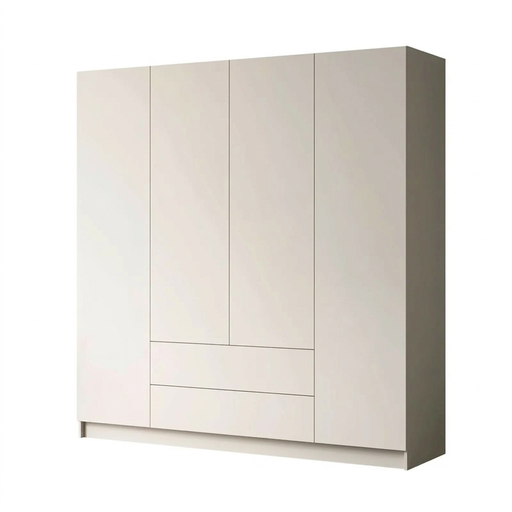
Why this product suits this profile: This wardrobe is designed for households with a large volume of clothing who want a fixed internal layout, closed fronts and two mirrored surfaces.
The interior fittings are clearly specified: 12 shelves, one hanging rail and two drawers with ball-bearing runners. Wall anchoring is required.
200 cm wide, 210 cm high, 57 cm deep, 16 mm laminated chipboard with ABS edging and a push-to-open mechanism.
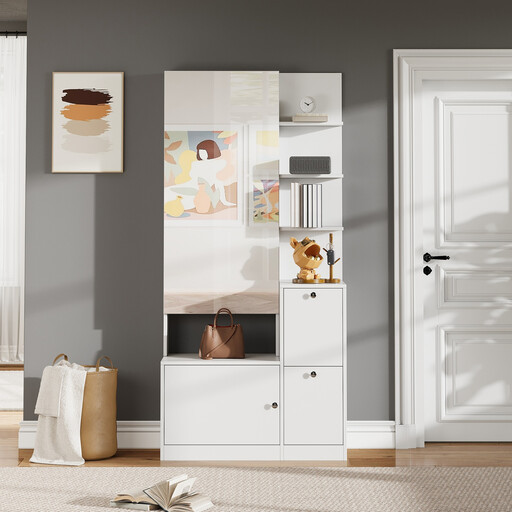
Why this product suits this profile: This hallway cabinet with shoe storage combines closed compartments, open shelves, pull-out shoe compartments and an integrated mirror in a single piece of furniture.
The depth of 40 cm is clearly specified. The shoe capacity is not given as a blanket promise either: according to the product information, it depends on shoe size and model.
85 x 40 x 180 cm, five open shelves, two pull-out shoe cabinets with two levels each and an integrated mirror.
Not every household needs a single large wardrobe. A combination of a main piece of furniture and complementary storage is often more practical:
Before buying, sort through the contents roughly. For example, count clothes on hangers, folded garments, pairs of shoes and bags. This will help you decide whether a piece of furniture with plenty of shelves or a combination with a hanging rail would be more suitable.
Discover more suitable models for modular organisation in the wardrobe shelving category.
We have put together a complete, regularly updated list of products that fully meet these strict selection criteria and the safety regulations applicable in the EU.
With hinged doors, there should be enough space in front of the furniture to open the doors and get dressed. Measure the door movement, including the handle area, and allow for walkways. In very tight layouts, sliding doors or narrow tall cabinets may be the more practical solution.
Their service life depends on the material, load, assembly and care. Staying within the stated load limits, positioning the furniture on a level surface and using the recommended wall mounting will reduce avoidable strain. Fabric organisers should not be overloaded and should be protected from sharp-edged objects.
A wardrobe does not incur any ongoing electricity costs during normal use. However, you may need to pay for assembly, additional fixing materials or supplementary organisers. If your delivery arrives in multiple packages, also check that all parts are present before starting assembly.