If you have no room to dry clothes
If you wash aprons at home and have no room for a second appliance or a suitable clothes airer, a washer-dryer could be an option – provided the care label says the aprons can be tumble-dried.


If you have no room for a second appliance or a suitable place to dry your washing, a washer-dryer could be a good option for aprons whose care labels say they can be tumble-dried. Before choosing one, check the space available, the care instructions and the lower load limit for a complete wash-and-dry cycle. If you dry items frequently, the energy and water consumption of the combined cycle also matters: the Verbraucherzentrale notes that washer-dryers use more electricity and water than separate appliances.
If you wash aprons at home and have no room for a second appliance or a suitable clothes airer, a washer-dryer could be an option – provided the care label says the aprons can be tumble-dried.
If you want to wash and dry your aprons in one uninterrupted cycle, check the stated capacity for the combined programme. It may be lower than the washing capacity.
If your aprons have different washing or drying instructions, make sure the programmes and methods you choose match their care labels. GINETEX Germany explains that the number inside the wash tub symbol indicates the maximum permitted washing temperature.
A good fit if: you only have space for one appliance and virtually no room to dry clothes, and your aprons are suitable for tumble-drying.
The trade-off: The capacity for a combined cycle may be lower than the washing capacity. If you use it frequently, compare the consumption figures for complete cycles.
A good fit if: you want to tumble-dry regularly and have enough space for the appliance and its dimensions.
The trade-off: Check the figures for the specific model and make sure its drying programmes are suitable for your aprons' care labels.
A good fit if: you have a suitable place to dry your washing or your aprons must not be tumble-dried.
The trade-off: Your aprons take up space while they air-dry, and you need to remove them from the washing machine after the wash cycle.
A good fit if: you have room for both appliances and regularly need to dry larger loads.
The trade-off: A separate setup takes up more space. The appliances, connections and room to use them all need to fit in the space available.
| Priority | What to check before buying | Who is this important to? |
|---|---|---|
| Appliance footprint and drying options | Appliance dimensions and installation setup, including connections and clearance for use; also check whether there is somewhere to air-dry clothes. | If I can't fit a second appliance or a suitable place to dry clothes, the single-appliance setup needs to fit properly. Around 33% of consumers put limited space first. |
| Washing and drying aprons in one cycle | The weight of a typical load and the capacity limit for a complete wash-and-dry cycle. | If I want to finish my usual load of aprons without taking anything out partway through, I need to follow the lower combined-cycle capacity. Around 27% of consumers prioritise completing a load in one cycle. |
| Care and cleanliness | The washing temperature and tumble-drying symbol on each apron; if they are used in professional food handling, also check workplace requirements. | If my aprons have different care instructions, I want to choose a suitable method for each one. Around 20% of consumers put fabric care first. |
| Consumption if you dry clothes frequently | Electricity and water consumption for combined cycles on a like-for-like label basis, as well as how often you use the appliance. | If I tumble-dry frequently, I compare figures for the complete cycle rather than just the washing figures. Around 20% of consumers prioritise running costs. |
The maximum washing load is not necessarily the amount you can dry afterwards without interrupting the cycle.
If you want to finish a load of aprons without transferring them elsewhere, plan it according to the capacity limit for the combined wash-and-dry cycle.
If the load is too large, you may need to run another drying cycle.
The EU energy label shows separate figures for washing only and for the complete wash-and-dry cycle.
Compare the figures for combined cycles on the same label basis and consider how often you actually dry clothes. The Verbraucherzentrale notes that washer-dryers use more electricity and water than separate appliances.
If you frequently use a combined cycle, it may use more electricity and water than you might expect from looking at the washing figures alone.
An apron being machine-washable does not automatically mean it can be tumble-dried. If it is used professionally, workplace hygiene requirements may also apply.
Check the care label on each item. For aprons used in food handling, also consider workplace procedures before choosing a programme.
The wrong treatment can damage fabrics. In a professional setting, unsuitable procedures may also fail to meet hygiene requirements.
The G3 HWD80-BP14637T is an example of a model with a stated depth of 507 mm. Haier Germany lists a washing capacity of 8 kg and a combined capacity of 5 kg.
The W4WR7096YB is an example of a model with a washing capacity of 9 kg and a drying capacity of 6 kg. LG Germany lists Steam and TurboWash.
The LWR9W81609 is an example of a heat pump model. AEG states a capacity of 10 kg for washing and 6 kg for combined use.
The Serie 8 washer-dryer WNC244070 is an example of a model in the range. Bosch Home Appliances Germany lists dimensions of 848 × 598 × 622 mm (H × W × D).
The iQ700 WN54C2A40 is an example of a model in the range. Siemens Home Appliances lists a washing capacity of 10.5 kg and a combined wash-and-dry capacity of 6 kg.
The Joybuy models below are washer-dryers for anyone who wants to wash and dry aprons in one appliance. Before buying, check that the dimensions and combined load limit suit your space and usual load of aprons. The care label will tell you whether tumble-drying is suitable.
 No image available
The separate washing and drying capacities make it easier to plan a load of aprons for a combined cycle.
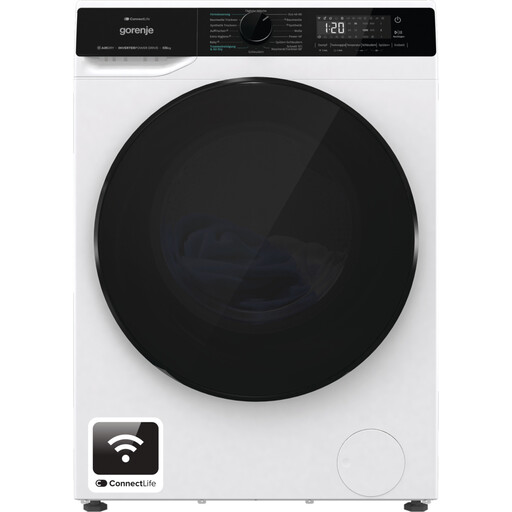 No image available
This model has different stated capacities for washing and for combined washing and drying, so follow the combined-cycle limit when loading aprons.
The product title lists 8 kg and 54 litres; the product details give a capacity of 5 kg for the combined wash-and-dry cycle.
 No image available
The stated capacities and heat pump are worth considering if you are looking for a washer-dryer with separate washing and drying figures.
The product description lists a Dual Inverter heat pump.
 No image available
The capacity figures distinguish between the washing load and the drying load. If you want to complete both in one cycle, bear the drying limit in mind.
The product title lists 1,400 rpm, plus Wi-Fi and voice control.
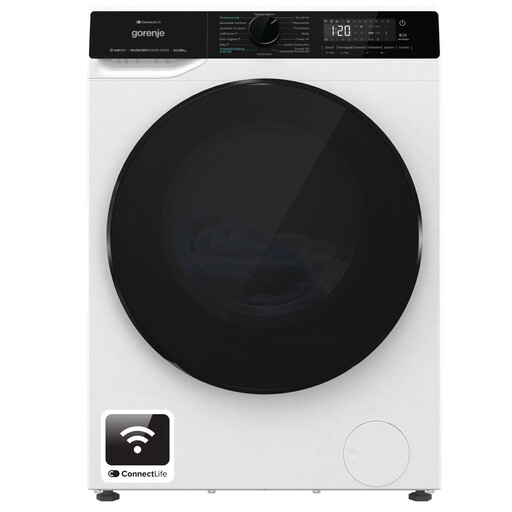 No image available
This washer-dryer may suit you if you want to wash and dry in one appliance. Before choosing it, check which stated capacity applies to the cycle you plan to use.
The product title lists 10.5 kg, 54 litres and 1,400 rpm.
No. The washing temperature and suitability for tumble-drying are separate details on the care label. If the tumble-drying symbol says not to tumble-dry, a combined wash-and-dry cycle is not suitable for that apron. Follow the care symbols from GINETEX Germany.
Compare the dimensions of the specific appliance with the space available, allowing for connections and enough clearance to use it. The published dimensions do not necessarily include all the space needed for installation.
The key figure is the capacity limit for a complete wash-and-dry cycle, not just the washing capacity. How many aprons will fit also depends on the weight of the particular load.
Compare electricity and water figures for the complete combined cycle on a like-for-like label basis, and take your usage into account. The Verbraucherzentrale notes that washer-dryers use more electricity and water than separate appliances.
Food businesses must comply with the relevant requirements of the EU Food Hygiene Regulation. The regulation excludes private domestic preparation, handling or storage of food for private consumption from its scope. The German Federal Institute for Risk Assessment recommends clean workwear for communal catering, kept separate from personal clothing. This does not establish a universal washing temperature for every apron or require you to choose a particular appliance.