Curtains with delicate care requirements
If you’re washing delicate curtains, check the washing and drying symbols separately. A delicate cycle doesn’t mean you can tumble-dry them; Bosch Home Appliances explains what the drying symbols mean.


A washer-dryer can help when drying space is limited, but only if the curtain care label allows tumble drying under the specified conditions. A delicate cycle doesn’t override that instruction, as Bosch Home Appliances explains. If tumble drying is prohibited, the appliance can still wash your curtains, but it won’t solve the drying problem – you’ll need a suitable place to hang them up while damp. For curtains that are suitable for tumble drying, check the lower drying capacity and the consumption figures for the full wash-and-dry cycle. The Verbraucherzentrale notes that washer-dryers use more than separate appliances.
If you’re washing delicate curtains, check the washing and drying symbols separately. A delicate cycle doesn’t mean you can tumble-dry them; Bosch Home Appliances explains what the drying symbols mean.
A washer-dryer can save the space needed for a separate tumble dryer. For curtains, though, this only helps if their care label allows machine drying. Otherwise, you’ll still need somewhere to hang them up while damp.
If you have several curtain panels, consider the washing and drying capacities separately, and check the load limit for the programme you plan to use. The stated washing capacity doesn’t tell you how much you can dry afterwards.
Best when: The curtain care label allows tumble drying, you have very little drying space, and you stay within the load and programme limits.
The trade-off: One appliance takes up less floor space than separate machines. However, the Verbraucherzentrale notes that washer-dryers use more than separate appliances.
Best when: Machine washing is allowed, but the care label rules out tumble drying and you have a suitable place to hang the curtains.
The trade-off: The drying function won’t solve the curtain-drying problem. If you dry them indoors, it’s important to ventilate the room regularly, as the Verbraucherzentrale explains.
Best when: You have enough space for the appliances and to dry laundry, or regularly wash larger loads of curtains that are suitable for tumble drying.
The trade-off: Separate appliances take up more space, but you can choose each one to suit your washing and drying needs.
To compare running costs, check the figures for washing and wash-and-dry operation on the same basis. The Verbraucherzentrale and the European Commission list consumption figures separately for each operating mode.
| Priority | What to check when buying | Who is it particularly relevant to? |
|---|---|---|
| Suitability for the care instructions | Check the washing and drying symbols on the specific curtains, as well as the programme and load limits. | If I’m washing delicate curtains, I want to make sure the care label and programme are a suitable match. Around 33 % of consumers consider care suitability a top priority. |
| Drying without needing extra space | Check the appliance dimensions and access route against the available space; if tumble drying is prohibited, allow room to hang the curtains up while damp. | If I don’t have room for an airer or a second appliance, being able to tumble-dry the curtains is especially important. Around 27 % of consumers prioritise a lack of drying space. |
| Size of the curtain load | Compare washing and drying capacities separately, and check the load limit for the programme you intend to use. | If I have several or bulky curtain panels, I want to know whether they’ll fit in the drum and can be dried afterwards. Around 20 % of consumers prioritise load size. |
| Running costs | Compare electricity and water figures for the same operating mode, and consider how often you’ll actually use the drying function. | If I want to keep an eye on ongoing costs, I’ll look beyond the washing cycle alone. Around 20 % of consumers put running costs first. |
Washing and drying symbols answer different questions. A care or delicate programme on the appliance doesn’t override a no-tumble-drying symbol on the label.
Check the care label on the specific curtains before buying and before every drying cycle. If tumble drying is prohibited, make sure you have a suitable place to hang them up while damp.
The stated drying capacity may be lower than the washing capacity, and an individual programme may also have its own load limit.
Compare washing and drying capacities separately. For delicate fabrics, follow the load limit for the programme you actually plan to use.
If you can’t dry all your curtains together, you may need to run extra smaller loads and allow more time.
The energy consumption of a wash cycle doesn’t tell you how much the full wash-and-dry cycle uses. The European Commission lists the operating modes separately.
Compare the figures for the same operating mode on the EU energy label, and consider how often you’ll actually use the drying function.
The L9WEF80690 is a heat pump option for comparing specific washing and drying capacities.
The models listed offer different features: the HPWD096C has a heat pump, while the W4WR7096YB includes fabric-care functions.
The WNC254A90 offers documented delicates options, with separate capacity figures for washing and wash-and-dry operation.
The WN44G243 is an example of a model with programmes such as Delicates/Silk and Gentle Dry.
The WTR860WPM from the WT1 range is a washer-dryer with documented dispensing and steam functions.
These appliances are worth considering for washing washable curtains when drying space is limited. Whether you can then machine-dry the curtains depends on their care label; if tumble drying is prohibited, you’ll still need to hang them up while damp.
 No image available
The separate capacities help you plan washing and drying loads independently. Machine drying is only suitable if the curtain care label allows it.
 No image available
The stated washing and drying capacities make it easy to compare the load limits for each stage separately. They don’t mean the curtains are suitable for tumble drying.
 No image available
The separate capacity figures make it easier to plan washing and drying loads. Whether you can dry curtains in the machine still depends on their care label.
 No image available
The listed Delicates programme may be useful for washing curtains, but whether they can be machine-dried still depends on their care label.
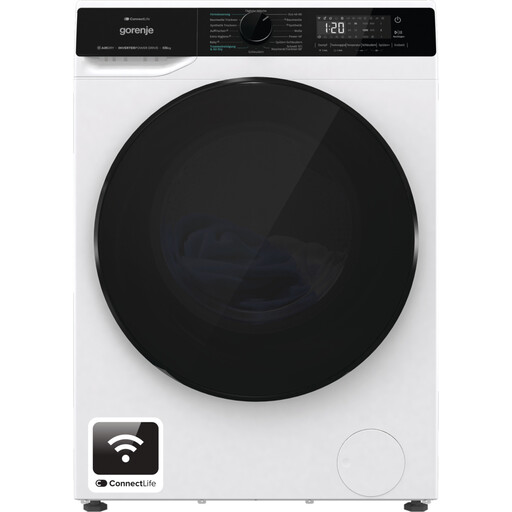 No image available
The separate figures for washing and wash-and-dry loads make it easier to compare both operating modes; they don’t automatically mean the appliance is suitable for curtains.
Only if the drying symbol on the specific curtains allows tumble drying under the specified conditions. The washing symbol alone isn’t enough, and a delicate cycle on the appliance doesn’t change the care label.
Check the care label and remove any detachable rings, gliders or weighting pieces. Bosch Home Appliances also recommends using a laundry bag for machine-washable curtains and making sure there’s enough room in the drum.
Compare washing and drying capacities separately, and also check the load limit for the programme you choose. The washing capacity isn’t automatically the amount you can dry.
Compare the figures for the full wash-and-dry cycle with those for the same operating mode on other appliances, rather than looking at the wash cycle alone. The European Commission lists energy use per 100 cycles and water use per stated cycle.
Only machine-wash them if their care label allows it, then hang them up to dry in a suitable place while damp. If you’re drying them indoors, it’s important to ventilate the room regularly; the Verbraucherzentrale highlights the importance of ventilation when dealing with moisture.