Families with several bedding loads
If you wash several bedding items, check how much can actually be dried in one cycle. The separate load limits for washing and wash-and-dry cycles are key.


A washer-dryer can suit families when there’s little room for separate appliances or an airer, and its smaller drying capacity works for your routine. For a continuous wash-and-dry cycle, it’s the drying programme limit that matters, not just the larger washing capacity. If you regularly wash large loads of bedding and have enough space, separate appliances are another option. The Verbraucherzentrale (German consumer advice centre) notes that washer-dryers can use more electricity and water than separate appliances.
If you wash several bedding items, check how much can actually be dried in one cycle. The separate load limits for washing and wash-and-dry cycles are key.
An appliance with both washing and drying functions could be a good fit if there’s little room for a separate tumble dryer or airer, and you can plan around smaller drying loads.
If you frequently tumble-dry your bedding, consider the energy use and duration of a complete wash-and-dry cycle. When you run several loads one after another, the drum remains occupied while drying.
Washer-dryers, air-drying and separate appliances differ mainly in how much space, time and drying capacity you’ll need in your day-to-day routine.
A good fit if: Space is limited and the dry bedding load stays within the limit for the selected drying programme.
The trade-off: With a continuous cycle, the smaller drying capacity limits the load. AEG Support recommends staying within the drying programme limit.
A good fit if: You only need to tumble-dry occasionally and have a suitable place to dry your bedding.
The trade-off: After washing, you’ll need space and time for your bedding to dry.
A good fit if: You regularly have several large bedding loads and enough space for two appliances.
The trade-off: The Verbraucherzentrale considers separate appliances more energy- and water-efficient than washer-dryers, but they do take up more space.
| Buying consideration | What to look for | Who should pay particular attention |
|---|---|---|
| Drying capacity | Weigh a typical dry bedding load and compare it with the washing, wash-and-dry and programme-specific load limits. | If I want to dry as much bedding as possible in one continuous cycle, the lower drying limit is crucial; around 28% of consumers put the size of the load that can be dried in one go first. |
| Appliance and drying space | Check the appliance dimensions, door opening and installation plan against the available space and connections. | If there’s little room for a second tumble dryer or an airer, a solution that fits within the footprint of one appliance is especially valuable; around 22% of consumers prioritise the space available. |
| Energy use in operation | Compare the EU label figures for washing alone and the complete wash-and-dry cycle separately. | If I tumble-dry frequently, I want to understand the energy use of a complete cycle; around 22% of consumers say running costs are their top buying priority. |
| Time until the next load | Check the duration of the complete cycle for your chosen programme, and don’t assume quick-programme times apply to full bedding loads. | If I want to finish several bedding loads one after another, I check how long the drum will be occupied; around 17% of consumers put throughput first. |
| Fabric care | Check care labels, permitted drying methods and the guidance for your chosen programme. | If I want to make sure the wash and dry programmes are suitable for my bedding, care instructions come first; around 11% of consumers say fabric care is their top buying priority. |
A washer-dryer may be able to wash more laundry than it can dry in a combined wash-and-dry cycle. For example, the Bosch WNG24443 is listed as having a 10.5 kg capacity for washing alone and 6 kg for washing and drying.
Compare your dry bedding load with the limit for the selected drying programme and the appliance’s stated capacity for a combined cycle.
If you need to split the load, you may need an additional drying cycle, keeping the drum occupied for longer.
The energy label distinguishes between washing alone and a complete wash-and-dry cycle. A figure for washing alone therefore doesn’t show how much energy is used if you regularly tumble-dry your laundry.
For the way you’ll mainly use the appliance, compare the relevant electricity and water figures on a like-for-like basis.
A time given for a smaller load doesn’t necessarily reflect how long a full cotton bedding load will take. With a washer-dryer, the drum remains occupied during drying.
Check the programme table and the duration of the complete cycle for the load you actually plan to wash.
If several loads need to go through the same drum one after another, you may have to wait longer for the next finished load.
According to AEG, the LWR7S656050 has a 10.5 kg washing capacity and a 6.0 kg drying capacity. This makes it useful for comparing larger wash loads with the lower limit for combined cycles.
According to LG, the W4WR7096YB is a washer-dryer with a 9 kg washing capacity and a 6 kg wash-and-dry capacity; cotton is listed as a programme.
According to Bosch, the Series 6 washer-dryer WNG24443 has a capacity of 10.5 kg for washing alone and 6 kg for washing and drying.
According to Samsung, the WD90DG5G34BEEG washer-dryer has a 9 kg washing capacity, a 5 kg drying capacity and a stated appliance depth of 480 mm.
The selection includes a WashTower with a washing machine and heat-pump tumble dryer, as well as washer-dryers. Compare the appliance type and stated washing and drying capacities with your available space and typical bedding load.
 No image available
For households looking to combine a washing machine and heat-pump tumble dryer within the footprint of one appliance.
12 kg washing capacity and 10 kg drying capacity; AI DD and TurboWash 360°.
 No image available
For households looking to compare a front-loading appliance with separately stated washing and drying capacities.
12 kg washing capacity, 10 kg drying capacity and Dual Inverter Heat-Pump.
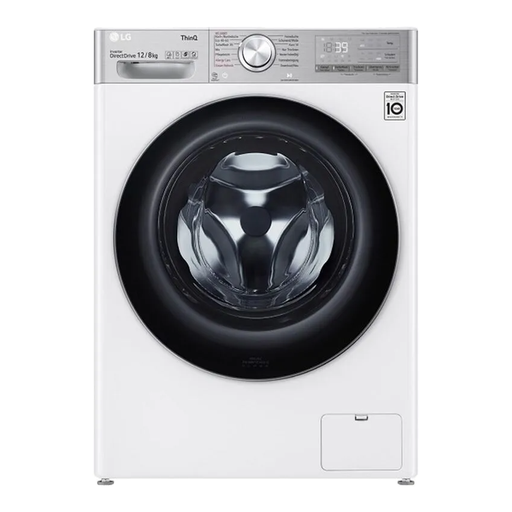 No image available
For households looking to consider an LG washer-dryer with AI DD and a Reload function.
The product name specifies the 12 kg version in white.
Only if the load is also within the limit for the selected drying programme. For continuous cycles, AEG Support recommends sticking to the permitted amount of dry laundry for the drying programme.
If you regularly tumble-dry your laundry, compare the complete wash-and-dry cycle. If you mostly air-dry, the figure for washing alone is relevant. The EU energy label lists these figures separately.
Check the dimensions of the exact appliance and the route it will take into your home against the space available. Check the installation plan for the water supply, drainage and electricity, and read the model’s safety and installation instructions.
No, not as a rule. The Umweltbundesamt (German Environment Agency) notes that high temperatures are often unnecessary for everyday cleaning. Follow the care label; if you have specific hygiene concerns, such as those relating to an infectious illness, it may be sensible to seek medical advice.
Household washer-dryers are covered by the EU energy label. According to Your Europe, the label must also be visible online where the product is sold; compare the separate figures for washing and washing and drying.