Who is this guide for?

Households that often wash small loads

If you often wash just a small amount of laundry at a time, check whether the programmes on the model you’re considering are suitable for each load. AEG describes load adjustment on certain models, while LG lists a half-load option for the W4WR7096YB.

Households short on space that wash bedding

If you need to fit washing and occasional drying into a small space, check the separate wash and dry capacities, as well as the dimensions of the specific appliance. GINETEX explains the care symbols that set limits on the washing temperature and drying method for each textile.

Households that often need to tumble-dry laundry

If you regularly use a tumble dryer, compare the full wash-and-dry cycle with a washing-only cycle, and consider air-drying or buying two separate appliances. The Verbraucherzentrale highlights that washer-dryers use more electricity and water than separate appliances.

What should you look for when washing small loads?

Criteria What to check before buying Who is it important to?
Small loads Check the load adjustment options and the minimum or maximum load for the specific wash programme; don’t assume a quick programme is automatically suitable for bedding. If you often wash small amounts of laundry, you’ll want to use a suitable programme without assuming that a marketing claim means it’s right for your load. This would be a priority for around 28% of consumers.
Cotton bedding Check the care label and the actual load size against the separate wash and dry capacities. If you may want to tumble-dry bedding straight after washing, the care label must allow it and the load must be suitable for the programme. Around 28% of consumers would have this as their main priority.
Space and drying Compare the appliance dimensions, drying capacity and programme duration with the space available for air-drying or for two separate appliances. If you want to tumble-dry laundry but have limited space, the combination of appliance dimensions and drying process matters. This requirement would apply to around 22% of consumers.
Running costs Compare the figures for the washing cycle and the full wash-and-dry cycle separately; the European Commission says the energy label includes information such as energy and water consumption. If you wash and dry frequently, you’ll want to compare the figures for the type of use that matters to you. Around 22% of consumers would have running costs as their main priority.

Common washer-dryer buying mistakes

  • Comparing only the washing capacity

    For the models considered here, the stated drying capacity is lower than the washing capacity. So a load that fits in the washing cycle won’t necessarily fit in the tumble-drying cycle that follows.

    Before planning a continuous wash-and-dry cycle, compare the actual bedding load with the drying limit for the programme you’ve chosen.

    An oversized drying load may mean running another drying cycle or finding a separate place to dry your laundry.

  • Confusing the washing figure with the consumption of a combined cycle

    Washing on its own and washing followed by drying are two different types of use. The Verbraucherzentrale notes that washer-dryers can use more electricity and water than two separate appliances.

    Compare like-for-like cycle types, and factor in how often you’ll use the appliance and your energy and water tariffs when working out the costs.

  • Assuming a quick programme is a one-size-fits-all solution for bedding

    Quick programmes have their own load and fabric limits. Care symbols can also restrict the washing temperature and drying method.

    Check the programme table and care label before putting cotton bedding through a quick or drying programme.

Brands and model ranges to consider

AEG

The 9000 series includes the L9WEF80690 and LWR9W81609 models described here, both featuring heat-pump drying.

  • AEG says that ProSense adjusts the time and consumption to suit each load. The product data sheet for the LWR9W81609 lists a 10 kg washing capacity, a 6 kg drying capacity and 206 kWh per 100 complete standard cycles.
  • Standardised product figures don’t show how much energy a specific small bedding load will use.

LG

The W4WR7096YB is an example of a model with a 9 kg washing capacity and a 6 kg drying capacity.

  • LG lists a half-load option for this model.
  • This option doesn’t automatically mean that a particular programme is suitable for your bedding load. Check the programme details and care label to make sure.

Bosch

The WNA14441 is listed with a 9 kg washing capacity and a 5 kg combined wash-and-dry capacity.

  • Bosch lists features for this model including AquaStop, Auto Dry and a programme for small wash-and-dry loads.
  • An advertised short programme time doesn’t prove that the programme is suitable for a particular bedding load. The drying capacity is lower than the washing capacity.

Miele

The WTD163 WCS from the WT1 range is listed with an 8 kg washing capacity and a 5 kg drying capacity.

  • Miele lists PerfectCare and CapDosing for this model.
  • Check any optional installation services and their terms separately before placing your order.

Joybuy products for washing and drying

The products below include washer-dryers as well as separate washing machines and tumble dryers. Check whether you’re looking for one shared drum or two separate appliances.

LG WT1210EGF WashTower, washing machine and heat-pump tumble dryer

LG WT1210EGF WashTower, 12 kg/10 kg

This set combines a separate washing machine and tumble dryer in one WashTower unit, making it an option if you want two appliances rather than a single shared drum.

The product name lists a 12 kg washing capacity, a 10 kg drying capacity and a heat-pump tumble dryer.

View at Joybuy

LG WT1210WWF front-loading washer-dryer, 12 kg washing and 10 kg drying capacity

LG WT1210WWF front-loading washer-dryer, 12 kg/10 kg

This product name describes a front-loading washer-dryer with heat-pump drying, for anyone looking to combine washing and drying in one appliance.

It lists a 12 kg washing capacity, a 10 kg drying capacity and a Dual Inverter heat pump.

View at Joybuy
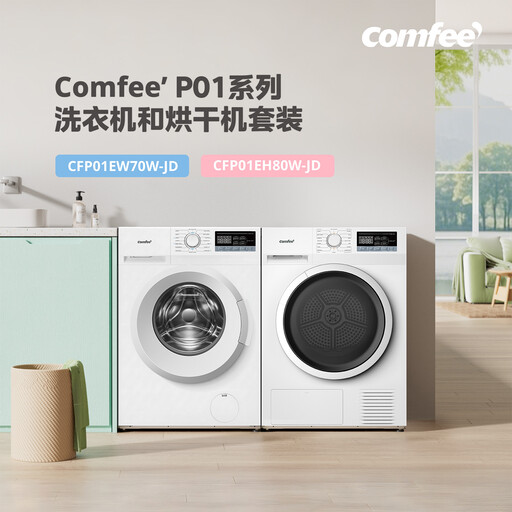
Comfee CFP01EW70W-JD washing machine and CFP01EH80W-JD heat-pump tumble dryer

Comfee CFP01EW70W-JD washing machine and CFP01EH80W-JD heat-pump tumble dryer

This pair of separate appliances is worth considering if you have space to install a washing machine and tumble dryer separately.

The product name identifies a heat-pump tumble dryer.

View at Joybuy

Samsung washer-dryer, 9 kg washing and 6 kg drying capacity

Samsung washer-dryer, 9 kg/6 kg

This washer-dryer could be an option if you want to combine washing and drying in one machine.

The product name lists a 9 kg washing capacity, a 6 kg drying capacity, energy ratings of A for washing and D for the full cycle, and a spin speed of 1,400 rpm.

View at Joybuy

Frequently asked questions about bedding and washer-dryers

Can I tumble-dry cotton bedding in the appliance straight after washing?

Only if the care label allows tumble-drying and the load is within the drying capacity for the programme you’ve chosen. The fact that a textile is made of cotton doesn’t automatically mean it’s suitable for tumble-drying.

What should I check before positioning and connecting the appliance?

Measure the space where the appliance will go and the route it needs to take to get there. Check the installation instructions for the specific model and make sure you have the required water, waste-water and electrical connections. Before booking an installation, confirm what work the provider you’ve chosen will carry out.

How should I measure detergent for frequent small loads?

Base the amount on the size of the load, how soiled it is and the hardness of your local water. The Verbraucherzentrale generally recommends running full loads and using Eco programmes; that doesn’t automatically make a small load an energy-efficient standard load.

Are a manufacturer’s guarantee and your statutory rights the same thing?

No. Your statutory rights apply to faulty goods and are enforceable against the seller. A guarantee is an additional, voluntary offer, subject to its own terms. The Verbraucherzentrale explains the difference between the two.

How do I dispose of an old washer-dryer in Germany?

Electrical waste must not be put in household rubbish. Local collection points accept it, and retailers have legal take-back obligations in certain circumstances, including when you buy an equivalent new appliance. Check when ordering whether collection of your old appliance is available.