Which option is right for you?

People who wear washable workwear

If you wash workwear regularly, follow the care instructions for each item. PPE must also retain its protective function after cleaning, as highlighted by GINETEX Germany and the Federal Institute for Occupational Safety and Health.

Households short on appliance space

If you need to fit washing and drying into the space for one appliance, a washer-dryer could be an option. When planning each load, bear in mind the combined appliance’s drying capacity.

Households with frequent large drying loads

If you regularly tumble-dry large amounts of workwear, compare the capacity and complete cycle of individual models with separate appliances. The Verbraucherzentrale recommends factoring in the higher electricity and water consumption of washer-dryers compared with separate machines.

What should you look for when buying?

Washer-dryer

A good fit if: There’s only room for one appliance in your utility room and your clothes are suitable for both washing and tumble-drying.

The trade-off: Washing and drying capacities differ. The Verbraucherzentrale also points out that washer-dryers use more electricity and water than separate appliances.

Separate washing machine and tumble dryer

A good fit if: You have room for two appliances and regularly need to tumble-dry larger loads.

The trade-off: You’ll need to transfer the washing between appliances, and you’ll need space for both.

Washing machine with air-drying

A good fit if: The care label advises against tumble-drying, or you have suitable drying space and ventilation.

The trade-off: Air-drying takes up space, and consistently high humidity indoors encourages mould growth, according to the Verbraucherzentrale.

Criteria What to check before buying Who this matters most to
Suitability for care requirements Check the care label and, where relevant, the PPE manufacturer’s instructions against the model’s washing and drying programmes. If I have workwear with different care requirements, I want to treat every item appropriately. Around 28% of consumers primarily check whether their clothes are suitable for washing and drying.
Dry in time for your next shift Check the programme duration and load limit for a complete wash-and-dry cycle. If my clothes need to be dry before I next wear them, the actual cycle time and the size of a continuous load matter. About 22% of consumers prioritise being able to reuse their clothes in time.
Electricity and water Compare kWh per 100 cycles and litres per cycle for a complete wash-and-dry cycle. If I tumble-dry frequently, I want to factor the ongoing energy and water use into my decision. Around 22% of consumers give these costs particular weight.
Load size Compare your usual load with the washing capacity and the smaller wash-and-dry capacity. If I regularly have larger loads of workwear, I don’t want to split them more often than necessary. Around 17% of consumers focus primarily on finding a capacity that suits their usual loads.
Installation Check the appliance dimensions, access route and space for connections, the door to open and the controls to be used. If there’s only one available spot in my utility room, the appliance must fit there, with enough room to access it. About 11% of consumers prioritise the space available for an appliance.

Common buying and usage mistakes

  • Looking only at the washing capacity

    The load size for a complete wash-and-dry cycle may be smaller than the washing capacity alone. So a larger washing load won’t necessarily fit in the drying cycle all at once.

    Compare your usual loads with the stated capacity for washing and drying.

    If the drying load is smaller, you may need to split the washing across several drying cycles.

  • Assuming washing figures apply to the complete cycle

    The EU energy label shows separate figures for washing alone and washing with drying. The washing consumption figure therefore doesn’t tell you how much a complete cycle will use.

    For the models you’re considering, compare the same operating mode and a similar frequency of use.

  • Automatically tumble-drying washable protective clothing

    Being machine-washable doesn’t automatically mean an item is suitable for tumble-drying. PPE must retain its protective performance after cleaning.

    Check the care label and, for PPE, confirm the manufacturer’s instructions and workplace requirements before planning a drying cycle.

  • Planning to air-dry without considering indoor humidity

    Consistently high humidity indoors encourages mould growth, according to the Verbraucherzentrale.

    Check that you have enough drying space and ventilation for your regular loads.

Key brands at a glance

LG

LG offers models with different washing and drying capacities, including the W4WR7096YB and HPWD116A.

  • LG Germany lists a washing capacity of 9 kg and a drying capacity of 6 kg for the W4WR7096YB.
  • The heat pump technology and complete-cycle figures for the HPWD116A don’t automatically apply to the W4WR7096YB. According to the footnote, LG’s claim of 18% more fabric protection applies to other models and is based on a test using 2 kg of underwear, not workwear.

Bosch

The Series 6 WNG24442 is an example of a freestanding model with automatic stain programmes and a water protection system.

  • Bosch home appliances Germany lists a washing capacity of 9 kg and a drying capacity of 6 kg for this model, as well as AquaStop.
  • The listed stain programmes don’t prove that they’ll remove every type of work-related dirt.

AEG

The Series 8000 LWR8B80600 is a comparison model with a washing capacity of 10 kg and a drying capacity of 6 kg.

  • AEG Germany lists 307 kWh per 100 complete wash-and-dry cycles and 51 kWh per 100 wash-only cycles for this model.
  • The stain-removal results advertised by the manufacturer aren’t independent evidence of performance on particular workwear or types of dirt.

Haier

The X5 range HWD120-BP14357U1 is a comparison model with a washing capacity of 12 kg and a drying capacity of 8 kg.

  • Its higher stated drying capacity may be useful for suitable loads of this size.
  • Haier Germany lists the appliance depth as 666 mm. Check that the model will fit in the room and that you can get it there; the rated capacity alone doesn’t tell you about cycle times or costs.

Bauknecht

The WT Super Eco 9614 N is another comparison model, with a washing capacity of 9 kg and a drying capacity of 6 kg.

  • Bauknecht Germany lists water consumption of 65 litres for a complete wash-and-dry cycle on this model.
  • This figure applies to the stated cycle and can’t be assumed to apply to other programmes or appliances.

Suitable appliances at Joybuy

This selection includes washer-dryers as well as separate washing machines and tumble dryers. The key things to consider are the capacity in the mode you’ll actually use and whether your workwear is suitable for the care programme.

LG WT1210EGF WashTower

LG WT1210EGF WashTower

An option if you want a washing machine and tumble dryer as separate appliances in a stacked unit.

Washing capacity: 12 kg.

Drying capacity: 10 kg.

Heat pump tumble dryer.

View at Joybuy
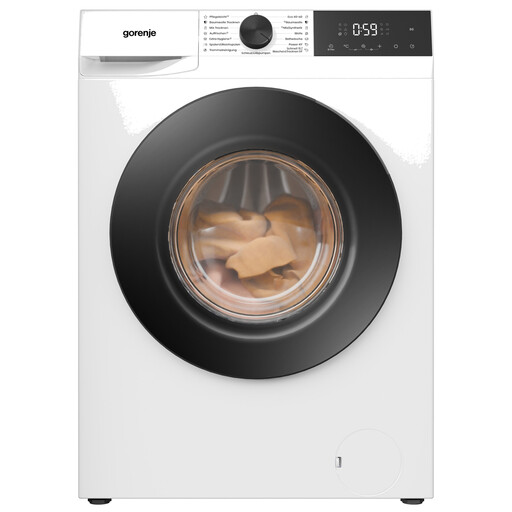
Gorenje WD5G2P1174A2DP2 washer-dryer, 11 kg washing and 7 kg drying

Gorenje WD5G2P1174A2DP2 washer-dryer

An option if you want to wash and then tumble-dry your workwear in one appliance, and the care instructions allow it.

Washing capacity: 11 kg.

Drying capacity: 7 kg.

Complete wash-and-dry cycle: 342 kWh per 100 cycles, 99 litres and 465 minutes.

View at Joybuy

LG WT1210WWF washer-dryer, 12 kg washing and 10 kg drying

LG WT1210WWF washer-dryer

An option if you want one appliance to handle both washing and drying, and the care label allows tumble-drying.

Washing capacity: 12 kg.

Drying capacity: 10 kg.

Dual Inverter Heat Pump.

View at Joybuy
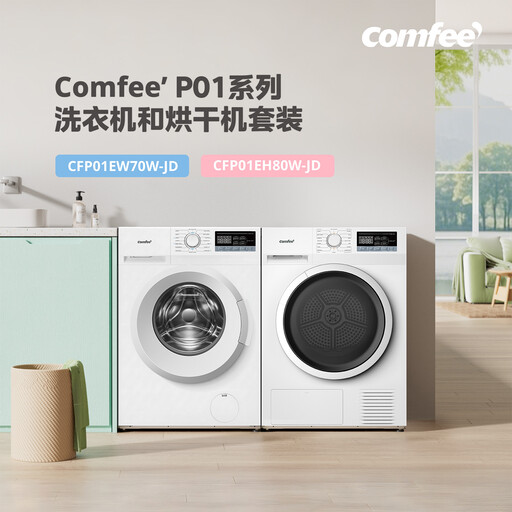
Comfee CFP01EW70W-JD washing machine and CFP01EH80W-JD heat pump tumble dryer

Comfee CFP01EW70W-JD and CFP01EH80W-JD

An option if you want to wash and dry with two separate appliances and have space for both.

Washing machine: 7 kg.

Heat pump tumble dryer: 8 kg.

The tumble dryer is described as using low-temperature drying.

View at Joybuy

Samsung washer-dryer, 9 kg washing and 6 kg drying

Samsung washer-dryer, 9 kg/6 kg

An option if you want to wash and dry in one appliance and your usual drying load fits within the stated capacity.

Washing capacity: 9 kg.

Drying capacity: 6 kg.

Complete wash-and-dry cycle: 308 kWh per 100 cycles and 90 litres per cycle.

View at Joybuy

Frequently asked questions

Can washable workwear automatically go in the tumble dryer too?

No. Washability and suitability for tumble-drying are separate care instructions. Check the label on each item and only select a programme that’s suitable for it.

What’s different when it comes to personal protective equipment?

PPE must retain its protective performance after cleaning, and you should follow the manufacturer’s instructions for cleaning it. In Germany, employers are responsible for ensuring that the PPE they provide remains functional and hygienically sound during use. The term workwear alone doesn’t tell you whether a particular item is PPE.

Which figures on the EU energy label matter for costs?

Compare energy use per 100 cycles, water per cycle, capacity and programme duration separately for washing alone and for a complete wash-and-dry cycle. To estimate your own costs, you’ll also need to take into account how often you use the appliance and your electricity and water rates.

How much workwear can you fit in a washer-dryer?

The key figure is the stated capacity for a complete wash-and-dry cycle, not just the washing capacity. Compare it with your usual load and also check the load limit for the programme you choose.

How should I dose detergent for regularly soiled clothes?

Adjust the dose to the size of the load, how dirty the clothes are and the hardness of your local water. Follow the instructions for your model for load limits, cleaning and maintenance.