
Lieferung heute & morgen

Qualitätsgarantie

Willkommens-Angebote freischalten: KOSTENLOSE Lieferung | Bis zu 80 % RABATT | Kostenlose 30-Tage-JoyPlus-Testphase
App herunterladen
A water-soluble non-permanent marker is ideal for writing that you may want to change or remove later. Typical uses include overhead transparencies, laminated summaries, glass surfaces, plastic folders and non-porous whiteboards. However, not every model is equally suited to school, university, office, presentations and creative projects.
The term wipeable marker usually refers to smooth, non-porous materials. On paper, cardboard, untreated wood or textiles, water-based ink can soak in and leave stains. So before you start any major labelling, test the marker on an inconspicuous area first.
A marker with a fine tip allows for small labels and detailed diagrams. For headings or highlighting, a chisel tip with a variable line width is more practical. If you only pay attention to the colour, you often overlook the tip width, which is crucial for the intended use.
Many water-based markers dry quickly on the surface. However, contact with a damp cloth or water can dissolve the writing again. For labels that need to stay legible long-term, or for important documents, a permanent marker is the better choice. A non-permanent marker should only be used where later correction is expressly desired.
Look for water-soluble ink if you want to remove markings from foils or other smooth surfaces with a damp cloth. A classic non-permanent foil pen is designed for overhead transparencies and similar transparent materials. According to product specifications, many universal pens can also be used on glass and plastic.
Removal is usually done with a soft, slightly damp cloth. Abrasive cleaners or rough sponges can scratch delicate surfaces. A test wipe is also recommended on coated materials.
The common variants can be roughly divided as follows:
A marker with a fine tip isn’t automatically better for presentations: from a distance, a narrow line can be hard to read. For projections or meetings with greater viewing distance, a medium or broad line is often more practical.
A refillable marker can be worthwhile for offices, schools and regular presentations. For selected STAEDTLER Lumocolor models, refilling is done with the Station 487 15. The polypropylene barrel and a tightly closing cap are designed to protect the ink from rapid evaporation.
After writing, the cap should click audibly into place. Storing the marker horizontally can help maintain even ink distribution. For air travel, models with automatic pressure regulation are interesting, as product specifications suggest they reduce the risk of ink leaks caused by pressure changes.
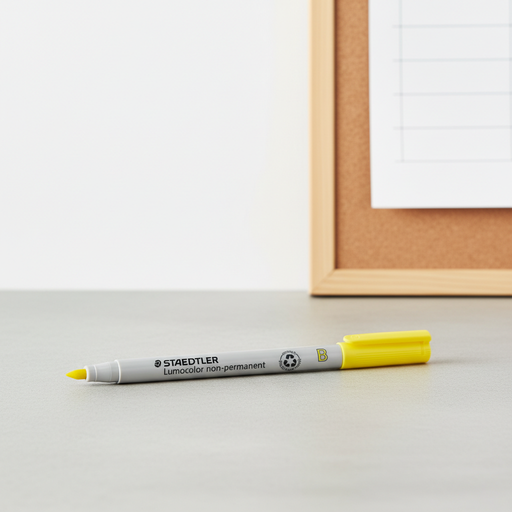
Why this product suits the profile: The yellow ink and variable line width of around 1.0 and 2.5 mm cover marking and highly visible highlighting with a single pen.
The chisel tip means you don’t need two different markers for narrow and broad lines. The ink is designed to be wiped off foil and non-porous surfaces with a damp cloth.
Water-soluble ink, polypropylene barrel and refillable with the STAEDTLER Station 487 15.
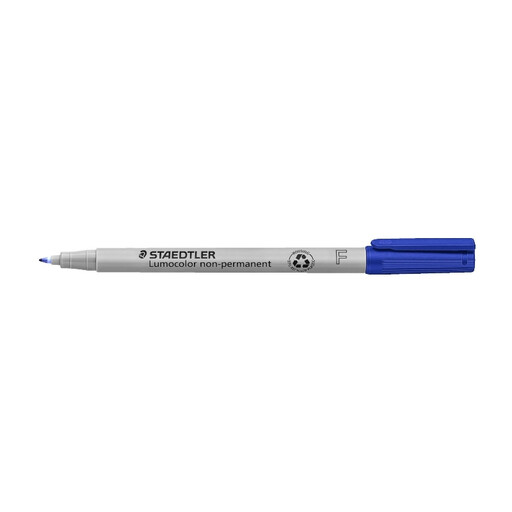
Why this product suits the profile: The fine synthetic tip is designed for detailed labelling on overhead transparencies, laminated plans and plastic folders.
The stated line width of around 0.6 mm is more clearly defined than with general markers. A damp cloth is intended for removal; porous materials should be avoided.
Fine synthetic tip, water-soluble ink, quick drying and refillable with Station 487 15.
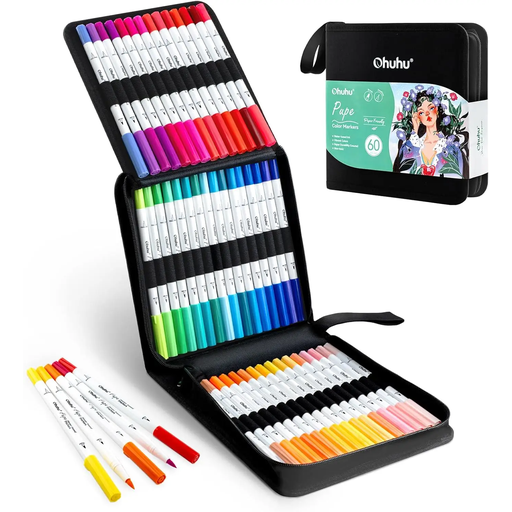
Why this product suits the profile: This set is aimed at creatives, students and organisers who need multiple tips and colours for journaling, calligraphy or colour-coded overviews.
The two tips per pen make the intended use clear: a 0.4 mm fineliner for details and a flexible brush tip of around 1–5 mm for broad strokes. The water-based ink is primarily intended for paper, not for glass or whiteboards.
60 pens with fineliner and brush tips, plus a colourless blender for gradients on suitable papers.
For large paper surfaces, flipchart markers with water-based, low-odour ink and a broad chisel tip are suitable. They are not the same as a water-soluble non-permanent marker for foils, as the ink primarily adheres to paper.
For notes on paper, erasable gel pens can be an alternative. Their heat-sensitive gel ink is removed by friction. However, the writing is not intended for important permanent documents, as heat or cold can affect visibility. For creative work, brush pens with a water base are suitable; before buying, check the paper quality, cap fit and tip combination.
We have compiled a complete, regularly updated list of products that fully meet these strict selection criteria and the safety regulations in force in the EU.
On smooth glass, the ink can usually be wiped off with a damp cloth. On textured, coated or dirty glass, removal may be more difficult. Test the surface before doing any full labelling.
The lifespan depends on frequency of use, storage and cap fit. A tightly closed cap prevents the tip from drying out. Refillable STAEDTLER Lumocolor models can be reused with the designated refill station when the ink runs out.
That depends on the specific product. A non-permanent foil pen can soak into paper and leave permanently visible stains. For paper, flipcharts and journaling, purpose-designed flipchart markers, brush pens or other water-based writing instruments are more suitable.