
Lieferung heute & morgen

Qualitätsgarantie

Willkommens-Angebote freischalten: KOSTENLOSE Lieferung | Bis zu 80 % RABATT | Kostenlose 30-Tage-JoyPlus-Testphase
App herunterladen
Water toys for children should suit their age, where they’ll be used and their stage of development. In practice, unclear age guidance, delicate materials or misjudging safety can quickly lead to a disappointing purchase. Most importantly, toys, swimming aids and inflatable pool toys all serve different purposes and shouldn’t be assessed in the same way.
A product for children aged 3 and over isn’t automatically suitable for toddlers. Small parts, detachable accessories or complex features may not be appropriate for babies and younger children. When choosing water toys for babies, make sure the recommended age is right for your child’s actual stage of motor development.
Armbands, swim discs and swimming rings provide buoyancy, but they are not life-saving equipment. They do not prevent drowning. Children must always be under the direct supervision of a suitable adult in or near water. A swimming aid is no substitute for swimming lessons or safe supervision.
Terms such as “robust”, “waterproof” or “suitable for all terrain” are hard to assess without specific details. Instead, look for clear information such as material, dimensions, maximum body weight, recommended age, care instructions and what’s included. Inflatable pool toys should also be checked for tears, leaks and damaged valves before every use.
For water toys for children aged 3 and over, warnings about small parts are particularly important. Water tracks and complex sets often include accessories that aren’t suitable for children under 3. For babies aged around 3 months and over, choose toys that are easy to grasp, sturdy and free from loose parts.
Also check that the age guidance is appropriate for your child’s weight. For swimming aids, specific weight ranges are more useful than a general description such as “for children”.
Washable plastics are suitable for the bath, garden and beach. After use, remove any sand, chlorine or salt water residue. Let products dry completely before putting them away to help prevent moisture building up in joints or hollow sections.
For inflatable items, welded seams, working valves and clear repair instructions are practical points to check. For hard plastic, look for rounded edges and a stable design. The CE mark and details of applicable safety standards should be clearly shown on the product or packaging.
Compact bath toys for children are often all you need for the bath. In the garden, a children’s water track, sand and water toys or a water mill can be a good choice. In the pool, swimming rings, animal figures and pool toys need plenty of space and constant supervision.
A remote-controlled watercraft should only be used where the water depth is suitable and in line with the manufacturer’s instructions. Electronic products must not be used in deep water unless they are expressly designed for it.

Why this product suits this profile: The water mill is listed for children aged 12 months to 6 years and can be used in a sandpit, garden or bath. That makes it a versatile option for families looking for one toy they can use in different places.
The age and size details are clearly specified. The wide feet are designed to keep it stable, but young children still need to be supervised.
The funnel, wheels and seesaw create a visible flow of water or sand. Stated dimensions: 22 × 14 × 43 cm.

Why this product suits this profile: This expandable water channel system is designed for children aged 3 and over and includes channels, locks, boats and accessories. It’s a good choice for families looking for a structured play system they can use again and again.
The set clearly explains what’s included and how to assemble it. It contains small parts, so it isn’t intended for children under 3.
The channels, locks and boats allow for a variety of ways to play. After use, you can empty the water and put the system away.

Why this product suits this profile: According to the product details, this lightweight ball is intended for children aged 3 months to 3 years. It can be used in shallow water, in the bath or on a play mat.
Its intended use in shallow water is clearly stated. The ball is not a swimming product and must not be used as a buoyancy aid.
Around 10 cm in diameter, it’s lightweight and has a transparent casing with a moving duck figure inside. Check the casing for cracks before every use.
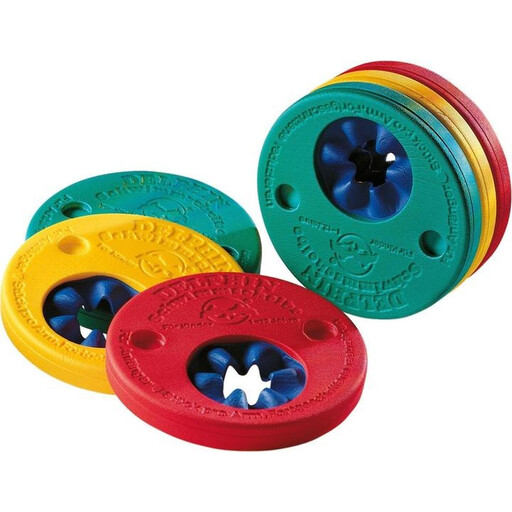
Why this product suits this profile: The six foam discs are listed for children aged 1 to 12, or up to 60 kg. The buoyancy elements can be removed gradually.
The age range and weight limit are clearly stated. The swim discs are explicitly not life-saving equipment and should only be used under supervision.
No inflation needed, and the six discs allow you to adjust how they’re used. Rinse them with clean water and let them dry after swimming.
We’ve put together a complete, regularly updated list of products that fully meet these strict selection criteria and the safety regulations in force in the EU.
For babies aged 3 months and over, choose lightweight products that are easy to grasp and have no loose small parts, such as a play ball with clear age guidance. Bath-time play should only take place in shallow water and under constant supervision. Water toys are not swimming aids.
Their lifespan depends on the material, how they’re used and stored, and how much sunlight they’re exposed to. Chlorine, salt water, rough surfaces and prolonged UV exposure can all wear down the material. Rinsing, drying thoroughly and storing them somewhere protected can help prevent unnecessary damage. Without specific information from the manufacturer, it isn’t possible to give a reliable estimate of how long they’ll last.
A water track doesn’t usually need electricity. The main ongoing costs come from filling it and topping up the water when needed. To use water sparingly, you can set up the track in a shallow tub and then reuse the water for suitable gardening tasks. Supervision and regular emptying are still essential.