
Lieferung heute & morgen

Qualitätsgarantie

Willkommens-Angebote freischalten: KOSTENLOSE Lieferung | Bis zu 80 % RABATT | Kostenlose 30-Tage-JoyPlus-Testphase
App herunterladen
Water toys for children should keep them entertained, suit their age group and be easy to use day to day. However, bath toys, pool toys, outdoor water toys and swimming aids for children are quite different. A product that works in a shallow paddling pool won’t automatically be suitable for the beach or for learning to swim.
Before you buy, it’s worth checking the recommended age, materials, dimensions and intended use. This can help you avoid common buying mistakes, such as choosing a toy with hard-to-clean cavities or mistaking a swimming aid for protection against drowning.
Armbands, swim discs and swimming rings for children can provide buoyancy. However, they are not life-saving devices and do not reliably prevent drowning. Children must always be under the close supervision of an adult when in or near water.
A good fit is important, too. A swimming aid should not slip, dig in or fit too loosely. Consider the child’s age and body weight alongside the manufacturer’s instructions.
An inflatable pool toy often looks more compact in product photos than it really is. Before buying, parents should check its inflated dimensions, maximum user weight and the space needed to lie or play on it. Inflatable products must be completely dry before being put away after use. Otherwise, moisture and residue can make them harder to clean.
Water courses for children, bath toys with accessories and sets with small figures are often intended for children aged 3 and over. Small parts can pose a choking risk for younger children. For bath toys with openings or cavities, also check that water can drain out completely. Regularly inspect toys for cracks, sharp edges or damaged valves to help ensure safe use.
For babies aged 3 months and over, choose lightweight toys that are easy to grip and have no loose small parts, such as a ball with moving elements. Water toys for children aged 3 and over could include water pistols, reusable water capsules or simple water courses, depending on the product. Older children may enjoy more complex channel systems, roll-on products or water games to play together.
The age recommendation isn’t just a marketing detail. It generally takes into account the size of the parts, how the toy is used and the type of play it’s designed for, so it shouldn’t be ignored.
For plastic and vinyl products, smooth surfaces, sturdy seams and working fastenings are useful things to check. For inflatables, valves should close tightly and the surface should have no visible damage. After playing in a pool or the sea, rinse the toy with clean water.
For bath toys, it’s important to check whether the product dries quickly. Water left inside inaccessible cavities makes it harder to keep the toy hygienic. Always follow the instructions on the packaging and product page.
For the garden, look for products that are easy to fill and have a controllable range. A water pistol with a tank can be used differently from small water capsules for a group water fight. When you’re on holiday, size when packed, weight and easy cleaning are more important.
Check swimming aids for children for cracks and leaks, and make sure they fit correctly before every use. A water course should stand securely and be emptied after play. For pool toys, also check the maximum weight capacity.
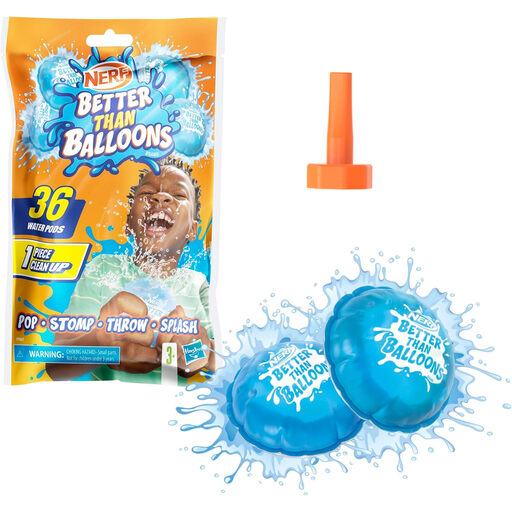
Why this product suits this type of buyer: The 36 reusable water capsules are made for garden water games with friends and don’t require any complicated equipment.
The age recommendation of 3 years and over, along with the warning about small parts, makes it clear who the product is for. Rinse the capsules after play and store them somewhere dry.
36 capsules, easy to fill and a low product weight of 65 g, according to the product details.

Why this product suits this type of buyer: This expandable channel system is designed for longer, creative play with several children and can be used indoors or outdoors.
The components, including channels, locks, boats and accessories, are listed clearly. You can drain the water after play and put the set away.
Suitable for children aged 3 and over, with an expandable design and accessories for creating different water flows.

Why this product suits this type of buyer: The portable water sprayer with a 2-litre tank is ideal for regular outdoor water play and garden role-play.
It’s clearly intended for children aged 3 and over, and for supervised play. The tank capacity and two spray settings are specific details, rather than vague claims about performance.
2-litre water tank, adjustable nozzle and backpack design; according to the product details, no batteries are required.

Why this product suits this type of buyer: According to the product details, this lightweight ball is designed for children aged 3 months to 3 years and can be used in shallow water under supervision.
The instructions specifically mention shallow water, constant supervision and checking for cracks. This product isn’t intended for unsupervised bath time.
Approximately 10 cm in diameter, lightweight and suitable for use in the bath, playpen or on a play mat.
We’ve put together a complete, regularly updated list of products that meet these strict selection criteria and the safety regulations in force in the EU.
Lightweight toys that are easy to grip and have no loose small parts are suitable for babies. The Fisher-Price WaterMates Duck Ball, for example, is listed as suitable from 3 months. Constant supervision is essential when using it in the bath or in shallow water. Clean bath toys after every use and let them dry completely.
How long a toy lasts depends on its materials, how often it’s used and how well it’s cared for. Check inflatables for leaks before every use, and store them away from sunlight, sharp objects and frost. Plastic toys generally last longer if you rinse them after exposure to chlorinated or salt water and store them somewhere dry. Don’t use damaged products in water.
Most simple products don’t need electricity or batteries. The main costs are water use and, if you have inflatable pool toys, possibly an air pump. Water courses and water-spraying toys usually need only a limited amount of water, which should be drained after use. When choosing, it’s worth considering the tank or fill capacity, how often it needs refilling and the options available locally for disposing of the water.