
Lieferung heute & morgen

Qualitätsgarantie

Willkommens-Angebote freischalten: KOSTENLOSE Lieferung | Bis zu 80 % RABATT | Kostenlose 30-Tage-JoyPlus-Testphase
App herunterladen
Water toys for children should be fun, easy to handle safely and suited to where they’ll be used. In practice, however, a few common buying mistakes can lead to unnecessary expense: a large inflatable water toy may not fit in the garden, a small bucket set may not include enough accessories, or a flotation aid may be mistakenly seen as protection against drowning.
This buying guide explains what parents, grandparents and families should look for in sand toys, pool toys and bath toys for toddlers.
A product for children aged 10 months and over isn’t automatically suitable for playing in water unsupervised. For toddlers, consider the toy’s shape and size, any small parts and the level of supervision required. Older children, on the other hand, may quickly find simple moulds don’t offer enough ways to play.
A swim ring or a pair of armbands can help children move around in the water, but they don’t replace close supervision. Guidance such as ‘up to 11 kg’ or ‘from 12 months’ tells you how a product is intended to be used; it doesn’t guarantee safety in every situation. Flotation aids do not prevent drowning.
A garden water play area needs a large, level surface and a continuous power supply for the blower. Sand can get stuck in moving parts of sand toys, while pool toys should be rinsed after use in chlorinated or salt water and left to dry completely. Neglecting care can affect the material and how well the toy works.
Compare the manufacturer’s guidance with your child’s age and weight. For an inflatable water toy, also check the maximum load capacity, the number of children who can play at the same time and how the weight should be distributed. For example, the inflatable water play equipment in our selection is designed for children aged 3 to 10, with a maximum of three children and a total weight of up to 135 kg.
Pay particular attention to the guidance for a swim ring or baby flotation aid. According to the product description, the BEMA swim ring is intended for children weighing up to approximately 11 kg or aged around 1 year. Its four separate air chambers and safety straps are design features, but they don’t replace direct supervision by an adult.
For sand and water toys, rounded edges, sturdy plastic parts and a stable design all matter. Wide feet can help a sand and water mill stay upright. When choosing beach toys for children, also check that the bucket, spade and rake are easy for little hands to hold.
For inflatable products, check the material thickness, welded seams, valves and whether a repair kit is included. If you spot damage, a leak or a brittle surface, stop using the product.
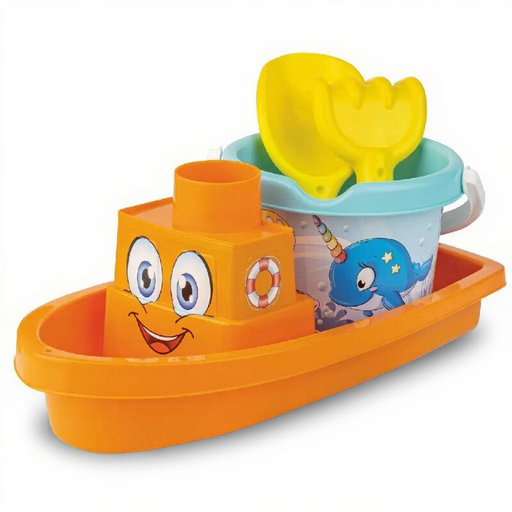
Why this product suits this profile: This four-piece set combines a bucket, spade, rake and boat for the beach, sandpit and shallow water. At 380 g, it’s easy to carry.
The included accessories are clearly listed and cover several ways to play, rather than offering just one container for pouring.
Four pieces, lightweight design and, according to the product description, suitable for children aged 1 and over.

Why this product suits this profile: Designed for both sand and water, this mill can be used in the bath, sandpit or garden. It’s recommended for children aged 12 months to 6 years.
The wide feet help address the risk of an unstable design. The care instructions recommend rinsing the toy and letting it dry completely.
22 × 14 × 43 cm, 390 g, plastic construction and several moving parts for pouring and exploring.
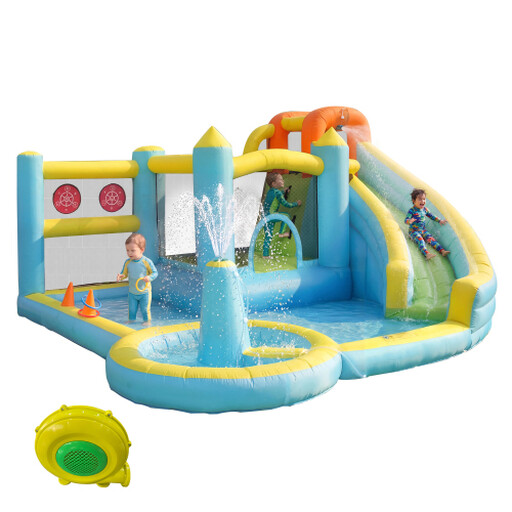
Why this product suits this profile: This large water play system is designed for families with a garden or patio. It features a slide, bouncing area, paddling pool, fountain and throwing games.
Its dimensions of 430 × 390 × 210 cm and three-child limit make it easier to assess the space and load requirements before buying.
Oxford fabric, foldable storage, a 450 W blower and several play areas in one.
We’ve put together a complete, regularly updated list of products that meet these strict selection criteria and fully comply with the safety regulations in force in the EU.
For children aged around 10 to 12 months and over, choose simple products that are easy to grip and have no loose small parts, such as a bucket set, a sand and water mill or age-appropriate bath toys. Check the manufacturer’s guidance, look for rounded edges and make sure your child is supervised at all times.
How long they last depends on the material, exposure to sunlight, storage and how heavily they’re used. After use, rinse the product, let it dry completely and store it somewhere dry and out of direct light. Only repair minor damage using suitable repair materials.
As well as the purchase price, you’ll need to allow for water, electricity and, potentially, replacement parts. The blower must stay on while the play area is in use. Before buying, check the power supply, water supply, set-up area and where you’ll store it afterwards.