Filming alone at the painting table
If you paint and film on your own, a well-positioned live view can help you check the frame, your hands and fine brushwork from your seat. Fotonomaden describes an additional monitor as helpful for checking focus.


If you can judge the framing and brush tip well enough on your camera screen from where you paint, you may not need an extra monitor. If not, a screen that you can position appropriately could be worth considering, provided your camera and monitor support the HDMI live view you want and you have enough space and power at your table. A high brightness rating alone doesn’t guarantee colour-accurate display of your watercolours.
If you paint and film on your own, a well-positioned live view can help you check the frame, your hands and fine brushwork from your seat. Fotonomaden describes an additional monitor as helpful for checking focus.
When bright paper and darker colours appear in the same shot, exposure displays can help you check the image while filming. Assess the actual colour reproduction separately: manufacturers’ brightness specifications are no substitute for testing the screen in your own workspace.
For longer painting sessions, the key is whether the monitor, mount, cables and power supply will fit alongside your painting area. Sony notes that HDMI display behaviour can vary with certain cameras and settings, so check the requirements for your specific camera model.
A good fit if: you can see the frame and focus clearly enough from your painting spot and don’t need any extra monitoring tools.
The trade-off: You won’t need another screen, an additional mount or a separate power source, but a small or awkwardly positioned display can make it harder to check your shot.
A good fit if: you want a larger live view or tools such as peaking close to your painting table, and your camera outputs a suitable HDMI signal in recording mode.
The trade-off: The screen, mount, cables and power supply all take up space. The right size also depends on how far away you’ll be sitting.
A good fit if: your viewing distance or the lighting by your window means a larger or higher-rated-brightness preview would work better for you.
The trade-off: A larger body can take up more room on your painting table. A maximum brightness rating doesn’t tell you how clearly you’ll see the image in your workspace or how accurately it will show colour.
A good fit if: you already have a computer screen positioned suitably at your work table and would like to set up your preview there.
The trade-off: Sony’s HDMI streaming method also requires an HDMI-to-USB capture device, cables and suitable software. Compatibility depends on the camera model.
A good fit if: you want to record externally as well as monitor your image, and your camera, signal and storage device are all compatible with the recording function you’ve chosen.
The trade-off: If you only need a preview, recording functionality isn’t a necessary reason to buy.
| What matters | What to look for | Who is it important to? |
|---|---|---|
| Framing and focus | Screen size from where you’ll be sitting; peaking or magnification if you’d like to use these tools. | When I paint and film on my own, I want to see the frame, my hands and the brush tip from my seat. Around 29% of consumers prioritise framing and focus. |
| Exposure of paper and areas of colour | Available displays such as a histogram or waveform; assess brightness in the actual spot by your window. | With bright paper and areas of colour in different shades, I want to be able to check exposure while filming. Around 29% of consumers prioritise this. |
| Camera HDMI live view | Check that the camera model, recording mode, output signal format and frame rate match the monitor. | If I want to keep using my existing camera, its live view needs to work in the recording mode I want. Around 21% of consumers prioritise HDMI compatibility. |
| Space and power at the painting table | Check the space available for placing or mounting the monitor, power options, what’s included and how to route the cables safely. | For longer painting sessions, I want to keep my workspace clear and plan for suitable power. Around 21% of consumers prioritise space and power. |
For the Portkeys PT6, the manufacturer lists a 4K-capable HDMI input and a display resolution of 1920 × 1080 pixels. Input format and native screen resolution are two different specifications.
Check the signal output by your camera separately from the monitor’s native resolution.
Manufacturers’ brightness and colour gamut specifications don’t prove how paper and pigments will look on a particular screen under your lighting.
Use exposure displays to check your recording, then assess critical colours separately in your own properly set-up image workflow.
Power options and accessories vary by model and version. NEEWER offers the F700 with different battery options and lists a DC cable as not included.
Check what’s included with the specific version and plan your monitor, mount and power supply together for your painting table.
Depending on the version, you may need to buy suitable accessories separately. External recording may also require a compatible storage device.
Video Assist combines monitoring with recording functions. If you only want to check the live view, you don’t automatically need the additional recording features.
First decide whether you want to record externally, then look for the right monitor or recorder functions.
The PT6 is worth considering if you want a compact HDMI live view with monitoring tools at your painting table.
The F6 PLUSX is a compact option with manufacturer specifications for display brightness and exposure tools.
The Shinobi II is worth considering for a compact preview and, with supported cameras, additional control functions.
The F700 is an option if a larger display or a high stated maximum brightness could suit your setup.
Video Assist is a monitor-recorder option if you want to record externally as well as preview your footage.
This selection features portable monitors with HDMI specifications that you could consider as a screen for your painting table. For a camera preview, the camera output and monitor input must support the live view you want; product names alone don’t confirm compatibility.
 No image available
This could work as a larger screen at your painting table if you can connect a suitable video source; you’ll need to check whether it’s suitable for your camera’s live view.
Specifications listed in the title: 1080p FHD, 60 Hz, IPS, HDR, HDMI, USB-C and built-in speakers; a stand is included.
 No image available
Its compact screen size could suit a limited amount of desk space. Before using it with a camera, check that it can display the live view you need.
Specifications listed in the title: 14-inch FHD IPS display, 18.2 mm body thickness, 1.5 W speakers and an adjustable stand. Described as compatible with laptops from 13 to 17.3 inches.
 No image available
You could consider it as a portable extra screen for your painting table; check separately whether your camera can output a compatible signal.
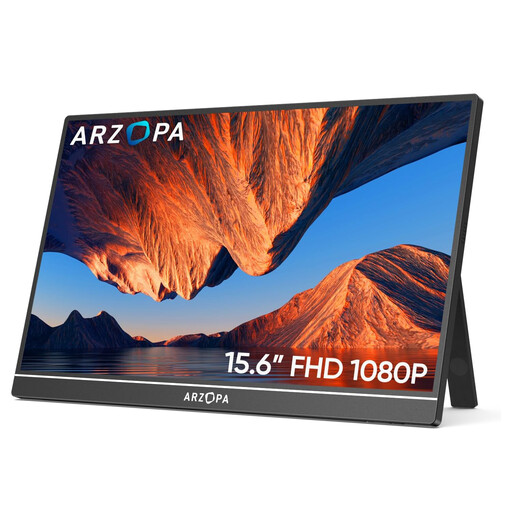
Specifications listed in the title: 15.6 inches, FHD 1080p, IPS, USB-C and HDMI. Described as having a Smart Cover stand and VESA mounting option.
 No image available
If you have room for a larger display at your work table, you could consider this model as an additional screen; check camera compatibility first.
Specifications listed in the title: 16 inches, 2560 × 1600 pixels, 16:10, IPS, HDR, 500 Nits, 8-bit, USB-C and HDMI.
 No image available
This could work as a portable screen if you have a suitable spot beside your watercolour painting; check whether your camera signal can be displayed through the intended connection.
Specifications listed in the title: 15.6 inches, 1920 × 1080 pixels, FHD, IPS, USB-C and HDMI. The product description gives its weight as 780 g.
No. Check the live view while recording, as well as the connection, resolution and frame rate. Sony explains that on certain models, the recording mode and settings can affect the display on the camera and an external monitor; this doesn’t necessarily apply to other cameras.
A high brightness rating alone doesn’t guarantee colour-accurate reproduction. Use exposure displays to check your recording, and assess critical colours separately in your own properly set-up image workflow.
For the HDMI method described by Sony, you’ll need a supported camera, an HDMI-to-USB capture device, cables, a computer and suitable software. Whether your camera supports this mode depends on the model.
Not simply by displaying an HDMI live view. Blackmagic Design describes Video Assist as a monitor and recorder. For external recording, check the specific model, the camera signal it supports and the storage device you need.
Check the power options and what’s included with the specific version. Atomos lists NP-F or USB-C-PD for the Shinobi II; NEEWER lists NP-F, DC and USB-C for the F700. Route cables so they don’t get in the way of your painting area.