
Lieferung heute & morgen

Qualitätsgarantie

Willkommens-Angebote freischalten: KOSTENLOSE Lieferung | Bis zu 80 % RABATT | Kostenlose 30-Tage-JoyPlus-Testphase
App herunterladen
Watercolour pencils combine the control of a coloured pencil with the ability to blend pigments with water afterwards. This makes them ideal for illustrations, sketches, gradients and classic watercolour painting. However, the choice is vast: terms like "professional", "intense colours" or "extra soft" alone don't tell you much about their actual suitability.
The following criteria will help you find the right watercolour pencil set and avoid common buying mistakes.
A large set may look versatile at first glance. But for focused studies, urban sketches or monochrome illustrations, six to twelve well-coordinated shades can be perfectly sufficient. A 6-piece watercolour pencil set is easier to carry and allows for a controlled start. A 12-piece watercolour pencil set, on the other hand, offers more scope for blending without immediately including too many individual colours you don't need.
Water-soluble coloured pencils can be activated with a damp brush. However, that doesn't mean every lead reacts the same way. What matters is the consistency of the lead, the pigment release and the paper you use. Very hard leads can be precise for dry drawing, but may dissolve less evenly. Soft leads release colour more easily, but require more care when sharpening.
Water and thin paper are a poor combination. The surface can buckle or become rough with repeated working. For drawing and painting with water, watercolour paper with a suitable weight is therefore recommended. For many applications, around 200 to 300 gsm is a sensible guide. The exact suitability depends on the amount of water and the technique you use.
Look for a lead that is explicitly labelled as water-soluble or "Watercolour Lead". This way, the pencils can be used dry like classic water-soluble coloured pencils and then activated with a brush. Also check whether the manufacturer provides information on the lead diameter. A thicker lead can be practical for covering larger areas and frequent sharpening, while a fine tip supports details and contours.
There are several common techniques for activating the colour:
Not every colour shade needs to spread completely without residue. For fine lines and textures, a partially visible pencil stroke can be exactly what you want.
The right set size depends on your intended use:
A set with 30 colours offers more shades ready to use straight away. Even so, blending techniques remain important, because colours can behave differently on paper and with water than they appear in the pencil case.
Round pencils can roll off slanted work surfaces. A hexagonal barrel sits more securely and provides a defined grip position during long drawing sessions. For on-the-go use, a metal tin or a roll-up case protects the tips. With soft leads, the storage location should remain dry; moisture can affect handling and the stability of the lead.
The following products differ mainly in set size, storage, colour range and design. The information is based on the respective product descriptions.
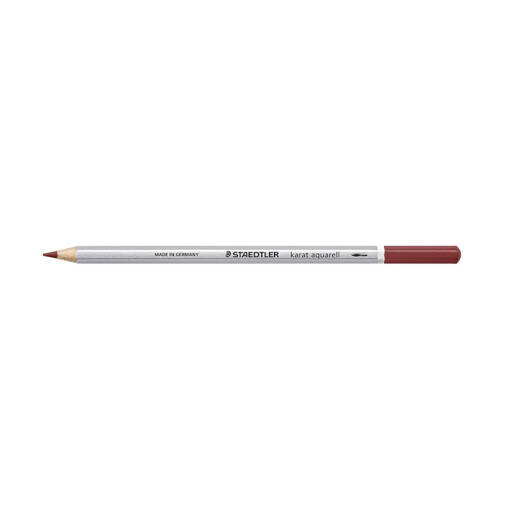
Why this product fits the profile: The 6-piece set is ideal as a compact starting point or as an addition for red tones. The hexagonal shape and soft watercolour lead support both dry and wet techniques.
The manageable number of pencils prevents beginners from paying for a large colour spectrum they don't initially need.
Water-soluble lead, hexagonal wooden barrel and three described techniques: dry, dry-on-wet and wet-on-wet.
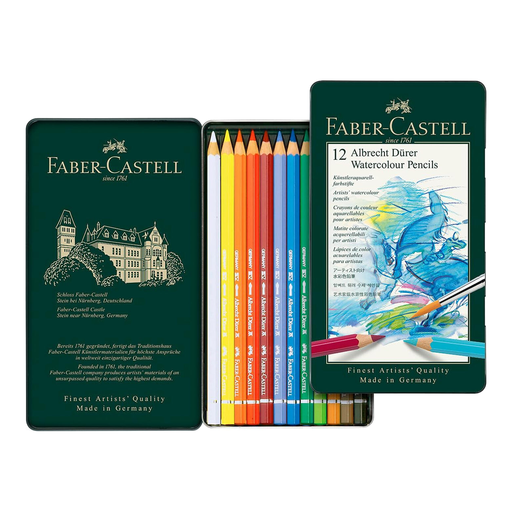
Why this product fits the profile: This set combines twelve colour shades with a stated lead diameter of 3.8 mm and a metal tin. It is designed for dry drawing and subsequent blending with a brush.
The product description provides concrete technical details rather than just general marketing claims: 12 pencils, 3.8 mm lead, water-soluble pigments and metal tin.
3.8 mm lead, ergonomic soft-grip according to product information and compact metal storage.
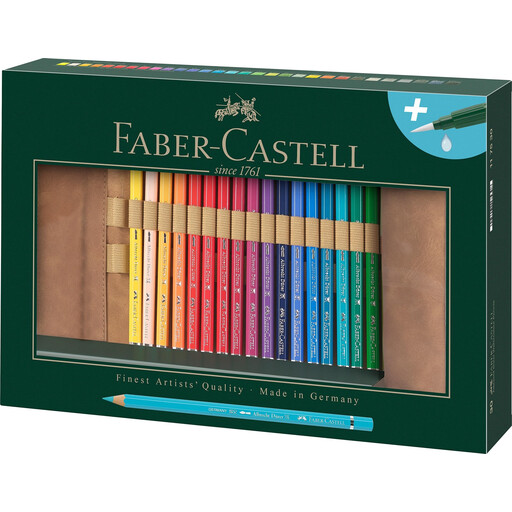
Why this product fits the profile: The 30-piece set is aimed at users who regularly illustrate, combine colour shades and use various watercolour techniques. A roll-up case and a water brush are included according to the description.
The storage solution is designed for portability. It is also clearly stated that the pencils can be used dry or with water.
30 coloured pencils, roll-up case, water brush and hexagonal barrel with a stated 3.8 mm lead.
We've put together a complete, regularly updated list of products that fully meet these strict selection criteria and the safety regulations in force in the EU.
First, apply the colour dry onto watercolour paper. Then activate the pigments with a slightly damp brush. For softer transitions, you can layer colours or apply them directly onto damp paper. Start with a small amount of water, as it's easier to add more moisture than to remove it.
Absorbent watercolour paper is suitable. For techniques involving several layers of water, around 200 to 300 gsm is a practical guide. Thin paper can buckle more easily; coated or very smooth surfaces also affect colour absorption.
The lifespan depends on the lead, how much you sharpen, the pressure you use and how often you use them. Dry hatching usually uses less material than covering large areas followed by blending. Protected, dry storage and a suitable sharpener help prevent breakage and unnecessary material loss.