
Lieferung heute & morgen

Qualitätsgarantie

Willkommens-Angebote freischalten: KOSTENLOSE Lieferung | Bis zu 80 % RABATT | Kostenlose 30-Tage-JoyPlus-Testphase
App herunterladen
Watercolour pencils combine the control of a coloured pencil with the ability to blend pigments with water afterwards. This makes them ideal for illustrations, journaling, colouring, sketching and classic watercolours. However, choosing the right set often seems simpler than it really is: many products are marketed as water-soluble coloured pencils when they are actually ordinary colouring pencils or water-based markers.
A coloured pencil is not automatically a watercolour pencil. For watercolour effects, the lead must be explicitly labelled as water-soluble or watercolour. Ordinary colouring pencils, such as the M&G 48-colour set, are designed for dry drawing, shading and colouring. You cannot use water with them in the same way as you can with watercolour pencils.
Many colours are practical, but they do not replace a suitable lead. For fine details, you need a stable lead that sharpens well. For broad washes, a softer, more soluble lead is preferable. A small set can therefore be more sensible for a specific purpose than a large, overwhelming colour selection.
Water-soluble coloured pencils do not perform equally well on every type of paper. Thin printer paper can buckle or become rough. For watercolour pencils, we recommend watercolour paper or mixed-media paper with a higher grammage, typically from around 200 g/m². You will also need a suitable brush, a sturdy sharpener and a way to store the leads dry.
Look for terms such as water-soluble, watercolour pencil or "water-soluble lead". Depending on the product, you can use several techniques:
Not every lead dissolves to the same degree. If you want to keep clear outlines, a controlled solubility is helpful. For transparent areas and soft transitions, pencils with a highly water-soluble lead are more suitable for blending.
A soft lead releases colour quickly and evenly. It is suitable for areas, intense colour tones and soft transitions, but requires a little more care when sharpening. A harder lead allows for finer lines and more precise details.
Among the products available, you will find, for example:
A hexagonal barrel prevents the pencil from rolling off the table and provides a stable grip when drawing. For soft leads, a high-quality metal sharpener is advisable, because blunt or damaged blades can put unnecessary strain on the lead.
A 6-piece set in a single colour direction is suitable if you want to add specific shades. For starting out in illustrations or watercolours, 12 to 30 colours are usually more manageable. Heavy users benefit from a larger colour spectrum and proper storage, such as in a metal box or a pencil roll.
Also pay attention to information about the wood source. Several STAEDTLER Karat Aquarell products mention FSC-certified wood. This information refers to the wood of the pencil and does not automatically apply to all components of the product.
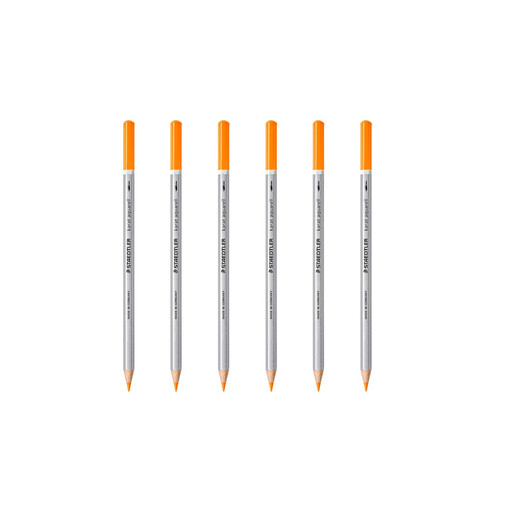
Why this product suits the profile: The 6-piece set offers a manageable introduction to dry and water-based techniques without having to buy an extensive colour range straight away.
The product description explicitly mentions a watercolour pencil lead and use with water and a brush. This makes its function clearer than with ordinary coloured pencils.
Water-soluble lead, hexagonal wooden barrel and suitability for both dry and wet techniques.
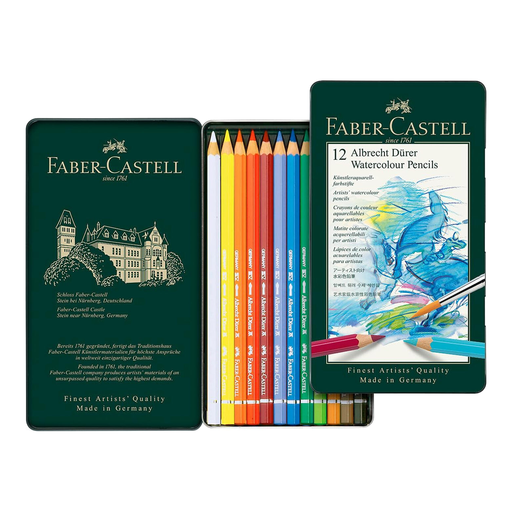
Why this product suits the profile: The set combines a clearly defined colour range with water-soluble pigments, a 3.8 mm lead diameter and a metal box for storage.
The product data mentions both water solubility and dry use. This allows you to check before buying whether both desired techniques are covered.
12 colours, 3.8 mm lead, metal box and, according to the product details, suitable for dry drawings as well as watercolour techniques.
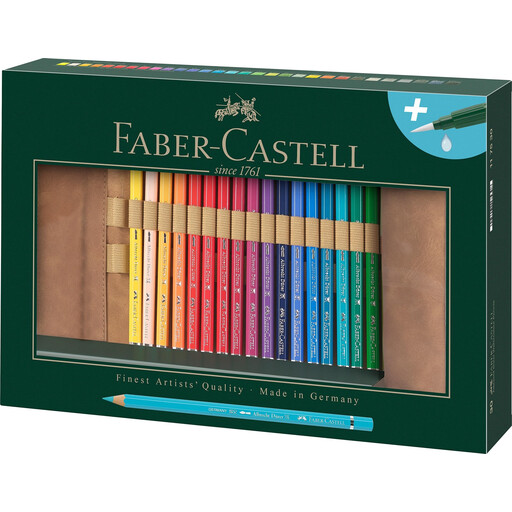
Why this product suits the profile: The larger set with a pencil roll and water brush pen is aimed at users who regularly illustrate, colour or work with various colour transitions.
The pencil roll protects the tips during transport and keeps the colours organised. The package contents also include a water brush pen for getting started straight away.
30 water-soluble colours, 3.8 mm leads, pencil roll and water brush pen.
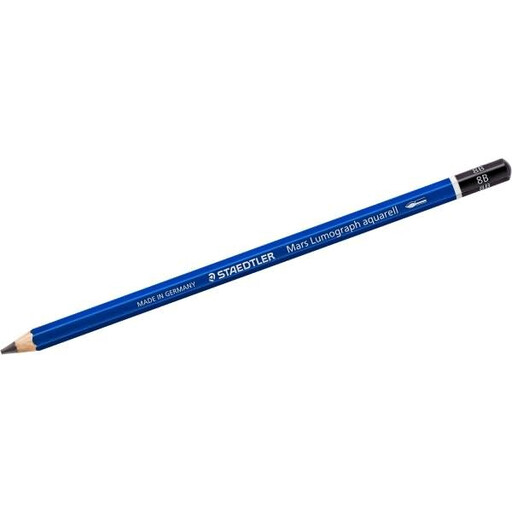
Why this product suits the profile: The water-soluble graphite pencil is intended for monochrome preliminary drawings, strong contrasts and grey watercolour washes, not for coloured subjects.
The product description identifies the pencil as a water-soluble graphite pencil. This makes it clear that it is not a coloured watercolour pencil.
Hardness grade 8B, approximately 3.6 mm lead and water-soluble graphite for dry and wet grey tones.
We have put together a complete, regularly updated list of products that fully meet these strict selection criteria and the safety regulations in force in the EU.
Yes. The dry application is comparable to classic coloured pencils. Beginners can start by laying down lines and areas and then observe how the colour changes with a little water. A small set makes it easier to get started and reduces the choice to manageable shades.
Watercolour or mixed-media papers with sufficient grammage are suitable. For many applications, around 200 g/m² or more is sensible. The more water you use, the more important a stable, well-sized paper becomes.
The lifespan depends on pressure, frequency of sharpening, storage and intensity of use. A lead with a larger diameter can last longer when used frequently for areas. Stored dry, protected from direct sunlight and with a suitable sharpener, watercolour pencils generally retain their working properties for longer.