
Lieferung heute & morgen

Qualitätsgarantie

Willkommens-Angebote freischalten: KOSTENLOSE Lieferung | Bis zu 80 % RABATT | Kostenlose 30-Tage-JoyPlus-Testphase
App herunterladen
A waterproof car cover can shield a vehicle parked outdoors from rain, snow, dust, leaves, bird droppings and intense sunlight. However, the word "waterproof" in the product description alone is not decisive. The material, dimensions and fastening system determine whether a car cover actually proves useful in everyday British conditions.
A cover with generous dimensions may be intended for several vehicle types, but it won't fit every model the same way. A cover that is too large can flap in the wind and rub against the paintwork. If it is too small, bumpers, wing mirrors or the sides of the vehicle may remain partially unprotected.
The body shape is particularly important: a car cover for a saloon is not automatically suitable for an SUV. A hatchback also has a different roof and rear shape than an estate. Therefore, check not only the vehicle length but also the width, height, wing mirrors, roof attachments and spoilers.
A waterproof car cover can repel precipitation, but on its own it tells you little about UV protection, breathability or tear resistance. A fully enclosed cover without adequate ventilation can trap moisture between the cover and the vehicle. This is especially problematic in changeable weather.
So look for specific details about the material, ventilation openings and the inner surface. A soft inner lining can reduce the risk of rubbing marks, but it won't prevent scratches if dust or sand gets between the paintwork and the cover.
A windproof car cover needs a suitable securing system. An elastic hem may be sufficient for calm conditions, whereas in stronger winds, tension straps, hooks or additional fastening points are advisable. Reflective strips improve the cover's visibility in the dark, but they do not replace a secure fastening.
Before fitting the cover, the vehicle should be as clean and dry as possible. If a dirty car cover is placed directly over the paintwork, trapped particles can cause movement and friction when the wind blows.
Measure the vehicle's overall length from the front to the rearmost point. Take bumpers, mirrors and any roof racks into account. Then compare the measurements with the fit specified by the supplier.
Typical classifications are:
The size specifications are not a universal standard. What matters is the specific product description.
A UV-resistant car cover has, depending on the version, a reflective coating or a separate UV layer. Silver-coated polyester fabrics can reflect sunlight and are often lighter than multi-layer covers. PEVA is also lightweight and water-repellent, while multi-layer fabrics can combine additional inner and outer layers.
For an all-season car cover, you should pay particular attention to the following points:
A scratch-resistant car cover in the sense of a scratch-reducing inner lining does not protect against every type of damage. The vehicle's surface should be clean before use.
For public parking spaces and open, windy parking areas, car covers with tension straps or multiple fixing points are practical. For daily use, zips, mirror pockets and a handy storage bag can make handling easier.
A hail protection car cover is constructed differently from a lightweight summer cover. The following model is described as having a 5 mm EVA blend and covering the roof, window and mirror areas. Such products are usually more heavily padded, but they require more storage space and are not suitable for every body shape.
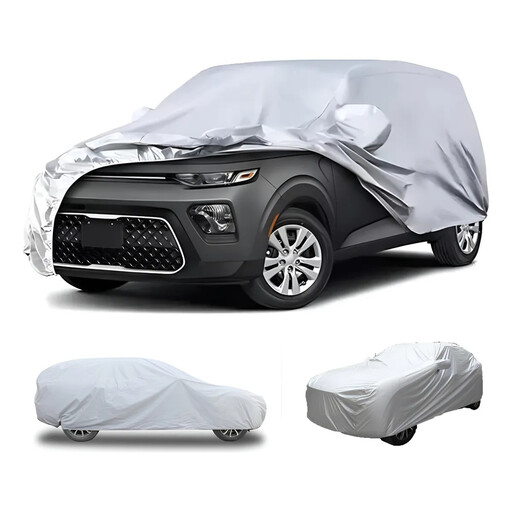
Why this product fits the profile: The single-layer PEVA construction is lightweight, foldable and intended for users who want a straightforward cover for many saloons and hatchbacks.
The dimensions of 540 × 175 × 120 cm are clearly stated. An elastic hem and an eyelet for an optional lock help with securing; you should still compare your vehicle's measurements beforehand.
Water-repellent PEVA, silver-coloured surface, dust protection and storage bag at a comparatively low weight.
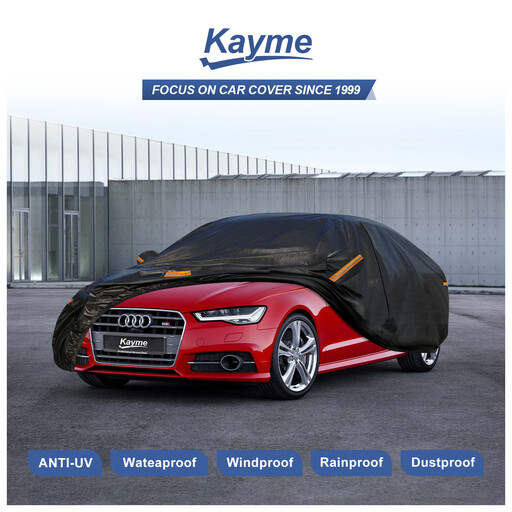
Why this product fits the profile: The multi-layer construction is aimed at saloon owners who prefer a defined fit and multiple protective layers for outdoor use.
The product specification explicitly limits use to saloon models with a length of 495 to 535 cm and includes three wind-resistant straps instead of just a hem fastening.
Seven-layer construction according to the product description, soft cotton inner lining, three tension straps and reflective strips.

Why this product fits the profile: The padded version is intended for users who park their vehicle in regions or situations with an increased risk of hail.
The cover is not described as a universal SUV cover, but for saloons and coupés with a length of 475 to 495 cm. Three straps and an elastic hem address wind securing.
According to the product description, 5 mm EVA blended fabric, reinforced 300D Oxford hem, ventilation openings and reflective elements.
We have compiled a complete, regularly updated list of products that fully meet these strict selection criteria and the safety regulations in force in the EU.
A weatherproof car cover is a protective product, not a substitute for a garage. With regular use, the fit, fastening and material condition should be checked repeatedly.
Yes, if the material is designed for outdoor use and the cover is correctly fastened. The vehicle and the inner surface should be clean before use. In prolonged damp conditions, ventilation and thorough drying are important.
The lifespan depends on UV radiation, wind, friction, washing intervals, storage and material quality. A fixed service life cannot be stated as a general rule. Tears, porous coatings, damaged eyelets or heavily worn inner linings are reasons for replacement.
Use a variant explicitly labelled as a car cover for SUV and compare the length, width and height. A saloon or hatchback cover may not fit properly despite a similar length, due to the greater vehicle height and roof shape.