
Lieferung heute & morgen

Qualitätsgarantie

Willkommens-Angebote freischalten: KOSTENLOSE Lieferung | Bis zu 80 % RABATT | Kostenlose 30-Tage-JoyPlus-Testphase
App herunterladen
If you park your car outdoors for long periods, you will usually be looking for a waterproof car cover to protect it from rain, snow, frost, UV radiation, dust, leaves and bird droppings. However, not every cover is suitable for every body shape. A cover that is too large can rub against the paintwork in the wind, while one that is too small may leave parts of the bonnet or boot exposed.
Your choice should therefore be based on more than just colour or price. The key factors are your vehicle’s dimensions, the material, the fastening system and how you intend to use the cover.
A car cover for a saloon advertised as a universal fit may work for a saloon, but could be unsuitable for a coupé, convertible, estate, compact car or SUV. Roof height, mirrors, spoilers, aerials and bumpers all affect the fit.
Before buying, you should therefore measure the length, width and height of your vehicle. With a tailored cover, it is also important to check whether the manufacturer explicitly distinguishes between saloons, coupés, convertibles, hatchbacks and SUVs.
A thin PEVA or polyester cover can repel rain and dust, but it generally does not provide the same level of cushioning as a designated hail-protection car cover. A lightweight layer is often sufficient for everyday weather protection. If hail is a regular risk, however, a padded construction with suitable fastening is a sensible choice.
Information about hailstone speed or size should be understood as manufacturer’s specifications. It is not a guarantee that the cover will prevent damage in every storm.
A weatherproof vehicle cover must remain securely in place in windy conditions. Depending on the location, an elasticated hem alone may not be enough. Tie-down straps, sturdy eyelets or both are useful features. A loose cover can flap, create noise, touch painted surfaces or come away completely.
During storms, strong winds and thunderstorms, you should also check the cover or remove it temporarily. This applies to a waterproof cover with eyelets as well.
Measure the vehicle at its longest and highest points. Take exterior mirrors, roof fixtures and spoilers into account. The cover should not be so tight that the seams and fastenings are under tension. On the other hand, too much excess material increases the surface area exposed to the wind.
A dustproof car cover will only provide reliable protection if it closes sufficiently all the way around. For models with a fixed length specification, vehicle compatibility should be checked particularly carefully.
Useful features include:
Before putting the cover on, the car should ideally be clean and dry. Dust between the fabric and paintwork can act like an abrasive when the cover moves. The cover should also be stored dry.
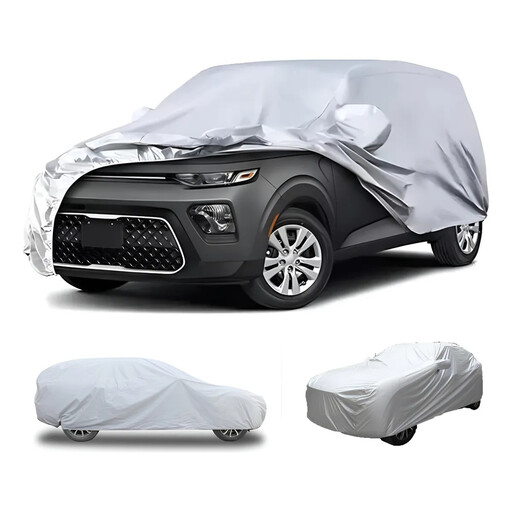
Why this product suits this profile: The single-layer PEVA cover is ideal for shoppers looking for a lightweight, foldable solution for regular use. The stated size is intended for many saloons and hatchbacks, but it must be checked against your vehicle’s dimensions.
The product description gives precise dimensions of 540 × 175 × 120 cm and highlights the need to check the vehicle size. This avoids making an overgeneralised universal-fit claim.
Water-repellent PEVA material, silver surface, elasticated hem and compact storage.
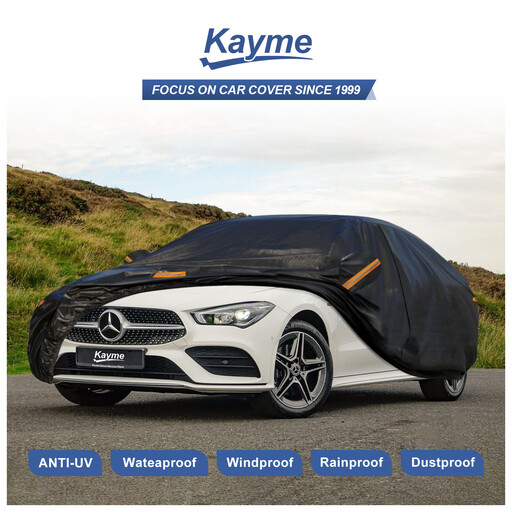
Why this product suits this profile: This multi-layer cover is designed for saloon owners with vehicles measuring 450 to 470 cm in length who value a clearly defined vehicle fit and additional fastening.
The model specification explicitly excludes hatchbacks and SUVs. This takes the vehicle shape into account as a purchasing criterion instead of simply advertising a universal size.
According to the product specifications, seven material layers, a soft inner layer, three tie-down straps and reflective strips.

Why this product suits this profile: The padded design is intended for saloon, coupé and convertible owners who place particular importance on additional protection when hail is forecast.
The 5-mm EVA blend clearly sets this cover apart from a thin rain cover. Three straps, an elasticated hem and side ventilation openings address other practical risks.
Suitable for vehicles measuring 450 to 475 cm in length; according to the product specifications, the padded areas also cover the mirrors and windows.
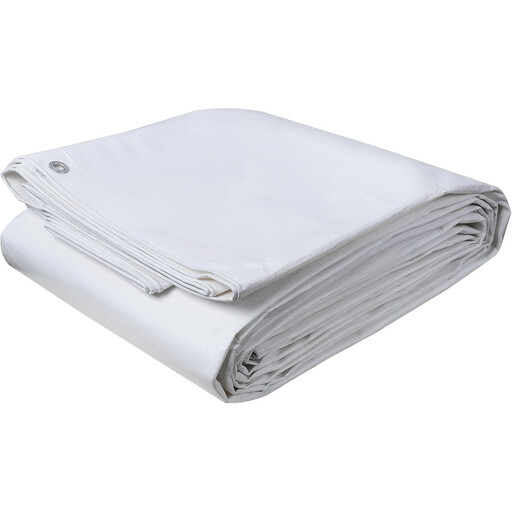
Why this product suits this profile: This tarpaulin is suitable not only as a car cover, but also for garden furniture, timber, pools, trailers or camping equipment. It is a sensible choice when you need a versatile cover with secure fastening points.
The 3 × 5 m format and eyelets spaced approximately 50 cm apart make this cover more predictable to use than an unmeasured universal tarpaulin. When covering a car, the excess material must be tensioned carefully.
280 g/m² new PE, reinforced edges, aluminium eyelets and, according to the product description, a water- and UV-resistant coating.
We have put together a complete, regularly updated list of products that fully meet these strict selection criteria and the safety regulations applicable in the EU.
A car cover should not be left on a wet or heavily soiled vehicle for extended periods. Otherwise, moisture and dirt can become trapped between the paintwork and the material. Clean the cover according to the manufacturer’s instructions, allow it to dry completely and store it in a dry place.
For garden furniture and timber, a cover for garden furniture and timber with eyelets is often more practical than a tailored car cover. A reflective car cover can improve visibility in the dark, but it is no substitute for adequate lighting or a safe parking position.
It can keep out rain, snow, dust and leaves, provided the material and fastening system are designed for this purpose. In strong winds, the cover must be secured particularly well. A standard waterproof cover is not automatically suitable for hail protection.
Clean and dry the vehicle before putting the cover on. A soft inner layer can reduce friction if the cover fits correctly. In strong winds, check the fastening, as flapping material can place greater strain on the paintwork.
Its service life depends on UV radiation, wind, moisture, storage conditions and material thickness. Reinforced edges, sturdy eyelets and regular drying can help extend its practical lifespan. Visible tears, damaged seams or brittle material are clear signs that the cover should be replaced.