
Lieferung heute & morgen

Qualitätsgarantie

Willkommens-Angebote freischalten: KOSTENLOSE Lieferung | Bis zu 80 % RABATT | Kostenlose 30-Tage-JoyPlus-Testphase
App herunterladen
A faded label on a plant tag, a smeared note on a freezer container, or an illegible note on a critical archive CD—these problems often arise from choosing the wrong pen. A standard permanent marker is not suitable for every task. Special requirements like direct sunlight, moisture, or smooth surfaces demand specialized solutions.
This article serves as a guide. We introduce different types of waterproof permanent markers and explain which features are crucial for specific applications such as gardening, laboratory work, archiving, or crafts. Our goal is to provide you with the information you need to make an informed choice.
The term "permanent" can be flexible. To find the right pen for your needs, three criteria are particularly important.
Not every ink adheres equally well to every material. For smooth, non-porous surfaces like glass, metal, or certain plastics, a specialized specialty film marker or glass marker is required, with an ink formulated to prevent beading or smudging. A marker for plastic, for example, must adhere to polypropylene (PP) or polyethylene (PE), which many standard markers cannot do reliably. For rough or dusty environments, such as those in trade and craft, a robust industrial marker with a durable nib may be a better choice than a delicate felt-tip pen.
For outdoor use, the distinction between "waterproof" and "weatherproof" is critical.
Some tasks require special features. A CD marker, for instance, has a soft tip and a chemically neutral ink that does not damage the data storage layer of a CD or DVD. For labelling in laboratories or the food industry, low-odour inks and a fast drying time are important to prevent contamination and smearing. The line width—from superfine (approx. 0.4 mm) for detailed notes to medium (approx. 1.0 mm) for easily readable labels—is also an important selection criterion.
Based on these criteria, we have compiled a selection of pens for specific, demanding tasks.
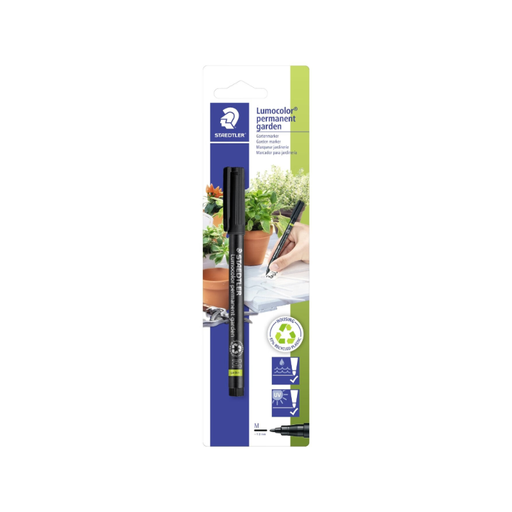
Why It Stands Out: This pen was specifically designed for outdoor use. Its ink is not only waterproof but also enriched with highly stable pigments that ensure high lightfastness. This keeps labels on plant tags, wooden stakes, or clay pots legible across multiple seasons.
Features:
Who Is It For? Ideal for gardeners, landscapers, and hobbyists who need a durable and reliable labelling solution for the outdoors.
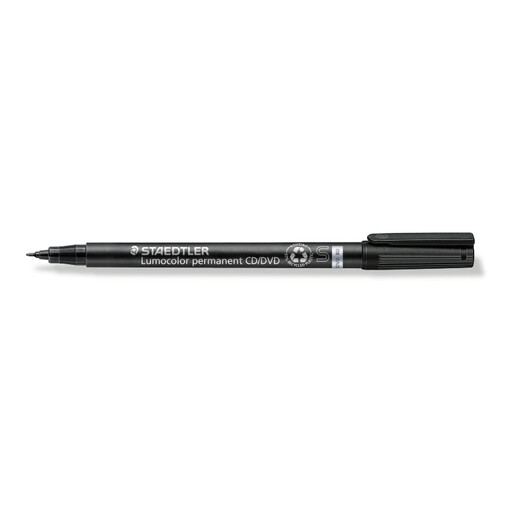
Why It Stands Out: This marker is the precision solution for labelling sensitive optical media. Its extra-soft tip prevents scratches on the surface, while the special ink does not penetrate the data layer, thus ensuring data integrity.
Features:
Who Is It For? Essential for professional archivists, photographers, musicians, and anyone who wants to catalogue their physical media collection safely and permanently.
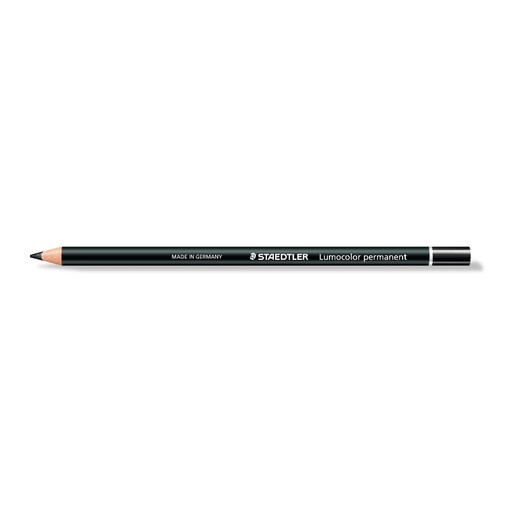
Why It Stands Out: Unlike liquid ink, the Glasochrom uses a waterproof, wax-based lead. This adheres exceptionally well to extremely smooth or even slightly oily surfaces where conventional markers fail. It is a classic industrial marker.
Features:
Who Is It For? An excellent choice for craftspeople, lab technicians, and manufacturing operations that need to mark parts made of glass, metal, or plastic. It is also useful for artists working on dark or transparent media.
The products presented here cover specific use cases. If you are looking for a broader overview or pens with different features, such as various colours or line widths, you can find more models in our category.
? Explore Our Full Range of Black Permanent Markers Here
1. What is the difference between "waterproof" and "weatherproof" in a permanent marker? "Waterproof" means that the ink, once dry, will not run when it comes into contact with water or moisture. "Weatherproof" is a more comprehensive property that also includes resistance to other weather conditions, especially UV radiation from the sun. A weatherproof pen is therefore designed for long-term outdoor use, as its writing will not fade as quickly.
2. Can I use a regular permanent marker for plastic outdoors? This is not recommended. The ink in standard permanent markers often lacks sufficient UV-stabilizing pigments. In direct sunlight, the writing can fade and become illegible within a few weeks or months. For lasting legibility, a specialized weatherproof garden marker is the more reliable solution.
3. How do you remove waterproof permanent markers from smooth surfaces like glass? For ink-based markers, solvents like isopropyl alcohol or ethanol are often effective. Apply the solvent to a cloth and rub over the marking. For wax-based dry markers (like the Glasochrom), the marking can often be carefully removed from the smooth surface with a blade or scraper. It is recommended to test any removal method on an inconspicuous area first.