Detail filming at the workbench
If you mainly want to show your work surface while laying track, wiring or attaching small parts, the distance to the lens and a clear camera position are key.


First, measure the planned distance between the lens and your workpiece. Then decide whether you’ll mainly film the layout or switch between filming yourself and the layout. A tilting webcam may suit occasional views of your workbench; for frequent close-ups, a camera that can be positioned independently is worth considering. A desk mode or 4K resolution alone doesn’t guarantee sufficient close focus or an unobstructed view of your hands.
If you mainly want to show your work surface while laying track, wiring or attaching small parts, the distance to the lens and a clear camera position are key.
If you switch between explaining things on camera and showing your layout, you should be able to adjust the view to suit your setup without always needing an overhead mount.
If you film the same area repeatedly, you can match the mount, connection and recording software to one another in advance.
Suitable if: You want to switch between presenting and occasional views of your work surface, and your monitor is in the right position. Logitech describes a Show Mode for the Brio 500 and MX Brio.
Trade-off: Tilting the camera isn’t the same as having a freely positionable overhead arm. With the Brio 500, you should hold the mount when tilting it if the suction pad isn’t attached.
Suitable if: You want to use different camera angles and your chosen position gives you the view of the workbench you need. OBSBOT specifies a minimum focus distance of 10 cm for the OBSBOT Tiny 2 Lite, along with pan-and-tilt movement.
Trade-off: Movement and close focus don’t guarantee a suitable overhead angle or enough room for your tools.
Suitable if: Your filming distance is consistently within the focus range and you want a fixed shot for repeatable building steps. Elgato specifies a focus range of 30–120 cm and a 1/4-inch thread for the Facecam MK.2.
Trade-off: The stated focus range doesn’t guarantee sharp images at distances under 30 cm; a separate mount also takes up space.
Suitable if: You mainly film small parts from directly above and need to position the camera independently of your monitor. IPEVO specifies autofocus from 10 cm and an adjustable setup for the V4K PRO.
Trade-off: Check the space it needs and the area it captures: IPEVO gives a maximum capture area of 34,2 × 25,5 cm, which won’t necessarily cover your entire layout.
| What you’re looking for | What to check before buying | Who should consider it? |
|---|---|---|
| Close focus and detail | Measure the distance from the lens to the nearest workpiece and compare it with the focus range of the specific model. | If you want to film small parts, what matters is whether they appear sharp in the position you plan to use. Around 36 % of consumers would rank close focus as their top purchasing priority. |
| Clear work surface and viewing angle | Mark out the desk width, monitor position, mounting point and required field of view in advance. | If the camera and mount need to stay clear of your hands and tools, the space they take up is crucial. Around 29 % of consumers who prioritise a clear work surface put it first. |
| Switching between your workpiece and presenting | Try the viewing mode with your intended recording software and in the planned location. | If you want to switch between showing yourself and your layout, the change should work with your setup. Around 21 % of consumers would make this ability to switch views their top purchasing priority. |
| Connection and recording workflow | Check the connection, operating system, available resolution and frame rate, then make a short test recording. | If you want to film without having to set everything up repeatedly, make sure your chosen camera, computer and recording software work together. Around 14 % of consumers would prioritise a straightforward recording workflow. |
Resolution and desk mode alone don’t tell you whether the camera will focus sharply from your planned distance.
Measure the distance first and compare it with the focus range of the specific model. Then check the framing and sharpness at your workbench.
A monitor clip positions differently from an overhead setup, while a separate arm can take up work surface space.
Mark the mounting point before you buy, and check that your hands and tools can move freely while you’re filming.
For the Facecam MK.2, Elgato requires USB 3.0 for uncompressed 1080p60; the manufacturer specifies only MJPEG over USB 2.0.
Check which combinations of connection, format, resolution and frame rate are available for the exact model.
The Brio 500 and MX Brio are monitor-mounted webcams with a Show Mode that the manufacturer describes as suitable for occasional desk views.
The Tiny 2 Lite is a pan-and-tilt webcam for changing your camera angle.
According to the manufacturer, Link 2 and Link 2C offer DeskView for occasional desk demonstrations.
The Facecam MK.2 is designed for a fixed shot on a suitable mount.
The V4K PRO is a document camera worth comparing if you want to show your layout from above on a permanent basis.
Joybuy webcams for filming at your desk. Check how their focus, framing and mounting options suit your model railway setup.
 No image available
This model is worth considering for filming building steps; check first that its focus suits your actual working distance.
Listed in the product name: 1080P, microphone and USB Plug & Play.
 No image available
If you want to film building steps with a webcam, you can assess this model by testing its focus at your planned distance.
Listed in the product name: Full HD, 1080p, 60 FPS and black.
 No image available
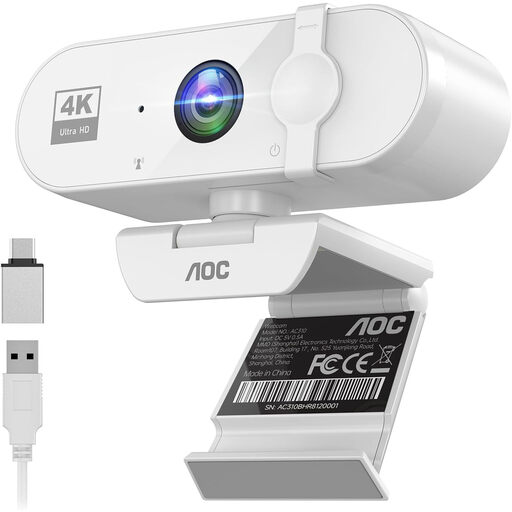
This model is worth considering for desk recordings; check whether its field of view suits your work surface.
Listed in the product name: 4K, 99° field of view, microphone, privacy cover and white.
 No image available
If you’re looking for a webcam to film building steps, check the focus and framing in the position you plan to use.
Listed in the product name: 4K, Sony IMX363 sensor, PDAF autofocus, dual microphone, 75° viewing angle and USB-A/USB-C.
 No image available
If you’re looking for a USB webcam for regular workbench recordings, test the focus and positioning with your actual setup.
Listed in the product name: USB webcam.
Not necessarily. Insta360 describes DeskView as being for occasional desk recordings and distinguishes it from a setup with a separate overhead mount. Check the viewing angle, focus and room for your hands at the planned workstation.
Add the webcam to OBS as a video capture device, select an available resolution and frame rate, then make a short test recording with audio. The OBS Project notes that choosing an unsupported setting may result in no image appearing from the video source.
According to Logitech’s instructions, you can clean the micro-suction pad with water if it gets dirty. Let it dry before attaching it again. If the pad isn’t attached, hold the mount when tilting it.
For eligible distance sales, you generally have a 14-day right to cancel from the date of delivery, subject to legal exceptions. If goods are faulty, you generally have a statutory claim against the seller for at least two years; this is separate from any voluntary manufacturer’s guarantee.
No, you shouldn’t assume that. Under § 22 KunstUrhG, distributing or publicly displaying images of people generally requires the consent of those pictured; any possible legal exceptions haven’t been assessed for individual cases here. If possible, point the camera only at your work surface, and clarify the rights to publish if people are identifiable.