Anyone weighing small quantities
If you make small batches of dough and only need a few grams of salt, the increments and minimum weight in the relevant measuring range matter more than the maximum capacity.


For a few grams of salt, scales with fine increments in the range you’ll actually use are more suitable than scales that only show whole grams. The stated minimum weight matters too. If you also want to weigh flour and water in a bowl, check the capacity, tare function and display visibility, or choose scales with separate weighing ranges. The increments are a manufacturer’s specification and, on their own, do not independently verify measuring accuracy.
If you make small batches of dough and only need a few grams of salt, the increments and minimum weight in the relevant measuring range matter more than the maximum capacity.
If you want to weigh salt, flour and water using the same device, consider the bowl’s weight, the tare function and whether you can still see the display, as well as the fine-weighing range.
If you bake small batches and need to put your scales away afterwards, compare the dimensions of the weighing platform with the container you plan to use, and check the care instructions.
First, check whether the scales display small portions of salt appropriately. For the other ingredients, the bowl, capacity and ease of use also matter.
| What you need | What to check before buying | Who is this important to? |
|---|---|---|
| Weighing small amounts of salt | Check the increments and minimum weight for the amount of salt you need. Fine increments do not in themselves prove measuring accuracy. | If I’m weighing just a few grams of salt for a small batch of dough, the increments in the relevant range are particularly important to me. Around 36% of consumers focus on weighing small amounts of salt. |
| Weighing the whole batch of dough | Compare the weight of the bowl and ingredients with the maximum capacity. Check whether the display remains visible with the bowl in place. | If I want to weigh salt, flour and water in the same bowl, I need enough capacity and a practical tare function. Around 29% of consumers mainly look for scales that can weigh the whole batch of dough. |
| Space and care | Compare the dimensions of the weighing platform with the container you plan to use, and follow the model’s cleaning instructions. | If I have a small kitchen, I want to be able to store the scales easily and place my container on them comfortably. Around 21% of consumers focus on space requirements and ease of use. |
| Cost and extra features | Consider whether you already have suitable bowl scales. Check the batteries and the terms for an extended warranty. | If I only weigh small amounts of salt occasionally, I want to consider whether extra features or a second set of scales would be useful for me. Around 14% of consumers mainly focus on overall cost and the value of additional features. |
The increments shown describe the steps on the display; they do not automatically reflect the actual measuring accuracy. According to the manufacturer, the GEFU PREZISO also switches to whole-gram increments from 1 kg.
Check the minimum weight and increments specifically for the amount of salt you want to weigh. Don’t claim independently verified accuracy unless a suitable test has been carried out for that model and measuring range.
Scales may be able to support a heavy bowl of dough but still show salt in tenths of a gram too coarsely. According to the manufacturer, the WMF kitchen scales 3201000339 can weigh up to 5 kg, but display measurements in 1 g increments.
Assess the salt range and the bowl range separately. If you weigh both regularly, compare scales with a suitable shared fine range against scales with separate platforms or an additional precision scale.
Ooni’s five-year extended manufacturer’s warranty for its dual-platform scales is conditional on registering within 60 days of receipt. A voluntary warranty is separate from your statutory rights if a product is faulty; the Verbraucherzentrale also makes this distinction.
Read the warranty terms and check whether registration is required. Don’t confuse a voluntary warranty with your statutory rights against the seller.
The KS 36 is a compact precision scale for weighing small ingredients separately.
According to the manufacturer, the PREZISO combines a fine range for small ingredients with a function for adding ingredients one by one.
The dual-platform scales are designed for anyone who wants to weigh small ingredients and a larger bowl on separate platforms.
The digital kitchen scales 3201000339 are designed for weighing bowls, flour and water when whole-gram measurements are sufficient.
The following Joybuy products include digital coffee and kitchen scales. If you’re weighing small amounts of salt, check the stated increments and minimum weight for your measuring range on each model.
 No image available
The product title describes portable digital coffee and kitchen scales. Check the increments and minimum weight to see whether they’re suitable for weighing your portion of salt.
 No image available
The removable bowl can be useful if you want to weigh ingredients directly in a container. For small portions of salt, check the model’s increments and minimum weight.
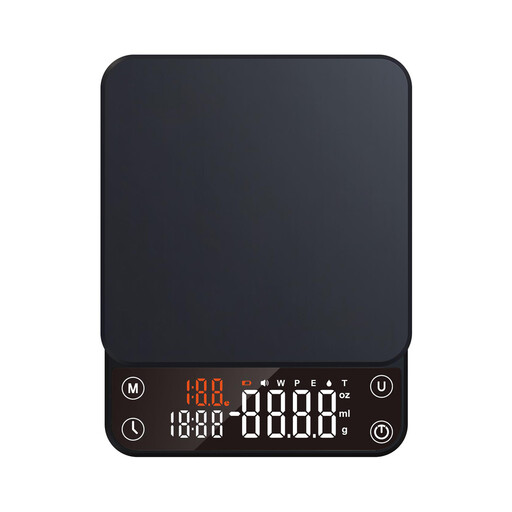 No image available
The product title describes coffee scales with four brewing modes and automatic tare. To weigh small amounts of salt, also check that the increments and minimum weight suit your recipe.
 No image available
The 0.1 g increments stated in the product title may be useful for small portions of salt. Also check the minimum weight for the range you need. The title also states a maximum capacity of 2,000 g, as well as timer and flow-rate functions.
 No image available
A tare function and the 5 kg maximum capacity stated in the product title may be useful when weighing a bowl and ingredients. Check the increments if your recipe specifies salt in tenths of a gram.
Start by using the proportions in your recipe and adjusting the ingredients to the same amount of flour. King Arthur Baking gives a general guideline of 1.8–2% salt by flour weight for bread dough; for 100 g of flour, that works out to 1.8–2.0 g of salt. This doesn’t override a different quantity specified in your recipe.
Place the scales on a firm, level surface and tare a suitable small container before adding the salt. For the PREZISO, GEFU recommends using a soft, slightly damp cloth and warns against letting water get into the device.
For surfaces intended to come into contact with food, look for a suitable statement or marking. The Federal Office of Consumer Protection and Food Safety recommends checking for the words “suitable for food contact” or the glass-and-fork symbol. If a surface isn’t marked accordingly, you can use a suitable container and tare it.
No. The Verbraucherzentrale distinguishes your statutory rights against the seller if goods are faulty from a voluntary warranty offered by the manufacturer or retailer. Check the warranty terms separately. Ooni’s extended manufacturer’s warranty for its dual-platform scales is conditional on registering within 60 days of receipt.
Take electrical waste to an appropriate collection point rather than putting it in your household rubbish. The Federal Environment Agency recommends removing any removable batteries before disposal, where possible, and taking them separately to a battery collection point.