Weighing salt portions precisely
You weigh the salt for your dough separately and want to know which increments apply to the actual total load. Beurer specifies different display increments for the KS 36, depending on the weight.


If you weigh small amounts of salt separately, a finer display increment in the relevant weight range can be useful. If you’re weighing several ingredients in the same bowl, capacity, platform size and tare are more important. A weighing spoon makes it easier to scoop salt from its container, but its limited capacity means it can’t replace a kitchen scale. The displayed increments alone don’t prove that a scale’s accuracy has been independently verified.
You weigh the salt for your dough separately and want to know which increments apply to the actual total load. Beurer specifies different display increments for the KS 36, depending on the weight.
You add flour and other dough ingredients to the same bowl, one after another. For scales from WMF and Soehnle, tare and suitability for a larger bowl are important things to consider.
You want to scoop up the salt with a weighing spoon and weigh it separately. Soehnle describes the Cooking Star as having a removable spoon and a capacity of 500 g.
Best for: Weighing a small amount of salt in a separate container when you want finer display increments than 1 g.
Things to consider: Check the weight range in which the finer increments apply. Small weighing platforms are less suitable for a large bowl of dough.
Best for: Weighing several ingredients in the same bowl, where you need a tare function and enough space.
Things to consider: The bowl and its contents count towards the total load. A 1 g increment won’t show tenths of a gram.
Best for: Scooping salt straight from its container and weighing it separately.
Things to consider: Its shape and limited capacity mean a weighing spoon isn’t suitable for weighing a full bowl of dough.
| What you need | What to check before buying | Who is it important to? |
|---|---|---|
| Fine increments | Check the display increments for the combined weight of the salt and its container. Fine increments aren’t independent proof of measurement accuracy. | If I’m weighing small amounts of salt separately, I want to know the increments for the actual load; around 36% of consumers put this first. |
| Weighing in a dough bowl | Allow for the combined weight of the bowl and ingredients, and check that you can still operate the scale with the bowl on it. | I want to weigh several ingredients in the same bowl, so I need enough capacity and a tare function; around 29% of consumers prioritise this. |
| Scooping salt directly | Check the weighing spoon’s capacity and which parts the manufacturer says are removable and suitable for cleaning. | If I want to scoop salt straight from its container, this design matters more to me than weighing the whole bowl; around 21% of consumers put this first. |
| Cleaning and power supply | Check the cleaning instructions for the specific model and whether it needs batteries or a rechargeable battery. | I want to clean and reuse the scale easily after baking; around 14% of consumers prioritise care and power supply. |
According to the manufacturer, the Beurer KS 36 measures in 0.1 g increments only below a total load of 500 g; above that, the increments are coarser. The container counts towards the load too.
Check the increments for the weight you’ll actually put on the scale, including the container and ingredients. Display increments aren’t independent proof of accuracy.
According to the manufacturer, the Soehnle Cooking Star has a capacity of 500 g and a spoon-shaped design, so it isn’t intended for weighing a whole bowl of dough.
Before you buy, decide whether you only want to weigh salt separately or also want to weigh other dough ingredients in one bowl.
If you want to weigh ingredients in the bowl, you may also need a kitchen scale designed for this purpose.
The Tefal Optiss BC50U0 and BC5005 are different models: Tefal specifies different increments for the BC50U0, depending on the load, while the Joybuy product description for the BC5005 specifies 1 g increments.
Compare the full model number and the details that matter to you, rather than relying on the product family name alone.
The KS 36 is designed for weighing ingredients separately, while the KS 19 Pure White is a larger kitchen scale with 1 g increments.
The Cooking Star is a weighing spoon for scooping salt separately; the Page Profi 100 is designed for weighing ingredients in a larger bowl.
According to Tanita, the KD-321 combines a removable weighing platform with a tare function and a capacity of up to 3 kg.
According to Tefal, the Optiss BC50U0 combines a high capacity with finer display increments for lighter loads.
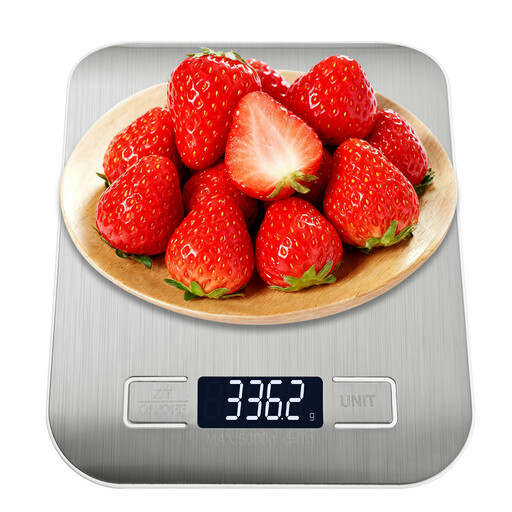
The black digital kitchen scale, with a 23 × 15 cm weighing platform, is one option for weighing ingredients in a bowl.
The following Joybuy products are digital kitchen scales for weighing ingredients in a container. Compare their capacity, tare function and stated increments with the way you plan to use them.
 No image available
For ingredients in a bowl, the product name specifies a capacity of up to 5 kg and a tare function.
The product name also specifies a stainless steel platform.
 No image available
The product name specifies a tare function and a capacity of up to 5 kg for weighing ingredients in a container.
It’s listed as having 1 g accuracy and measuring in g, ml, oz, lb and fl oz.
 No image available
For ingredients in a container, the product name specifies a capacity of 5 kg and 1 g increments.
The product name also specifies multiple units and a stainless steel surface.
 No image available
A tare function and a capacity of 5 kg are specified for weighing ingredients one after another in a bowl.
The stated increment is 1 g, so this model isn’t listed as offering finer display increments.
 No image available
A removable bowl is a handy option if you want to weigh ingredients in a separate container.
The stated increment is 1 g, and the minimum weighing amount is listed as 3 g.
Follow the specific recipe. In baker’s percentages, the flour weight is the reference point at 100%; King Arthur Baking gives 2% salt by flour weight for an example loaf. This is an example, not a recommendation for every dough.
Yes, as long as the bowl and its contents stay within the scale’s capacity and you can operate and read the display with the bowl in place. Tare sets the display to zero before you add an ingredient, but it doesn’t increase the permitted total load.
Follow the instructions for the specific model. The removable weighing spoon on the Soehnle Cooking Star is described as dishwasher-safe. The Tanita instructions for the KD-320 family recommend a firm, level surface and warn against significant changes in temperature and humidity.
The requirements covered here don’t establish a verification requirement for weighing ingredients for private home baking. The overview from the Lower Saxony weights and measures authority focuses in particular on commercial and official uses, as well as certain medical applications. Other purposes, such as commercial use, need to be considered separately.
Take old batteries to collection boxes in shops or to local collection points; don’t put them in household waste. The German Environment Agency recommends removing any removable batteries before handing in an old electrical appliance. Electrical appliances are collected separately.