Bread makers using very little yeast
If your recipe calls for less than 1 g of yeast, check the minimum weight and increments separately. A fine display alone doesn’t tell you whether the scale can measure that amount.


For yeast quantities well below 1 g, a precision scale is only suitable if its stated minimum weight and increments cover the amount you need; a display that shows 0.1 g increments is not enough on its own. For larger amounts of yeast and weighing flour into a bowl, a kitchen scale with a suitable maximum capacity and tare function is a good choice, provided its increments suit the recipe. A small weighing platform may be awkward to use with a large mixing bowl.
If your recipe calls for less than 1 g of yeast, check the minimum weight and increments separately. A fine display alone doesn’t tell you whether the scale can measure that amount.
If you want to weigh flour and other ingredients in the same bowl, its weight counts towards the maximum capacity. Also make sure the bowl won’t obscure the display.
If you mainly want to weigh ingredients without any fuss, first check that your kitchen scale’s increments suit the amount of yeast in your recipe. You only need an additional precision scale if you need one for the quantity in question.
A good choice if: You’re following a recipe that uses very little yeast and the minimum weight and increments cover the amount you need.
The trade-off: The Beurer KS 36 has an 11.5 × 8.0 cm weighing platform, which won’t easily accommodate a large mixing bowl.
A good choice if: You weigh larger quantities in a bowl and the bowl and ingredients together stay within the maximum capacity.
The trade-off: Increments of 1 g are too coarse for a recipe that calls for, for example, 0.1 g of yeast.
A good choice if: You weigh both very small amounts of yeast and a heavy, filled bowl, and already own one of the two types of scale.
The trade-off: Two appliances take up more space, so check whether your recipe really requires the extra one.
| What matters | What to check when buying | Who it matters most to |
|---|---|---|
| Small amounts of yeast | Compare the recipe quantity with the minimum weight and increments for the relevant load range. | If I’m weighing less than 1 g of yeast for a recipe, I check the minimum weight and increments separately. Around 36% of consumers put this at the top of their list. |
| Bowl and ingredients | Check the bowl’s empty weight and the quantity of ingredients against the maximum capacity; consider the weighing platform and display too. | If I’m preparing several loaves, the filled bowl needs to fit on the scale and the display must remain easy to read. Around 29% of consumers focus mainly on the weight of the bowl and its contents. |
| Adding ingredients by weight | Check the tare function, whether you can read the display with the bowl in place, and whether the buttons are easy to reach. | If I’m weighing ingredients one after another into the same bowl, I want to be able to reset and read the weight easily. Around 21% of consumers prioritise this way of working. |
| Care and use | Check the power supply, cleaning instructions and terms of any voluntary warranty. | If easy care and everyday use matter to me, I look at the cleaning instructions and power supply. Around 14% of consumers prioritise these aspects. |
Fine increments don’t automatically mean the scale can measure the small amount you want from as little as one tenth of a gram. GEFU states a minimum weight of 1 g for the PREZISO, despite its 0.1 g increments.
Compare the minimum weight and increments across the relevant load range with the amount of yeast in your recipe.
The bowl’s weight is added to the weight of the ingredients. A high maximum capacity also doesn’t tell you whether a large bowl will obscure the display.
Allow for the bowl and the largest quantity of ingredients you’ll weigh at one time, and check that the display stays visible.
According to the manufacturers’ information, neither the WMF scale reviewed here nor the GEFU PREZISO is dishwasher-safe.
Clean the specific model according to its instructions instead of relying on the surface material alone.
The KS 36 is a compact precision kitchen scale for smaller quantities that you weigh separately from a large mixing bowl.
The PREZISO combines precision and kitchen scale functions for smaller quantities of ingredients.
According to WMF, the CMMF 3201000339 digital kitchen scale is designed for larger quantities of ingredients in a container.
The Enfinigy scale reviewed here is worth considering if a larger bowl and a rechargeable battery are priorities.
The following Joybuy options are designed for weighing larger quantities of ingredients in a bowl. For very small amounts of yeast, the key is whether the stated increments or minimum load suit your recipe.
 No image available
The tare function makes it easier to weigh ingredients in a container; the stated maximum capacity is 5 kg.
According to the description, the platform is made of glass and can be cleaned with a soft, damp cloth.
 No image available
The removable bowl is designed for weighing ingredients directly; the stated maximum capacity is 5,000 g.
 No image available
The stated tare function and 5 kg maximum capacity make it suitable for weighing ingredients in a container, provided the increments are fine enough for your recipe.
It also features an LCD display and a Bluetooth connection to an app. Increments of 1 g are too coarse for very small amounts of yeast.
 No image available
The tare function and stated maximum capacity of 5 kg make it suitable for weighing ingredients in a container, provided the stated 1 g increments suit the recipe quantity.
Features include an LCD display and automatic switch-off. A 1 g increment does not prove that the scale is suitable for very small amounts of yeast.
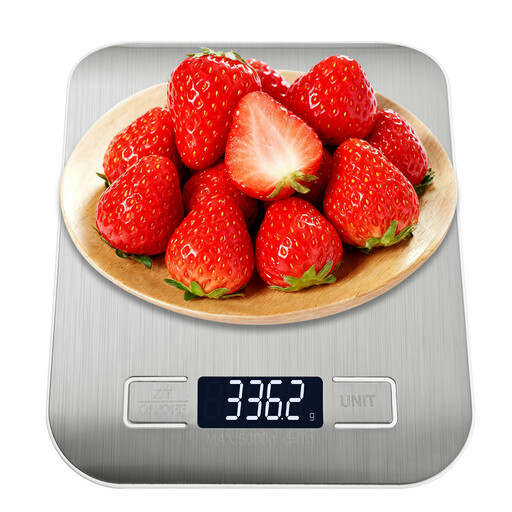 No image available
The tare function and stated maximum capacity of 5 kg make it suitable for weighing ingredients in a container, provided the 1 g increments suit the recipe.
It also features several units of measurement and a stainless steel surface. The 1 g increment does not prove that the scale is suitable for very small amounts of yeast.
Not necessarily: also check the minimum weight and the load range for those increments. GEFU states a minimum weight of 1 g for the PREZISO, despite its 0.1 g increments; Beurer specifies 0.1 g increments below 500 g for the KS 36. An increment specification alone doesn’t prove measurement accuracy.
Plötzblog describes a dilution method: dissolve 10 g of yeast in 990 g of water, then use 10 g of this solution to get 0.1 g of yeast. Subtract the 10 g of yeast water you add from the amount of water specified in the recipe; this method requires extra yeast and water.
Follow the instructions for your specific model. WMF states that the scale mentioned here is not dishwasher-safe; GEFU gives the same guidance for the PREZISO.
According to guidance from the German Environment Agency, used batteries must not go in household waste. Take them to collection boxes in shops or to local collection points instead. Remove batteries from old appliances if you can do so easily.