
Lieferung heute & morgen

Qualitätsgarantie

Willkommens-Angebote freischalten: KOSTENLOSE Lieferung | Bis zu 80 % RABATT | Kostenlose 30-Tage-JoyPlus-Testphase
App herunterladen
The choice of wet food for cats is vast: sauce, jelly or broth, fish or meat, single portions or cat food multipacks. At the same time, terms such as “grain-free”, “sugar-free” or “high meat content” may seem clear at first glance. On their own, however, they do not tell you whether a product is suitable for your cat’s daily diet.
An appealing cat food containing tuna, salmon or prawns may be suitable as a snack, but it is not automatically intended to provide complete daily nutrition. The label must clearly state whether it is complete food for cats or complementary food for cats.
According to the product details, a complementary food such as LUCKY LOU Tuna & Salmon in Broth is intended solely for occasional feeding or for supplementing a complete ration. It does not replace a balanced main meal.
When looking for sugar-free cat food, it is worth checking the full list of ingredients. Some recipes contain no added sugar but do include grains or other plant-based ingredients. If you are specifically looking for grain-free cat food, you should check both details separately.
The wording “with meat” should not be assessed in isolation either. What matters is the stated proportion of animal ingredients and whether the declaration names specific animal species.
A cat food multipack can make serving daily portions easier. However, with fussy cats or after changing food, there is a risk that a large supply may not be accepted. Individual 70-g or 85-g portions are ideal for trying different flavours and reduce opened leftovers in the fridge.
For adult cats, a daily main food should be labelled as a complete feed. According to the manufacturer’s information, it is intended to be fed as the sole food and contains added vitamins, minerals and taurine in line with the particular recipe.
Complementary food, on the other hand, should make up only part of the diet. Products in broth or jelly often have a high moisture content and are suitable as a snack or as an addition to complete cat food.
Cat food for adult cats is designed for fully grown animals. Kittens have different requirements when it comes to energy and nutrient intake. Designated kitten wet food such as animonda Vom Feinsten Kitten Poultry is, according to the product description, intended for young cats up to twelve months old.
The quantities stated on the packaging are guidelines. Weight, activity levels, age and living conditions all affect actual requirements. Fresh drinking water should always be available.
Checking the analytical constituents helps you make an objective comparison. For example, the products mentioned have moisture levels of around 80 to 84 per cent. However, these values are only meaningfully comparable within similar types of food.
Pay particular attention to:
“Cat food in sauce” may appeal to cats that prefer a moist texture. However, the sauce alone is not a measure of quality. The complete composition remains the deciding factor.
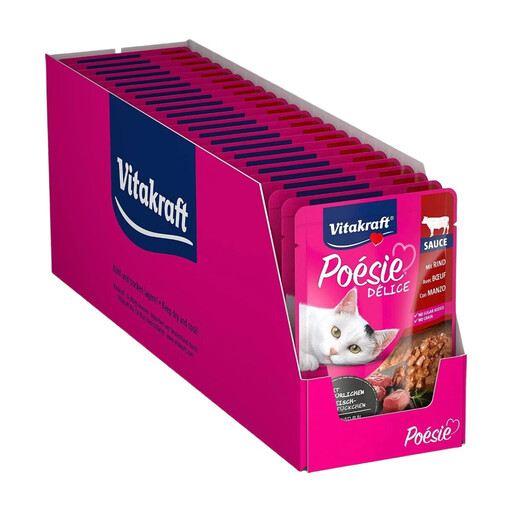
Why this product fits the profile: The 23-pack of 85-g portions is ideal for households that want to plan and store daily servings easily, while preferring beef as a flavour.
It is labelled as complete wet food for adult cats and, according to the product details, is formulated with no added sugar and no grains.
23 portions of 85 g, beef as the declared flavour, plus information about taurine and added vitamins and minerals.
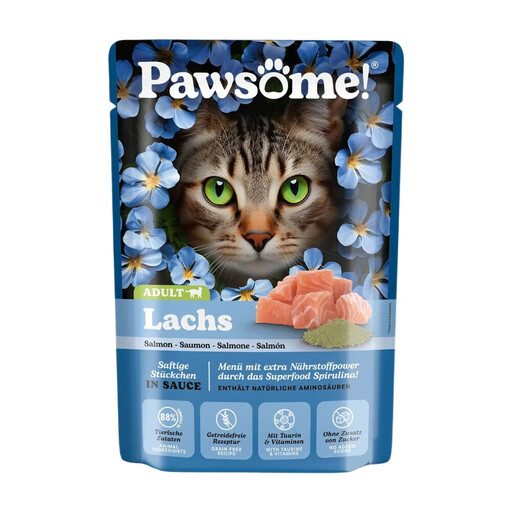
Why this product fits the profile: The recipe is designed for adult cats and combines salmon with a sauce. The 28-pack is intended for regular daily feeding.
The product details describe it as complete food, grain-free and made with no added sugar. This means key selection criteria can be checked directly on the product page.
28 pouches of 85 g, according to the manufacturer, containing 88 per cent animal ingredients and added taurine.
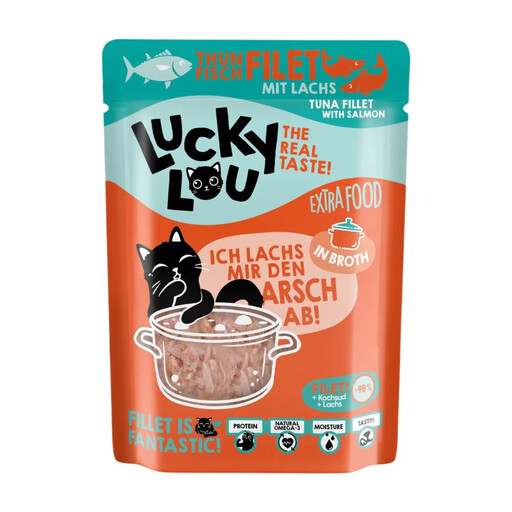
Why this product fits the profile: The 12 pouches of 70 g are suitable as a portioned addition when cat food with salmon or cat food with tuna is to be offered occasionally.
The complementary food label makes it clear that this product is not intended as the sole daily ration. According to the product details, the recipe contains no added sugar, grains or preservatives.
70-g pouches, broth with tuna fillet and salmon, plus a stated use as a snack or complementary food.
We have put together a complete, regularly updated list of products that fully meet these strict selection criteria and the safety regulations applicable in the EU.
The right amount depends on body weight, activity levels, age and the food’s energy content. The manufacturer’s feeding guidelines on the packaging provide a starting point. Monitor your cat’s weight and body condition, and adjust the portions if necessary.
Not every cat necessarily needs a grain-free recipe. If you want to avoid grains or prefer a particular list of ingredients, read the full composition carefully. If your cat has known intolerances, consulting a vet may be advisable.
Opened portions should be covered, stored in the fridge and fed promptly. Follow the manufacturer’s instructions on the packaging. Unopened pouches, trays or tins should be kept in a cool, dry place.