
Lieferung heute & morgen

Qualitätsgarantie

Willkommens-Angebote freischalten: KOSTENLOSE Lieferung | Bis zu 80 % RABATT | Kostenlose 30-Tage-JoyPlus-Testphase
App herunterladen
A wet and dry vacuum cleaner can pick up liquids, remove dry dirt and, depending on its design, also mop floors, clean carpets or work as a blower. This versatility is precisely what makes choosing the right model challenging. A compact appliance for hard floors is not automatically suitable for wood shavings in a workshop, while a large workshop vacuum can be awkward for everyday floor care.
As a Joybuy Product Recommendation Officer, I filter the most important product details using clear, transparent criteria. This helps you avoid common buying mistakes.
Manufacturers often quote maximum suction power in pascals. This figure can indicate the motor and suction performance, but it is not the only deciding factor. Airflow, brush design, filters, hose diameter and suitability for the intended surface are equally important.
A cordless wet and dry floor washer with a high Pa rating is designed for wet spills and pet hair on sealed hard floors. For coarse building debris, wood shavings or larger quantities of liquid, a traditional wet vacuum with a large tank is usually more suitable.
A vacuum cleaner with a mopping function distributes water across the floor and then picks it up again. This is not the same as a carpet and upholstery cleaner with spray extraction. The latter uses separate clean- and dirty-water tanks together with a hose or a special textile nozzle.
If you want to deep-clean sofas, car seats or carpets, look for a model specifically approved for use on textiles. For parquet, laminate or tiles, a hard-floor washer with controlled water delivery is the more practical choice.
A floor washer with self-cleaning usually rinses the brush roller and internal lines. The dirty-water tank, filter and, where applicable, the brush roller still need to be emptied, rinsed and dried afterwards. If moisture remains inside the appliance, unpleasant odours may develop.
Therefore, check the exact function offered: does it only rinse, or does it also dry the components with warm air? How large are the tanks? Can the brush roller be removed?
Cordless appliances with separate clean- and dirty-water tanks are suitable for families with hard floors and pets. A cordless wet vacuum cleaner can be used quickly, but it has a limited runtime and needs time to recharge.
For renovations, vehicles and workshops, a corded workshop vacuum cleaner is often more practical. Look for:
For floor washers, the clean-water tank should be large enough without making the appliance unnecessarily heavy. The dirty-water tank must be emptied separately and must not be filled beyond the manufacturer’s stated marking.
With traditional wet and dry vacuum cleaners, a larger container is useful if you frequently pick up liquids or coarse dirt. A 30-litre tank provides more capacity than a compact container, but it also increases the appliance’s dimensions and weight.
Always compare the stated runtime with the operating mode. Turbo or intensive settings use more energy than standard mode. Removable batteries are practical if a replacement battery is available.
Ongoing costs also include:
Automatic brush cleaning reduces manual effort, but it does not replace rinsing and fully drying the removable parts.
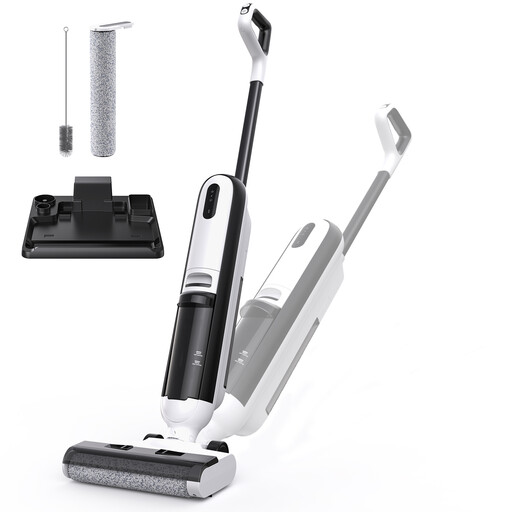
Why this product suits the profile: This cordless model is designed for everyday wet and dry cleaning on hard floors. The stated runtime is up to 30 minutes, while the product details list a weight of 4 kg.
The specifications state tank capacities of 540 ml for clean water and 460 ml for dirty water, along with a self-cleaning function. This makes the key operating limits easy to understand.
Maximum suction power of 16,000 Pa according to the product details, cordless operation and self-cleaning.
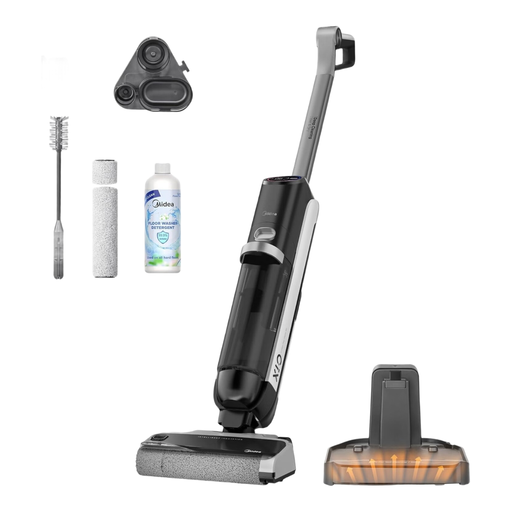
Why this product suits the profile: This model is aimed at households with hard floors, pets and regular cleaning needs. Features include automatic dirt detection, anti-tangle technology and a station with 60-degree warm-air drying.
Self-cleaning is combined with a subsequent drying cycle. Even so, the tanks still need to be emptied and the filters maintained.
170-degree recline for cleaning beneath low furniture, LED display, edge-cleaning brush and 60-degree warm-air drying according to the product description.
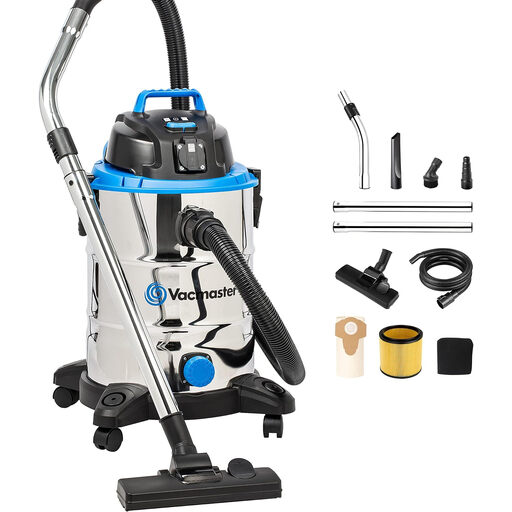
Why this product suits the profile: This corded wet and dry vacuum cleaner is suitable for workshops, renovation work, cars and larger quantities of liquid. The 30-litre stainless-steel container is designed for longer periods of use without frequent emptying.
The product description explicitly mentions separate filters for wet and dry operation. This helps prevent the common mistake of using an unsuitable filter.
1,500-watt motor, 30-litre tank, 240-volt power socket for power tools and blower function according to the product details.
We have put together a complete, regularly updated list of products that fully meet these strict selection criteria and the safety regulations applicable in the EU.
Before buying, check whether the appliance is intended exclusively for indoor use and which substances it is not suitable for. Petrol, solvents, flammable liquids, hot ash, sharp-edged objects and hazardous materials must not be put into an ordinary wet and dry vacuum cleaner.
For a longer service life:
Yes, provided the model is explicitly designed for wet operation. The appropriate wet filter or foam filter must be fitted. With a combined floor washer, liquid is collected in the dirty-water tank. The operating instructions specify which quantities and types of liquid are permitted.
Service life depends on the motor, battery, filter maintenance, frequency of use and type of dirt. An appliance used for occasional household cleaning is subjected to different demands from a workshop vacuum used for building debris. Replaceable filters, readily available brush rollers and reliable access to spare parts can extend its practical service life.
With corded appliances, electricity costs depend on the motor’s power rating and runtime. Cordless floor washers also require energy for charging, as well as cleaning solution and replacement parts where applicable. For a fair comparison, you should therefore consider not only the purchase price, but also the filters, rollers, battery capacity and maintenance effort.