
Lieferung heute & morgen

Qualitätsgarantie

Willkommens-Angebote freischalten: KOSTENLOSE Lieferung | Bis zu 80 % RABATT | Kostenlose 30-Tage-JoyPlus-Testphase
App herunterladen
A cordless wet & dry vacuum promises to combine two of the most time-consuming household chores—vacuuming and mopping—into a single, effortless step. However, the market is flooded with devices whose marketing promises often fall short in practice. As your Joybuy Product Recommendation Officer, I'll help you identify the common pitfalls and make an informed decision that will genuinely save you time and effort.
Many buyers quickly discover that their new device has costly weaknesses. These include three widespread problems:
To avoid a bad purchase, you should focus on technical features that directly counteract these problems. Instead of being dazzled by pure performance specs, examine the following three core functions.
A crucial quality feature is the device's ability to clean right up to the edge. Look for models with a brush design explicitly advertised as borderless or "Edge-to-Edge". On these devices, the rotating roller on at least one side extends right to the housing. This is the only way for a wet & dry vac with edge cleaning to pick up dirt and liquids directly against walls and furniture edges without leaving a dirty strip behind. This is a detail that marks the difference between a superficial and a truly thorough clean.
A wet & dry vac with self-cleaning is standard today, but the differences in execution are enormous. A high-quality station should do more than just rinse the brush with water. Look for systems that offer a complete maintenance cycle:
Such a station is what makes a cordless wet-dry vacuum truly low-maintenance and hygienic.
The mere specification of battery runtime in minutes is not very meaningful. What's crucial is how efficiently the device uses its energy. Modern devices feature infrared sensors or other technologies for smart dirt detection. They dynamically adjust the suction power and water flow to the level of dirt. This means: energy is saved on lightly soiled areas, while full power is engaged for stubborn stains. This feature ensures a more realistic and longer runtime under everyday conditions and is particularly relevant for floor washers for hard floors in larger apartments or houses.
Based on these objective criteria, we have identified a few models that are suitable for different user profiles.
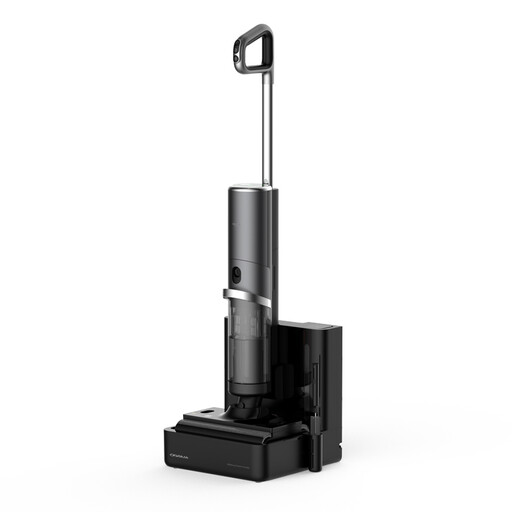
Why This Fits Their Persona: This model is designed for users seeking an all-in-one solution for large hard floor areas. It combines vacuuming and mopping in a single pass, aiming to minimise the time spent on floor care.
The Edge-to-Edge-Design solves the problem of dirt streaks. The all-in-one station with hot-air drying and automatic refilling counteracts the typical hygiene issues and odour formation found in simpler self-cleaning systems.
Fully automatic base station with hot-air drying and water-refill function; Smart dirt detection to optimise performance and battery life.
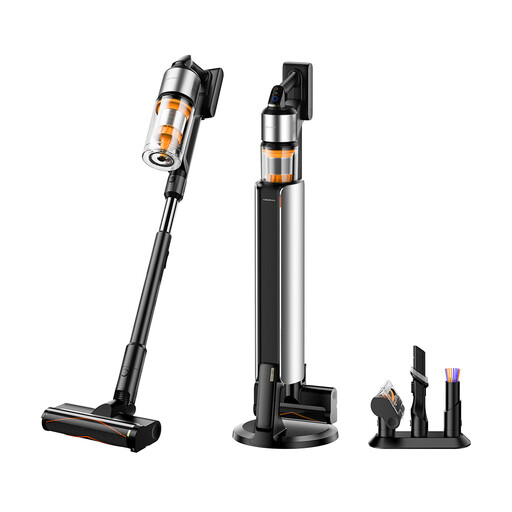
Why This Fits Their Persona: This is not a wet & dry vacuum, but a pure vacuum cleaner with a mopping function as an optional accessory. It is suitable for users who prioritise maximum suction power for carpets and hard floors and prefer a separate mopping solution, but still want the convenience of a fully automatic station.
By being a specialised dry vacuum, this model bypasses the specific hygiene problems of wet-dry vacuums. The station automates dust disposal for up to 100 days (according to the manufacturer), which minimises the maintenance effort for vacuuming.
Very high suction power (27000 Pa according to the manufacturer), ideal for pet hair and carpets; Maintenance-free station with automatic dust extraction; Special brush to prevent hair tangles.
We have compiled a complete, up-to-date list of products that fully meet these strict selection criteria and safety regulations.
The frequency of filter replacement depends heavily on usage and the model. Many modern devices are equipped with washable filters that last a long time with regular cleaning. Always follow the manufacturer's instructions. On models with advanced cleaning stations, the filter is often rinsed during the self-cleaning cycle, which reduces manual maintenance.
Yes, but it is crucial to only use low-foaming cleaning solutions recommended by the manufacturer or specifically designed for wet & dry vacuums. Conventional floor cleaners can create too much foam and damage the device's internal pipes, sensors, and motor. Using the wrong solutions can void the warranty.
Most cordless wet & dry vacuums are primarily designed for sealed hard floors such as tile, laminate, vinyl, and sealed parquet. While some models offer a vacuum-only mode that can be used on low-pile carpets to pick up loose dirt, their main strength lies in combined wet and dry cleaning. For deep cleaning carpets, a specialised, powerful dry vacuum is generally the more effective choice.