
Lieferung heute & morgen

Qualitätsgarantie

Willkommens-Angebote freischalten: KOSTENLOSE Lieferung | Bis zu 80 % RABATT | Kostenlose 30-Tage-JoyPlus-Testphase
App herunterladen
Wet food for adult cats should suit the cat’s life stage, daily routine and individual needs. The choice ranges from cat food in portion pouches and trays to large tins. At the same time, terms such as “premium”, “natural” or “with lots of meat” can sound more meaningful on the packaging than they are when examined closely.
The following points can help cat owners in Germany assess marketing claims and choose suitable complete cat food.
The wording “with chicken” or “with salmon” initially only indicates that the ingredient is included. The quantity stated in the ingredients list is what matters. Some recipes state the total proportion of animal-based ingredients, while the specific proportion of chicken, beef or fish may be considerably lower.
If you are specifically looking for cat food with chicken or cat food with salmon, you should therefore check:
Soups, snacks and meat strips in gravy can complement a meal, but they do not necessarily replace a balanced complete food. Felix Soup Tender Strips, for example, is described as a complementary feed according to the product information. It should therefore be offered alongside suitable complete food.
For everyday feeding, the label “complete food for adult cats” is a more important starting point than an eye-catching flavour description.
A multipack of cat food can make shopping easier. However, with 85 g portion pouches, it is often easier to plan the daily quantity than with opened large tins. You should also consider how long an opened pack may be kept in the fridge. Manufacturers’ instructions vary depending on the product and packaging.
For an adult cat, the product should be expressly intended for the “Adult” life stage or for “adult cats”. Feeding guidelines are a starting point. Weight, activity levels, whether the cat has been neutered and other individual factors can affect its actual needs.
When changing food, a gradual transition over several days is recommended. This makes it easier to observe whether your cat accepts the new food.
The ingredients list shows which ingredients have been used. The analytical constituents include crude protein, fat, crude fibre, crude ash and moisture. Wet food naturally contains a lot of water, so protein values cannot be compared directly with those of dry food.
As a practical guide:
Grain-free cat food may be of interest to owners who want to avoid certain ingredients. However, “grain-free” alone is not proof of a balanced recipe. Similarly, “sugar-free cat food” should be checked against the ingredients list. Some products explicitly contain sugar, sugar syrups or related terms.
Products without artificial colourings or preservatives should also not be judged solely by the front of the pack. The complete declaration, type of food and feeding instructions remain the decisive factors.
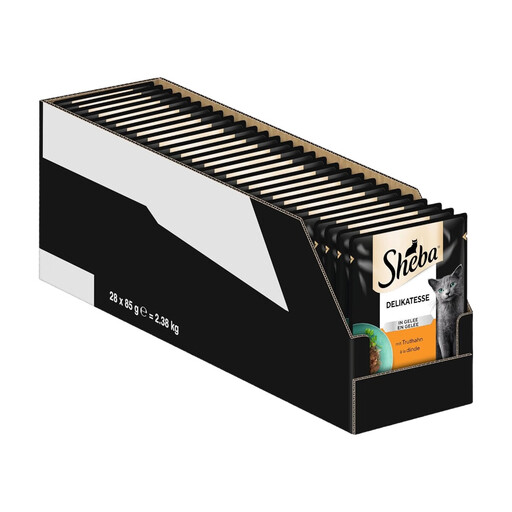
Why this product suits this profile: The 28 individual portion pouches make daily portioning easier and provide a larger supply for households with regular feeding requirements.
The product information identifies it as complete daily food for adult cats. The individual portions reduce open leftovers.
28 pouches, each containing 85 g; recipe with turkey in jelly and no artificial colourings or preservatives, according to the product description.
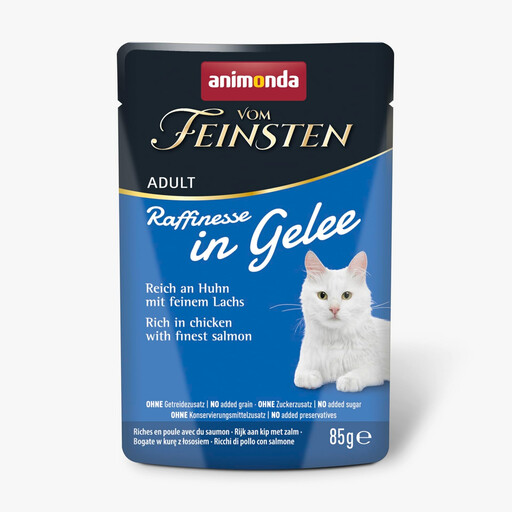
Why this product suits this profile: The recipe combines chicken and ASC-certified salmon in jelly, making it suitable for owners who compare ingredients and exclusion criteria in detail.
The information states 35% meat and animal derivatives, including 20% chicken and 4% ASC salmon. According to the declaration, it contains no grains, sugar, soya or added flavourings.
24 portion pouches, each containing 85 g; analytical values include 8.5% protein, 5% fat and 82% moisture.
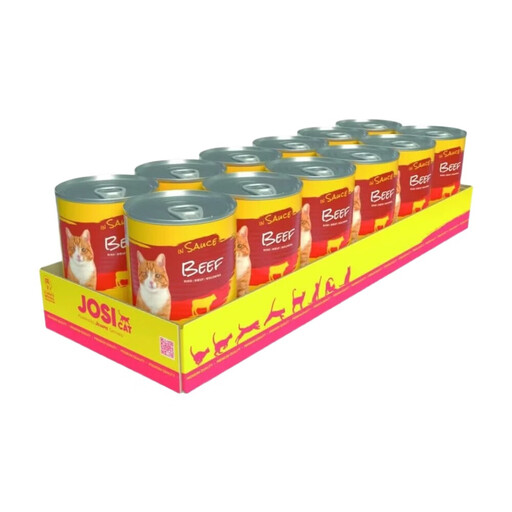
Why this product suits this profile: The larger tins are suitable for households with several cats or higher daily wet food requirements, provided the opened tin is stored correctly in the fridge.
The product description identifies it as complete food for adult cats and expressly states that it contains no added soya, dairy products, colourings or preservatives.
12 tins with a total weight of 4,980 g; declared values of 7% protein, 4% fat and 82% moisture.
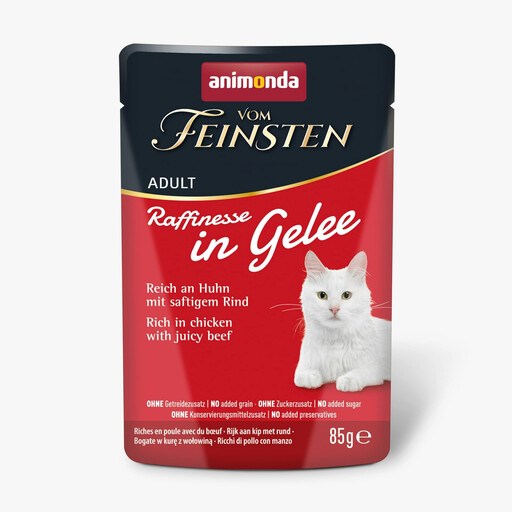
Why this product suits this profile: The portion pouches combine a consistent fill quantity with a different flavour option for cats that are more receptive when their food is varied.
The declaration states 39% meat and animal derivatives, including 20% chicken and 4% beef. According to the product information, no grains, sugar or soya have been added.
24 pouches containing 85 g each; according to the analysis, 8.5% protein, 5% fat and 82% moisture.
We have put together a complete, regularly updated list of products that fully meet these strict selection criteria and the safety regulations applicable in the EU.
Wet food contains considerably more moisture and is often supplied in small daily portions. Dry food is easier to store and portion, but has a significantly lower water content. A combination can be useful if the total quantity is adjusted according to the feeding guidelines.
For neutered cats, weight management or known medical conditions, the choice should be discussed with a veterinary practice. Special diet foods are not automatically necessary for every cat.
The appropriate amount depends, among other things, on body weight, activity levels, neutering status and the energy content of the product. The feeding table on the packaging provides a useful starting point. Body weight should be checked regularly and the portion adjusted where necessary.
Opened portions or tins should be stored in the fridge. The permitted storage period depends on the label. Some product information states 24 hours, while other products allow up to two days. The smell, appearance and packaging should be checked before feeding.
“Sugar-free” describes just one characteristic. The label confirming that it is complete food, the life stage, ingredients, analytical values and your cat’s tolerance are also relevant when choosing a product. The ingredients list should therefore always be read in full.