
Lieferung heute & morgen

Qualitätsgarantie

Willkommens-Angebote freischalten: KOSTENLOSE Lieferung | Bis zu 80 % RABATT | Kostenlose 30-Tage-JoyPlus-Testphase
App herunterladen
A wheeled storage cabinet can keep documents, household items, tools or equipment neatly stored and easy to move. However, mobile cabinets vary considerably in their materials, stability and assembly requirements. If you focus only on the number of compartments or a low price, you could miss important details.
The claim “large capacity” tells you little about whether A4 ring binders, printer accessories or tools will actually fit inside. So check the width, depth, internal height and compartment layout. A narrow cabinet with several compartments may suit clothes or smaller items, but that doesn’t necessarily mean it can hold wide ring binders.
A storage cabinet on castors needs to be stable as well as easy to move. Small castors or castors without brakes can make it harder to move when the cabinet is heavily loaded. 360-degree swivel castors and lockable castors are useful for equipment and frequent repositioning. If you have delicate flooring, look for a design that helps protect the floor too.
A foldable plastic cabinet is easy to store away and can usually be set up without tools. However, its material isn’t equivalent to a reinforced office cabinet made from engineered wood or metal. Check the stated load capacity, and don’t use the cabinet for heavy industrial loads unless it’s designed for them.
First, measure the available floor space, allowing for doors and drawers to open fully. Compact dimensions such as around 60 × 35 × 70 cm work well for a home office cabinet that fits under a desk. A space-saving storage cabinet measuring 45 to 55 cm wide, meanwhile, could fit beside a bed, in a kitchen or in a small hallway.
Also consider:
For equipment such as printers, 3D printers or small machines, maximum load capacity is a key consideration. For an office cabinet on castors, check the stated load capacity for the top surface and, where specified, for the drawers or compartments.
Engineered wood materials such as MDF or coated chipboard offer a sturdier construction, but usually need to be assembled. A plastic cabinet on castors is lighter and often easier to put together. It’s better suited to light or medium-weight everyday items, unless the product details say otherwise.
A cabinet that requires no assembly is a particularly handy choice for students, rented homes or temporary workspaces. Magnetic closures and a foldable design mean you’ll need fewer tools. Drawers or an open compartment, on the other hand, are useful for documents you need to access often. A filing cabinet with drawers helps keep things organised, while a printer cabinet can also provide a sturdy surface.
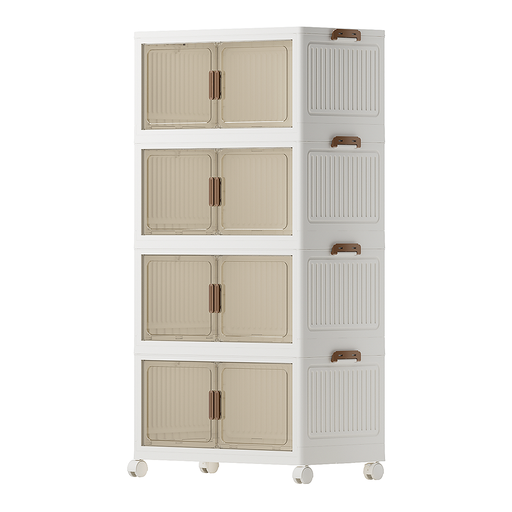
Why this product suits this buyer: The 55 cm-wide version has four compartments and can be set up without tools. It’s a good choice for storing everyday items in the bedroom, living room or home office.
The product details clearly specify the material, number of compartments and assembly method. No load capacity is given, so it’s best not to plan to store heavy equipment in it.
PP plastic, four compartments, nylon castors and a foldable design with magnetic closures.
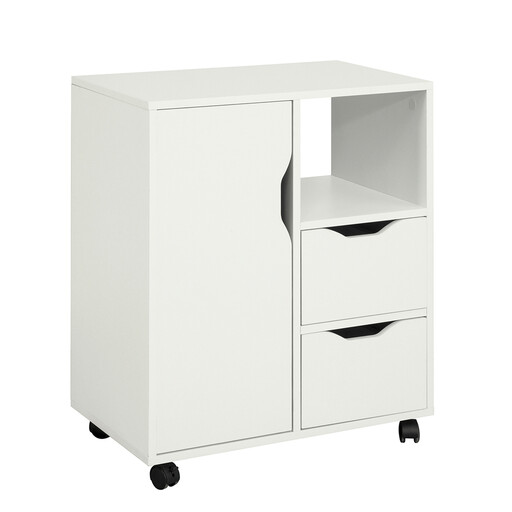
Why this product suits this buyer: This mobile cabinet combines a top surface with two drawers, a door and open compartments. It’s designed for home offices, offices and equipment weighing up to 50 kg in total.
The dimensions of 60 × 35 × 70 cm and maximum load capacity of 50 kg are clearly stated. Bear in mind that assembly is required.
PB(E1), MDF, two drawers, one door, two shelves and castors; the product details state a net weight of 19,5 kg.
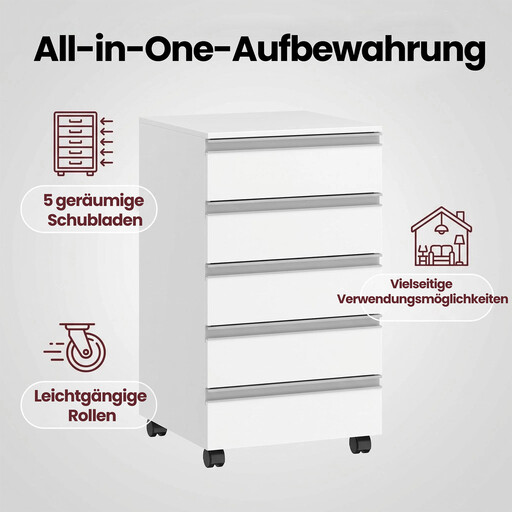
Why this product suits this buyer: Five deep drawers and a sturdy top surface make this cabinet suitable for documents, drawings, tools and accessories in an office, studio or workshop.
The product description states a load capacity of up to 50 kg, reinforced drawer runners and lockable front castors. Assembly is still required.
Particleboard and steel, five drawers, 360-degree castors and stated dimensions of around 40,5 × 40,5 × 65,5 cm.
We’ve put together a complete, regularly updated list of products that meet these strict selection criteria and fully comply with the safety regulations in force in the EU.
For small spaces, compact dimensions, castors and a well-organised compartment layout are key. A model measuring 45 to 60 cm wide could fit beside or under a desk. If you’re storing a printer or heavier equipment, look for a clearly stated load capacity too.
That depends on the material, construction and load limit. A foldable plastic cabinet is generally suitable for lighter items such as clothes, a limited number of books or household accessories. For heavy ring binders, choose a model with a stated load capacity and a sturdy cabinet frame.
Castors usually add only a little to the overall height, but you’ll need clear space to move the cabinet around. Before buying, measure the space where you plan to keep it, as well as the swing area for doors and drawers. If you don’t move the cabinet often, lockable castors can help keep it steady.