
Lieferung heute & morgen

Qualitätsgarantie

Willkommens-Angebote freischalten: KOSTENLOSE Lieferung | Bis zu 80 % RABATT | Kostenlose 30-Tage-JoyPlus-Testphase
App herunterladen
A white bookshelf is more than just a piece of furniture; it's a blank canvas for your books, decorative items, and memories. It brightens up a room and creates a clean, organized atmosphere. But the search for the perfect model can quickly lead to disappointment if the shelf you buy shows defects after just a few months. Many buyers fall into the same traps: they are swayed by beautiful product photos and overlook critical weaknesses.
As your Joybuy Product Recommendation Officer, I'm here to help you identify these pitfalls. We'll focus on the facts so your next purchase is one you'll be happy with for years to come.
The 3 Most Common Mistakes When Buying a White Bookshelf:
To avoid buyer's remorse, let verifiable criteria—not marketing promises—guide your decision. Three factors are especially important.
The choice of material is the foundation for your shelf's durability. While wooden shelves (solid wood) have a high-quality feel, they are also often more expensive. In the mid-range price segment, engineered woods dominate:
Also, pay close attention to the surface finish. A high-quality paint or a melamine resin coating protects the material from scratches and moisture and ensures the white finish stays bright for a long time.
A tall or narrow shelf must be stable. Stability depends on the construction method (e.g., a solid back panel, cross-bracing) and its own weight. However, an anti-tip kit for securing it to the wall is essential. Reputable manufacturers include one with the product. Installation is a small effort that significantly increases safety, especially in homes with children or pets. Before buying, check if such a mounting kit is included.
Not every shelf is right for every room. Think carefully about what you need it for:
Measure not only the available space in your room but also the items you plan to store. This ensures the shelf depth and height will meet your needs.
Here are some models that represent a smart choice for specific user profiles, based on objective features.
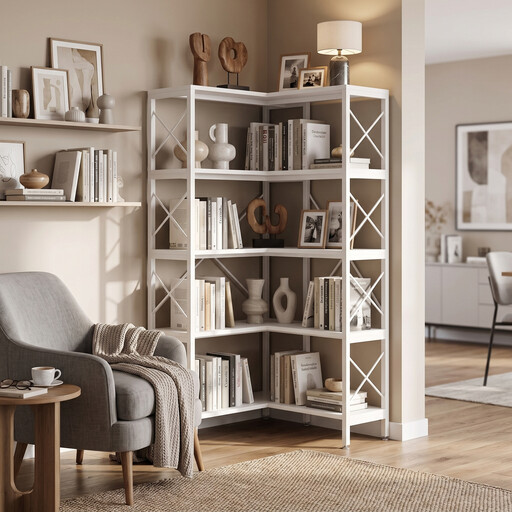
Why This Fits Their Persona: Ideal for anyone looking to make the most of unused corners in a living room or home office. The design combines functionality with a modern industrial aesthetic that fits well in many contemporary homes.
Instead of a wobbly build, this corner shelf features a matte black metal frame with X-bracing for high stability. Adjustable feet compensate for uneven floors—a common issue in older buildings.
The shelves are scratch-resistant and, according to the manufacturer, can each support up to 20 kg. This allows for the safe storage of heavy books or binders.
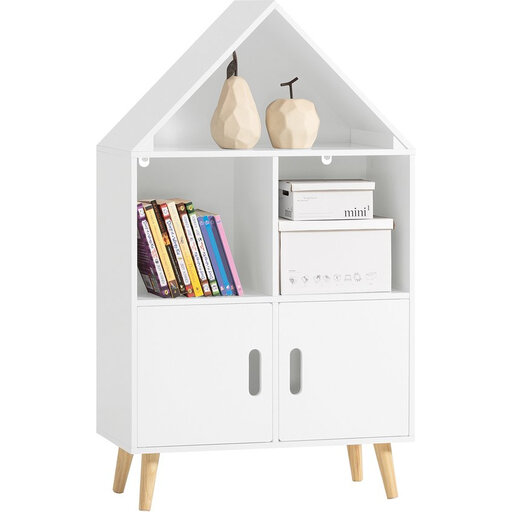
Why This Fits Their Persona: This kids' shelf combines a playful design with practical utility. Its child-friendly height encourages independence, while safety-focused details meet the demands of parents.
It proactively addresses the danger of tipping furniture: an anti-tip kit for wall mounting is included. Additionally, the corners are rounded to minimize the risk of injury.
The combination of MDF (E1 Grade) and pine wood ensures stability. The mix of open shelves and closed storage behind two doors helps keep a child's room tidy.
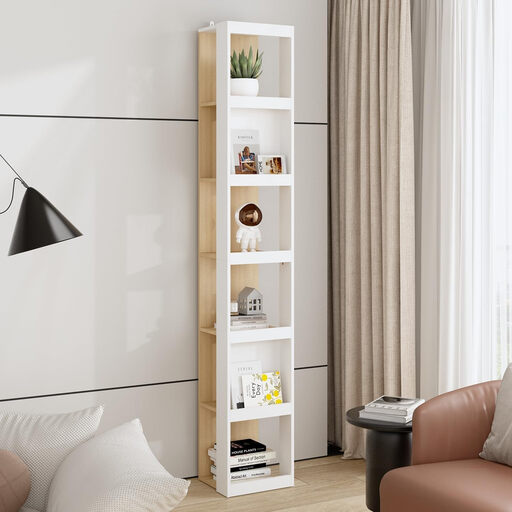
Why This Fits Their Persona: Perfect for anyone needing to create vertical storage in small apartments, bathrooms, or narrow hallways. The slim design utilizes the room's height without taking up valuable floor space.
This shelf avoids the trap of impractical dimensions by being specifically designed for niches. With a height of 200 cm and a shallow depth of 30 cm, it offers ample space on six levels where standard shelves would be too bulky.
The MDF construction provides reliable stability. The combination of a white frame and wood-toned shelves creates a modern yet understated look that is easy to coordinate with other furniture.
We've compiled a complete, up-to-date list of products that meet these strict selection criteria and safety standards.
1. How do you securely attach a bookshelf to the wall? Always use the anti-tip kit provided by the manufacturer. This usually consists of a bracket or strap that is screwed to the top of the shelf and to the wall. Choose wall anchors and screws appropriate for your wall type (e.g., drywall, brick, concrete). The bracket should be mounted as high as possible on the shelf to maximize leverage.
2. What is the difference between MDF and particleboard for shelves? MDF (Medium-Density Fibreboard) has a higher density and a more uniform structure than particleboard. This makes it more stable, more resistant to bending, and more resilient against moisture. Particleboard is lighter and cheaper but is more prone to sagging under load and can swell easily if the surface is damaged. For shelves that need to support weight, MDF is generally the more durable choice.
3. How much weight can a white bookshelf hold? The load capacity varies greatly depending on the model, material, and construction. There is no one-size-fits-all answer. Therefore, always check the manufacturer's specification for "maximum load capacity per shelf." As a rule of thumb, distribute the weight evenly and place heavy items like thick books or binders on the lower shelves to keep the shelf's centre of gravity low.